Most people who see a badger in the wild see only part of one: a flat, grizzled back disappearing into a hole, or a striped face peering over a mound of fresh dirt. American badgers spend much of their lives underground, and they are mostly active at night. Still, in the right place and season, they can be surprisingly easy to watch, especially around the prairie dog towns of the Great Plains.
The American badger (Taxidea taxus) belongs to Mustelidae, the same family as weasels, otters, ferrets, and the wolverine. Its range covers a large part of the continent, reaching north into Canada, south into Mexico, west to the Pacific, and east to the Great Lakes. NPSpecies records list badgers as present in 28 National Parks, including Badlands, Grand Teton, Theodore Roosevelt, Wind Cave, and Yellowstone.
Learning about animals like American badgers can significantly enhance wildlife photography skills by providing valuable insights into animal behavior, habitat, and physical characteristics. Understanding an animal’s habits can allow photographers to better anticipate and capture unique and authentic moments. Knowledge of an animal’s habitat may also help in selecting the best locations and times for wildlife viewing and photography, while familiarity with physical characteristics is essential for accurately identifying wildlife in the field. If wildlife photography or simply wildlife viewing are of interest to you, then you’ve come to the right place! Together, let’s learn more about what makes American badgers so special.
Physical Characteristics
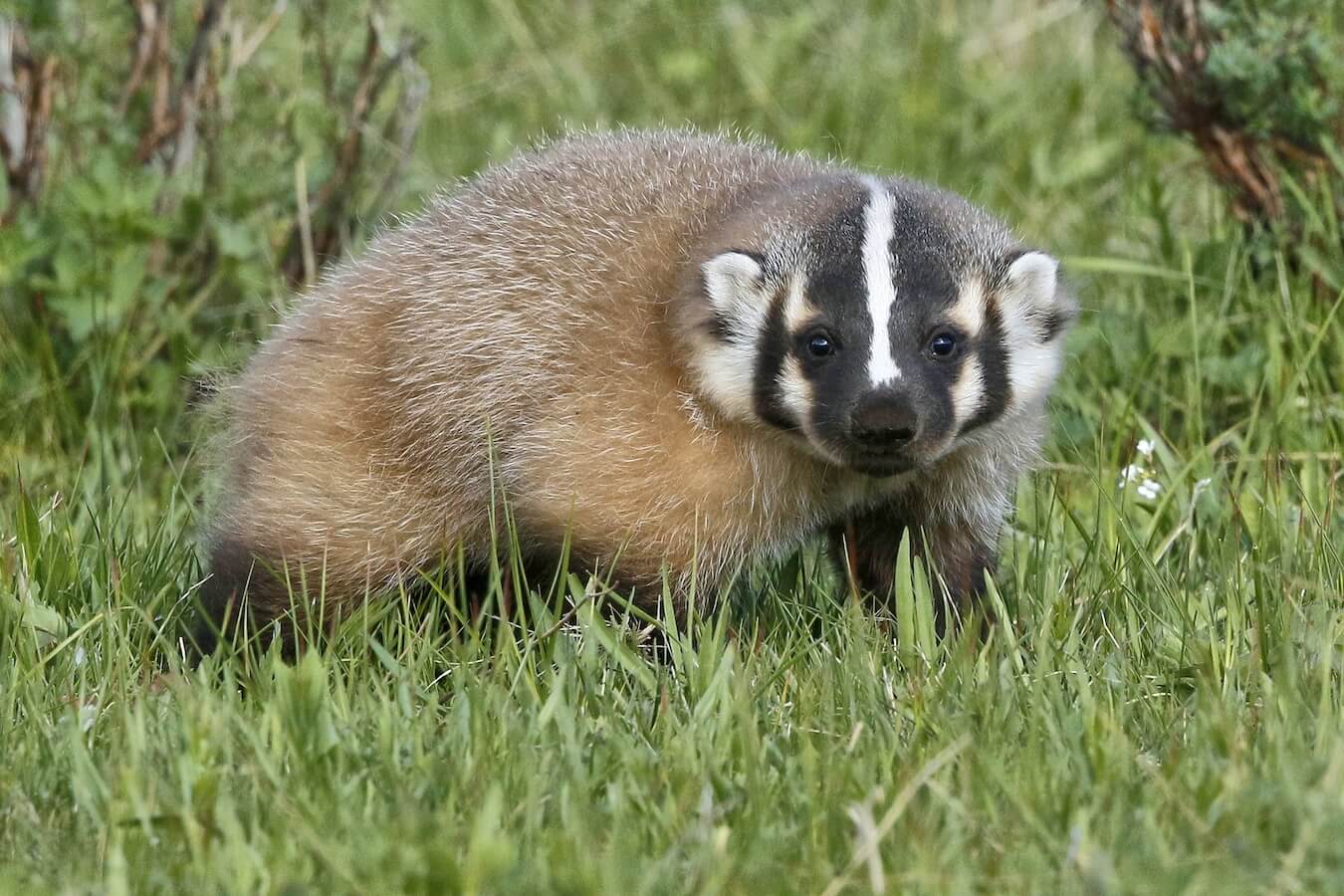
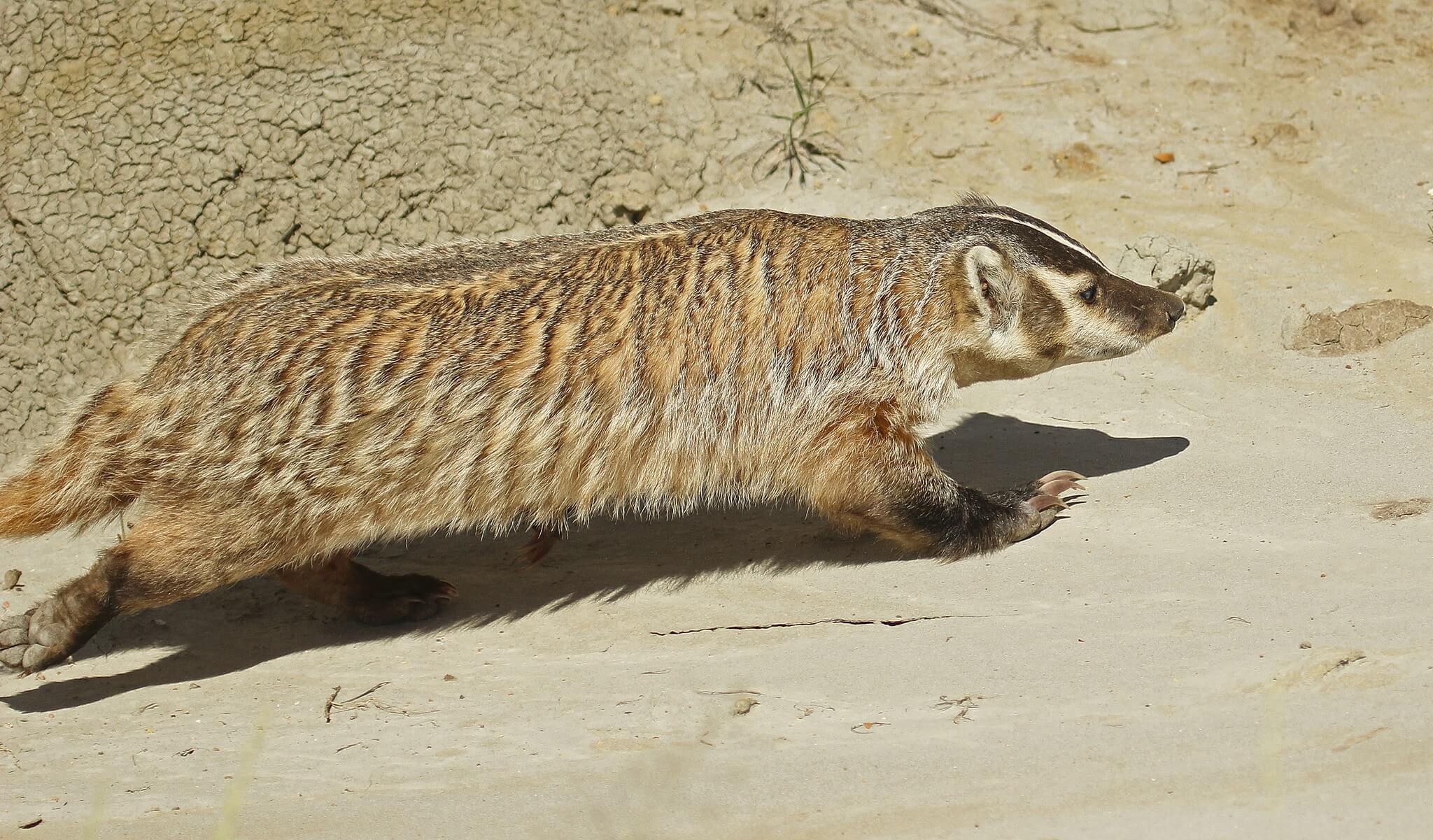
Badgers are short, wide, and low to the ground. Adults measure about 22 to 30 inches from nose to tail and weigh 13 to 25 pounds. The tail is short and bushy, and the fur is longest along the sides. With its loose, shaggy coat and short legs, a badger seems to flow over the ground when it walks.
The face is the easiest way to recognize one:
- Stripe: A white stripe runs from the nose over the top of the head. In northern badgers it usually stops around the neck or shoulders, while in southern badgers it often continues down the back toward the rump.
- Face markings: Pale cheeks set off by dark patches, plus a small dark mark just ahead of each ear.
- Head shape: Broad, tapering to a wedge at the nose.
- Body: Grizzled gray, tan, or yellowish brown to reddish brown, with buff-colored underparts and dark feet.
That grizzled look comes from the coat itself. Coarse black, brown, and white guard hairs lie over a soft underfur, and from a distance the colors blend together. On open prairie, a badger lying flat beside its mound can be very hard to spot.
Badgers also have a clear inner eyelid, called a nictitating membrane, that slides across the eye and shields it from flying dirt. Nearly every part of the animal is shaped for life in and around burrows.
Built for Digging
No other North American carnivore is as completely adapted to digging. Biologists call animals like this fossorial, and the badger is the clearest example among the continent’s meat-eaters. Several features make that possible:
- Front claws: Long, heavy claws on powerful, muscular forelimbs.
- Toes: Partially webbed, which helps the feet work like shovels.
- Body shape: Flat and wide, with short legs and a streamlined head.
- Eyes: Protected by the nictitating membrane while dirt is flying.
A digging badger is fast. Several National Park Service pages note the old claim that a badger can dig faster than a person with a shovel, and anyone who has watched one disappear into hard prairie soil in a few minutes will believe it.
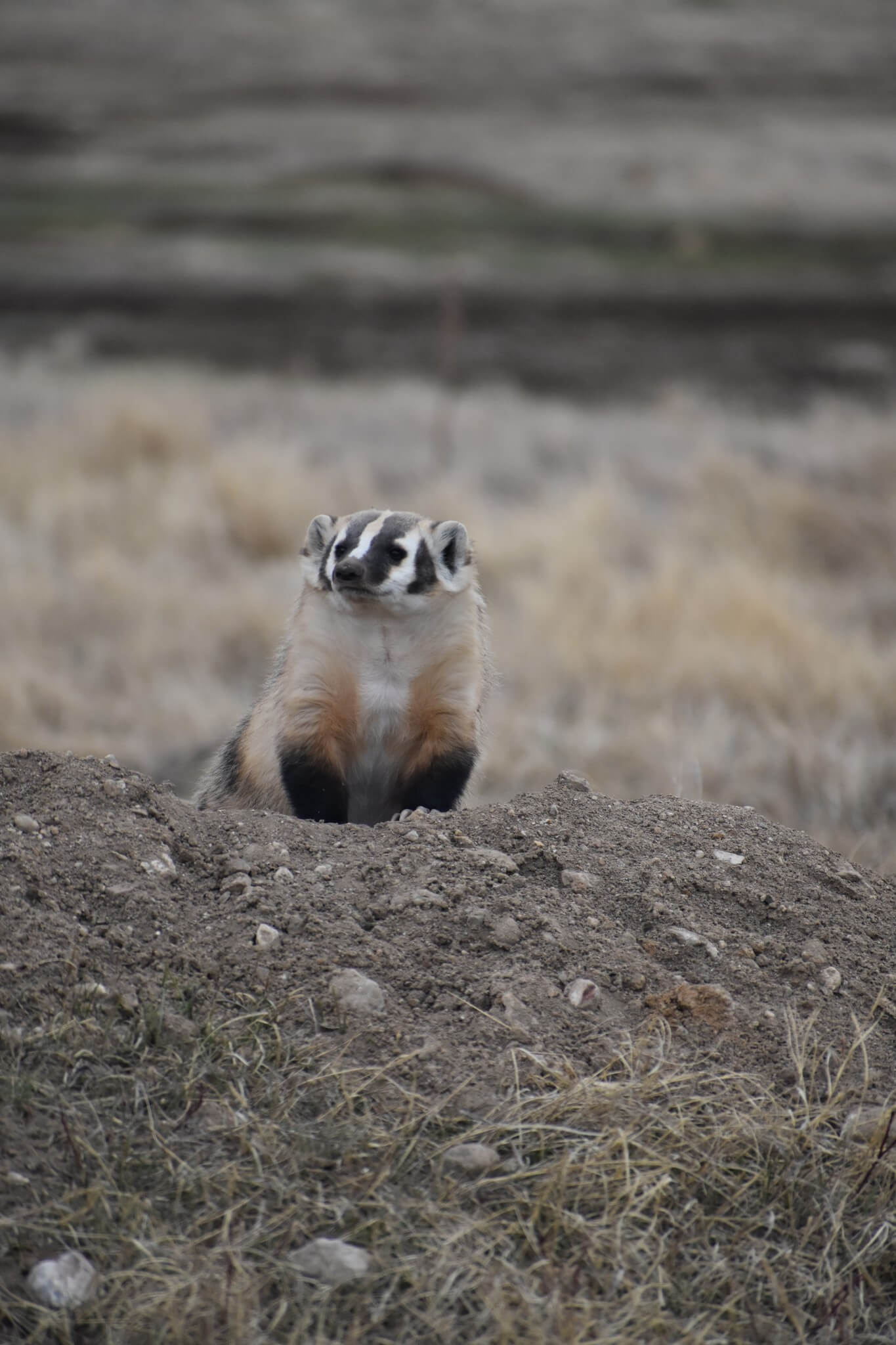
Their burrows can be large. Burrows can run up to 30 feet long and reach 10 feet deep, and the entrance is usually marked by a big fan of loose soil. Most have a single main entrance. A badger uses its burrows for daytime rest, for storing food, for shelter from heat and cold, and for raising young.
How a badger uses those burrows changes through the year. In summer it often moves into a different burrow every day, and it may dig a hole a few days before it starts sleeping in it. In fall it may stay in one for several days at a time. In winter it usually settles into a single burrow and may partly plug the entrance with loose soil to hold in warmth. That is why winter home ranges can be so small, sometimes only a few acres.
Habitat and Range
Badgers favor open country with soil they can dig. Grasslands and prairies are classic badger habitat, but they also live in shrublands, deserts, mountain meadows, farm fields, and pastures. What they need most is loose or loamy soil and plenty of burrowing rodents to eat. They turn up in forest glades, brushy areas, and marshes as well, and have been recorded as high as 12,000 feet, though most live at lower, warmer elevations below the conifer forests. In Arizona they use desert scrub and semidesert grassland.
In parks, those conditions often mean prairie dog towns. At Wind Cave National Park, the mixed-grass prairie has sandy loam soil that suits badger burrows, and badgers are often found in and around prairie dog towns. At Valles Caldera National Preserve in New Mexico, wide grassy valleys and an abundance of rodents make good badger habitat, and badgers hunt in the prairie dog towns near the entrance station.
The species ranges from central Alberta and southern British Columbia south to central Mexico. Its eastern edge reaches Ohio, Indiana, Michigan, and southern Ontario, and badgers have been expanding east, helped in part by changes in farming. Biologists recognize several subspecies, and their ranges overlap where they meet.
Badgers can cover a lot of ground. Radio-tracked badgers in one study used home ranges averaging about 2,100 acres a year, with males generally using more area than females. One female used about 1,790 acres in summer, 131 acres in fall, and just 5 acres in winter, which shows how much a badger’s world shrinks in the cold months.
Behavior and Diet
Badgers are mostly solitary and mostly nocturnal. In quiet, rural areas with little human activity, though, they are often out during the day. In spring, females raising young may spend the nights with their kits and forage in daylight, which makes spring a good time to look for them.
Badgers are carnivores that specialize in burrowing prey:
- Main prey: Small burrowing rodents, including ground squirrels, pocket gophers, prairie dogs, voles, and mice.
- Other foods: Ground-nesting birds and their eggs, insects, lizards, carrion, and snakes, including rattlesnakes.
- Unusual items: Hibernating skunks, honeycombs, bees, and larvae.
- Plants: A small part of the diet, such as sunflower seeds and corn.
To hold its weight, a typical badger has to catch roughly two pocket gophers or ground squirrels every day. To catch them, a badger sniffs out an active burrow and digs in after the occupant. Some badgers plug the extra openings of a burrow system first to block escape routes, and some dig in from a back entrance and then wait at the main one to catch prey as it comes in.
Extra food does not always go to waste. Badgers cache leftovers, burying them or storing them in a burrow to eat later.
They have a reputation for being fierce, and it is mostly deserved. Badgers are aggressive and will hold their ground against dangerous opponents, which is one reason they have few natural enemies.
Winter and Torpor
Badgers are not true hibernators. In cold weather they slow down instead, spending long stretches in a single den and entering torpor, a state of reduced body temperature and metabolism, then waking to hunt when conditions allow.
A badger can remain underground without becoming active for as long as a month in midwinter. Wind Cave National Park describes torpor periods of roughly 29 hours, after which badgers wake and come out to hunt.
Winter is also when a badger’s pregnancy really begins. Badgers mate in summer and early fall, but through a process called delayed implantation, the fertilized eggs do not attach and start developing until winter. Active gestation starts around February and lasts about six to eight weeks.
Signs of badger activity are easy to find even when the animals stay out of sight. Look for fresh mounds of dirt at burrow entrances, and in snow, for tracks with long claw marks ahead of the toes. A burrow with loose soil pushed partway into the entrance may be an occupied winter den, so give it space.
Hunting with Coyotes
One of the most remarkable things about badgers is their habit of hunting alongside coyotes. The badger digs after prey underground while the coyote waits and watches above. A prairie dog or ground squirrel that stays in its burrow risks the badger, and one that bolts out of another hole risks the coyote.
This partnership is not new. Indigenous people and early European settlers described it at least as far back as the 19th century. Still, little research has been done on when and why the two species team up.
Researcher Emma Balunek of the University of Nebraska-Lincoln set out to change that. She placed camera grids at five field sites across four states (Colorado, New Mexico, South Dakota, and Wyoming), one of them in Valles Caldera National Preserve. Her work asks what conditions bring the two predators together, looking at things like the season, the hour, how close a big prairie dog colony is, and how much people are around. Visitors who see a coyote and badger together can report the sighting to the project.
The arrangement is thought to raise the odds of a successful hunt for both animals, since prey has nowhere safe to go. Coyotes have also been seen simply following badgers and waiting near a dig, hoping to grab anything that escapes. Sometimes more than one coyote tags along, and photos from the prairie at Wind Cave National Park show a badger hunting with a pair of coyotes. At Theodore Roosevelt National Park, coyotes are sometimes spotted waiting nearby while a badger digs.
Burrows Other Animals Use
Badgers dig far more burrows than they need, and the old ones rarely sit empty. Abandoned badger holes shelter a long list of other animals:
- Snakes
- Rabbits
- Burrowing owls
- Tiger salamanders
- Insects and other invertebrates
All that digging also loosens and aerates the soil. Estimates from Utah scrub-steppe put badgers at about one per square mile, but that one badger may have around 10 dens in current or recent use, so their mark on the land is much larger than their numbers.
By eating large numbers of rodents, badgers also help keep ground squirrel, gopher, and prairie dog populations in check. In turn, they have few predators of their own. Golden eagles, coyotes, mountain lions, and bobcats have been reported to kill badgers, and bears and wolves do so occasionally. Coyotes and eagles are a bigger threat to young badgers than to adults.
For photographers, a cluster of old badger mounds is worth a second look even when no badger is around, since burrowing owls, rabbits, and other animals may be using them.
Young Badgers
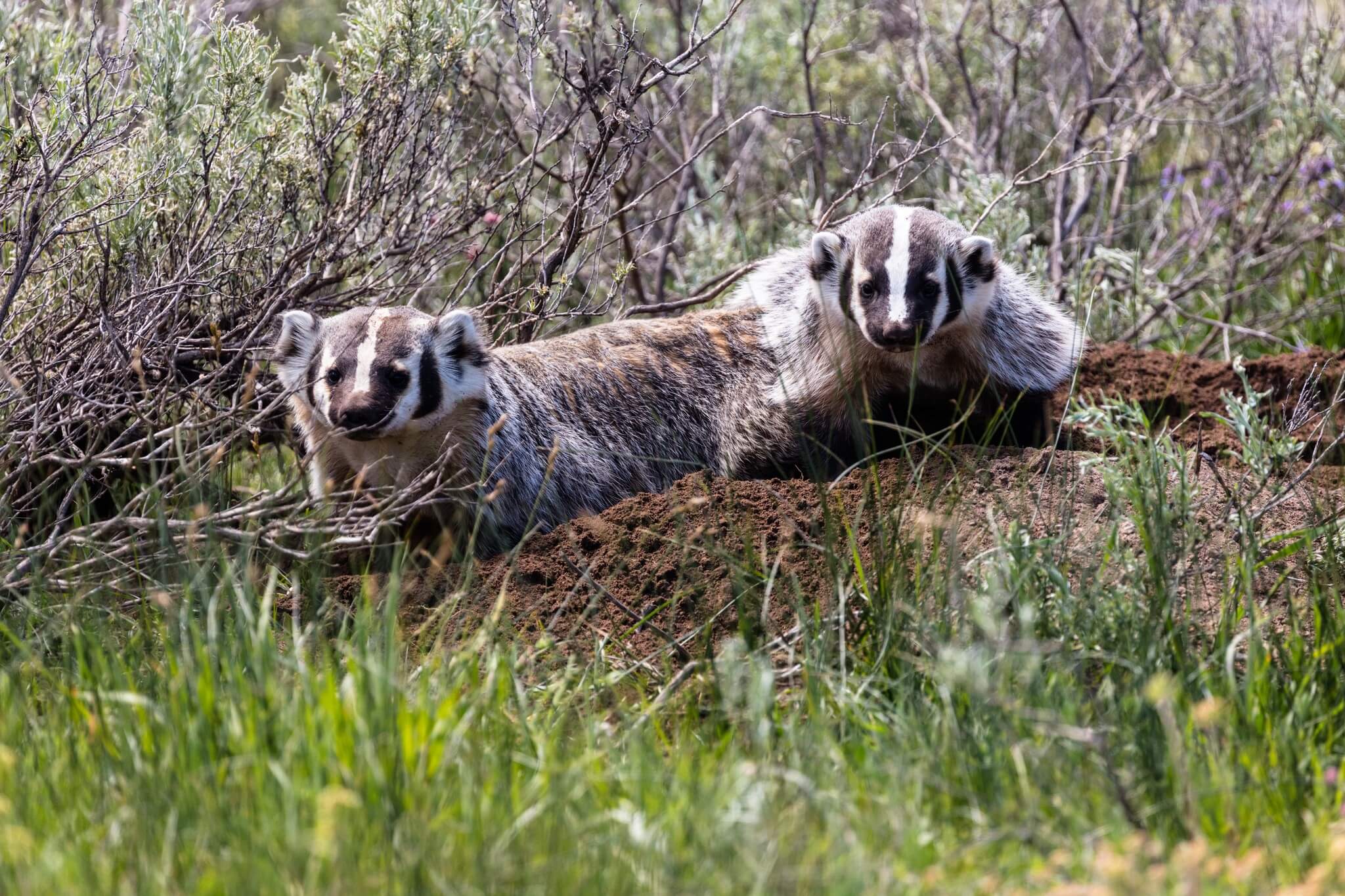
After mating in summer or early fall and the long pause of delayed implantation, female badgers give birth in spring, usually from late March to early April. A litter averages about three young, with a range of one to five.
The young develop in stages:
- Birth: Born blind, furred, and helpless in a natal den the mother digs.
- 4 to 6 weeks: Their eyes open.
- 5 to 6 weeks: They begin coming out of the den on their own.
- Weaning: The mother brings them solid food before and for a few weeks after weaning.
- Late June to August: Families break up and the young set off on their own, though some leave as early as late May or June.
Young badgers on their own for the first time do not travel in straight lines. Their dispersal movements tend to be erratic as they search for a place to settle and an empty patch of ground with enough prey.
Natal dens are more complex than everyday burrows, with extra tunnels, chambers, and latrine areas. A mother may move her litter from one den to another. Most females breed for the first time after their first year, although a few become pregnant when only 4 to 5 months old. Males usually wait until their second year. A badger’s life span can reach 14 years.
Spring and early summer are the best times to see young badgers near a den entrance. If you find an active den, watch from a distance and keep your visit short.
National Park Presence
Badgers live in many of the 63 designated U.S. National Parks. For photographers, American badgers can be found in the following parks:
According to National Park Service NPSpecies records, badgers are listed as common in Great Basin, Grand Teton, Theodore Roosevelt, and Yellowstone National Parks and as occasional in Wind Cave National Park. In many other parks, abundance is listed as uncommon, rare, or unknown, which partly reflects how hard a burrowing, mostly nocturnal animal is to count. Bryce Canyon National Park lists abundance as unknown, yet its own wildlife page recommends checking prairie dog fields early and late in the day for a chance to see one.
American Badger Photography Tips
Park pages and NPS photos point to several good places to look:
- Theodore Roosevelt: Big prairie dog towns, right around sunrise. Badgers have turned up at the Old East Entrance station and on Lindbo Flats north of Boicourt Overlook.
- Wind Cave: Prairie dog towns scattered across the mixed-grass prairie.
- Badlands: Prairie dog towns such as Roberts Prairie Dog Town.
- Bryce Canyon: Meadows where prairie dogs live, first thing in the morning or near dusk.
- Yellowstone: Open grassland, where badgers dig after ground squirrels and pocket gophers, including the area near Indian Creek Campground.
Keep your distance. Badgers can be aggressive when cornered, and a badger at its burrow is close to safety and may stay put if you do not crowd it. Never block its path to a burrow. Yellowstone National Park, for example, requires visitors to stay at least 25 yards from most wildlife, and many other parks have similar rules.
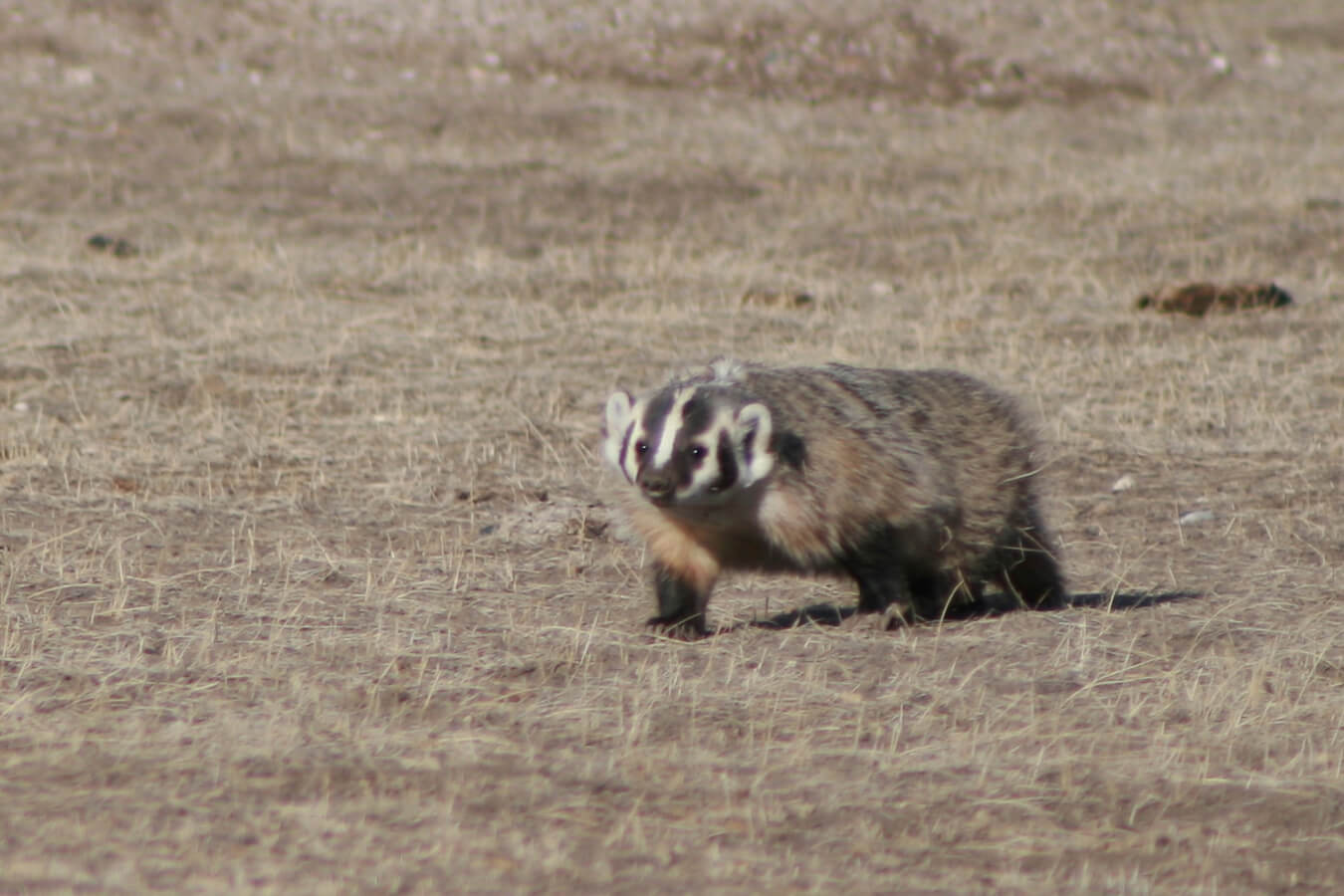
Timing matters. Early morning and evening are the best times to find a badger above ground, and spring offers extra daytime activity. Watch the prairie dogs themselves. When a whole town stands up and starts calling, a predator is often close, and it may be a badger working its way between holes. Scan for fresh dirt being thrown from a hole, then settle in and wait. Stay low and still, keep the camera ready, and let the badger decide how close to come. A long lens lets you fill the frame without pushing an animal back underground.
A telephoto lens is essential for photographing American badgers responsibly. If you already own or want to own a professional-grade mirrored camera like the Canon EOS 5D Mark IV Full Frame Digital SLR, we recommend using a Canon EF 100-400mm f/4.5-5.6L IS II USM Lens zoom lens for wildlife photography. If you have or are interested in a newer mirrorless model like the Canon EOS R5 Full-Frame Mirrorless Camera, we recommend using a Canon RF100-400mm F5.6-8 IS USM for long-distance shots.
Not quite ready to invest in traditional professional-grade camera equipment but want to enhance the quality of your cell phone photographs? Consider using a Moment Tele 58mm Mobile Lens II for improved reach, and use a Moment camera case with a lens mount to attach it to your phone. Since cell phones generally cannot provide the same reach as a dedicated telephoto camera lens, never compensate by moving dangerously close to wildlife.
No photograph is worth disturbing an animal or putting yourself or others at risk.
A Note About Badger Taxonomy
Readers researching badgers may encounter several scientific names. This page uses:
Taxidea taxus
However, some National Park Service records and older references use subspecies names, including:
Taxidea taxus berlandieri, Taxidea taxus jeffersonii, Taxidea taxus jacksoni, Taxidea taxus neglecta, Taxidea taxus taxus, and Taxidea berlandieri
Several southwestern parks, including Big Bend, Carlsbad Caverns, Guadalupe Mountains, and Joshua Tree National Parks, list berlandieri as a synonym. Lassen Volcanic National Park uses Taxidea taxus neglecta as its main name, and Crater Lake National Park lists the same name as a synonym. Great Basin National Park lists both jeffersonii and taxus. Where subspecies ranges meet, intermediate forms occur, so the lines between them are not sharp.
For consistency throughout National Park Photographer, this page uses Taxidea taxus while recognizing the other names visitors may encounter.
Final Thoughts
American badgers are built for one job, and they do it well. By digging after rodents, they shape grasslands, open homes for owls and salamanders, and even recruit coyotes as hunting partners.
Whether it’s a badger peering from its burrow at Wind Cave, a pair resting on a mound near Indian Creek Campground in Yellowstone, or one crossing a prairie dog town at sunrise in Theodore Roosevelt, a badger sighting is something to remember. Watch for fresh dirt, keep your distance, and be patient.
Want more information about the amazing wildlife that call our National Parks home? Take a look at our National Park Wildlife page to explore the various parks and the animals in them. Planning on visiting a National Park in the near future? Be sure to follow park regulations, practice Leave No Trace principles, and prioritize both your safety and the well-being of wildlife while exploring.
Joyful Journeys!
Bonnie, Co-Owner, National Park Photographer
Want to learn more about American badgers? Check out the additional resources below!
American Badger Books & Field Guides
- Peterson Field Guide to Mammals of North America
- Bedtime for Frances (Children’s Picture Book)
- Mammal Tracks & Sign: A Guide to North American Species
- 10×42 Binoculars for Wildlife Viewing
- Monocular for Wildlife Viewing
- Camera Bean Bag for Wildlife Photography
Please note, by making purchases through our affiliate links, you are supporting our mission to celebrate and showcase our National Parks and the photographers who frequent them. As an Amazon Associate, National Park Photographer earns from qualifying purchases at no cost to you. We appreciate your support.
References & Additional Resources
- National Park Service — Yellowstone National Park: Badger
- National Park Service — Theodore Roosevelt National Park: American Badger
- National Park Service — Wind Cave National Park: American Badger
- National Park Service — Bryce Canyon National Park: American Badger
- National Park Service — Valles Caldera National Preserve: Badger
- National Park Service — Missouri National Recreational River: Badger
- National Park Service — You Go Over, I Go Under: A Study of the Coyote-Badger Hunting Relationship
- National Park Service — Yellowstone National Park: Safety
- USDA Forest Service — Fire Effects Information System: Taxidea taxus
- Montana Field Guide: American Badger
- National Park Service — NPSpecies Species Search
Do you want to be featured on National Park Photographer?
Why wait! Contact us today at nationalparkphoto@gmail.com for a chance to be a Featured National Park Photographer!