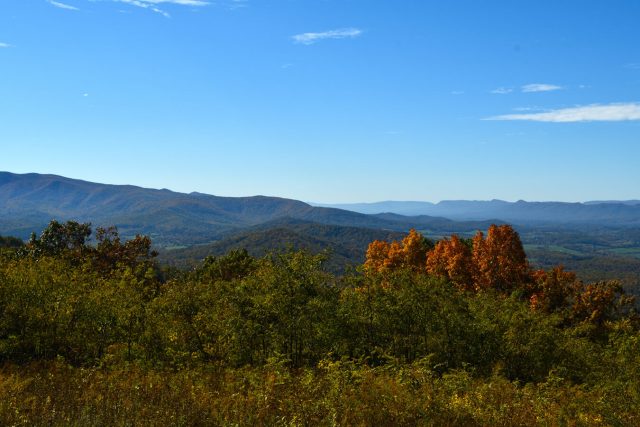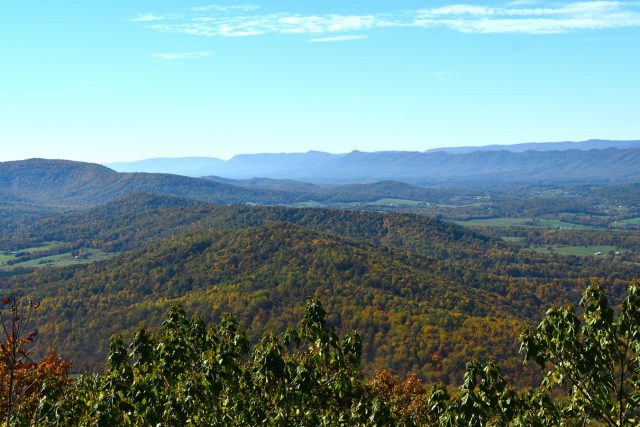
Hawaiʻi Volcanoes National Park on the Island of Hawaiʻi stretches from the rocky Puna coastline to the summit of Kīlauea and the high slopes of Mauna Loa. Before people arrived, every plant and animal reached these remote islands on the wind, on the waves or on its own wings. The Hawaiian hoary bat, or ʻōpeʻapeʻa, made one of the longest of those journeys, flying more than 2,000 miles of open ocean, and it is still the only native land mammal in Hawaiʻi. Rather than living in caves or lava tubes, these endangered bats roost in trees and leave around sunset to hunt insects, mostly moths. The park’s other land mammals were brought by people. Feral pigs root up the ground and knock over native tree ferns, leaving pools of water where mosquitoes that spread avian malaria can breed, and cats, mongooses and rats prey on native birds. Along the coast, endangered hawksbill sea turtles, or honuʻea, nest on park beaches from late May into December, green sea turtles feed on algae near the shore, and Hawaiian monk seals are seen along the coast from time to time.
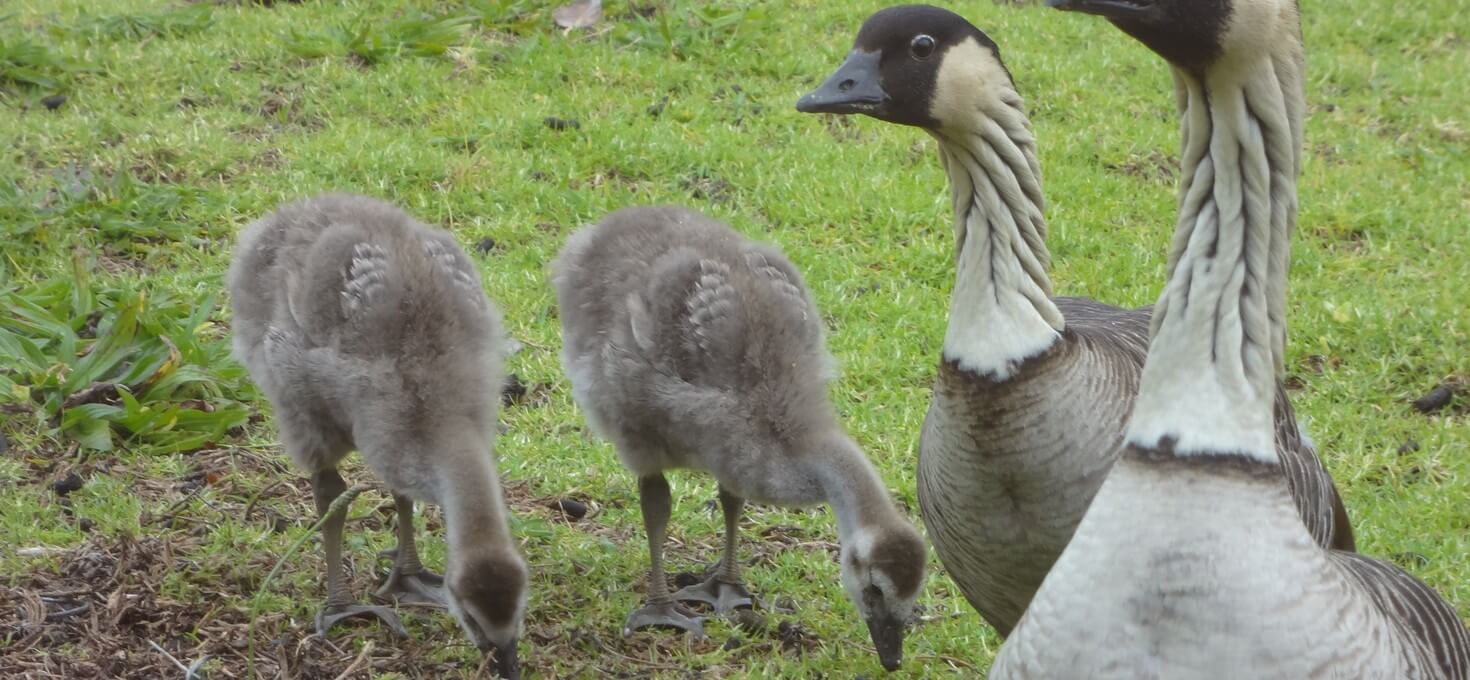
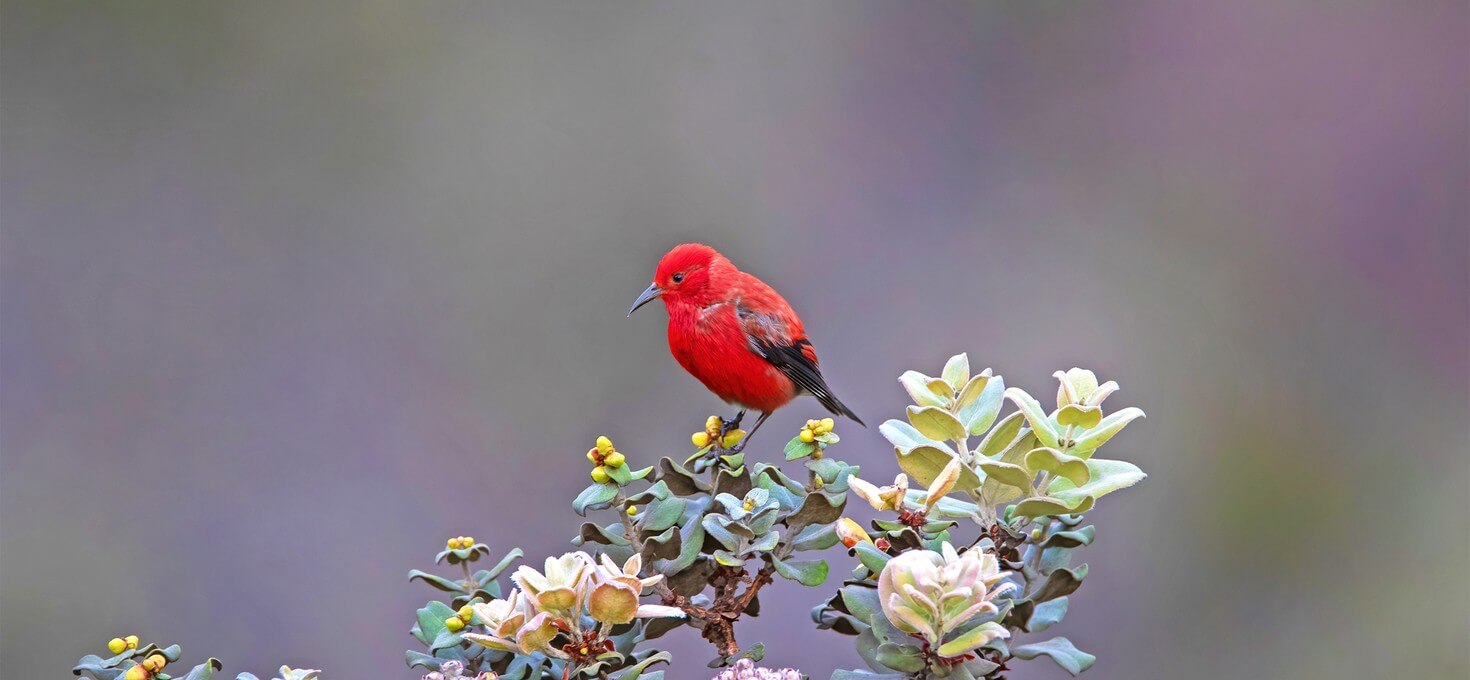
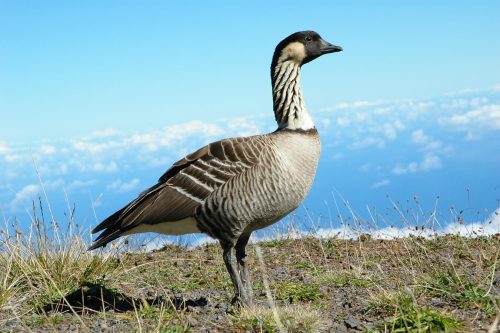
The nēnē, or Hawaiian goose, is Hawaiʻi’s state bird. About 25,000 nēnē may have lived in the islands when Captain Cook arrived in 1778, but only about 50 were left by the mid-1940s. The park began a captive breeding and reintroduction program in the 1970s, and today cars are the leading cause of adult nēnē deaths in the park, so watch for them on roads and never feed them. The ʻio, the only hawk native to Hawaiʻi, lives only on the Island of Hawaiʻi and is often seen circling near the summit of Kīlauea and along Mauna Loa Road. In the high forests, red ʻapapane and ʻiʻiwi search for the flowers of ʻōhiʻa trees, ʻōmaʻo (Hawaiian thrushes) eat fruit, and ʻelepaio catch insects in the understory. The endangered ʻakiapōlāʻau and Hawaiʻi ʻākepa live in the high-elevation forests of the park’s Kahuku Unit. Only 50 to 60 breeding pairs of ʻuaʻu, or Hawaiian petrels, nest in burrows on the upper slopes of Mauna Loa, coming and going only after dark. The common coquí, a tiny frog from Puerto Rico that arrived on potted plants in the 1980s, eats native insects, and its loud calls drown out the calls of native animals at night. Keep reading to see featured photos of Hawaiʻi Volcanoes’ wildlife and to learn more about wildlife photography.
Featured Hawaiʻi Volcanoes National Park Wildlife Photographs
Have a National Park Wildlife photograph you’d like featured? Contact us today to learn more!
Wildlife Photography Tips
Wildlife photography in the US National Parks offers a unique and enriching experience, as these protected areas are havens for diverse species and pristine natural landscapes. Capturing wildlife in such settings requires preparation and respect for both the environment and its inhabitants. Photographers should familiarize themselves with the specific animals and ecosystems of the park they are visiting, as each park hosts different species and behaviors. Early mornings and late afternoons, known as the golden hours, provide the best light and increased wildlife activity. Different seasons also offer different wildlife viewing opportunities. Patience and stillness are key, as the best moments often come to those who wait quietly.
If wildlife does present itself, always make sure to maintain a safe distance. Using a telephoto lens allows for close-up shots without intruding on the animals’ space. If you already own or want to own a professional grade mirrored camera like the Canon EOS 5D Mark IV Full Frame Digital SLR, we recommend using a Canon EF 100-400mm f/4.5-5.6L IS II USM Lens zoom lens for wildlife photography. If you have or are interested in a newer mirrorless model like the Canon EOS R5 Full-Frame Mirrorless Camera, we recommend using a Canon RF100-400mm F5.6-8 IS USM Black for long distance shots.
Not quite ready to invest in traditional professional-grade camera equipment but want to enhance the quality of your cell phone photographs? Consider using a Moment Tele 58mm Mobile Lens II for improved reach, and use a Moment camera case with a lens mount to attach it to your phone. Since cell phones generally cannot provide the same reach as a dedicated telephoto camera lens, never compensate by moving dangerously close to wildlife. As with any visit to a national park, it’s important to follow park regulations, practice “Leave No Trace” principles, and prioritize safety while photographing wildlife.
Want to take your wildlife photos further? Featured photographer Vella Torvik shares her field-tested advice on gear, camera settings, light, composition and safely approaching wildlife in our Wildlife Photography 101: Insider Tips From the Field masterclass.
Hawaiʻi Volcanoes Wildlife Education and Resources
Want to learn more about Hawaiʻi Volcanoes National Park and the wildlife that inhabits it? Check out these guides & books:
- Peterson Field Guide To Mammals Of North America: Fourth Edition (Peterson Field Guides)
- Peterson Field Guide To Birds Of Western North America, Fifth Edition (Peterson Field Guides)
- Bird Songs: 250 North American Birds in Song
- Animal Tracks: A Folding Pocket Guide to the Tracks & Signs of Familiar North American Species (Wildlife and Nature Identification)
Please note, by making purchases through our affiliate links, you are supporting our mission to celebrate and showcase our National Parks and the photographers who frequent them. As an Amazon Associate, National Park Photographer earns from qualifying purchases at no cost to you. We appreciate your support.
Hawaiʻi Volcanoes National Park Species List
The wildlife at Hawaiʻi Volcanoes National Park is beautiful and diverse. There are a variety of mammals, birds, reptiles, amphibians and fish to view. Check out all the incredible species this park has to offer! Click on the links below to see the different animal species that inhabit Hawaiʻi Volcanoes National Park:
Hawaiʻi Volcanoes National Park Mammals
14 species
- Black Rat(Rattus rattus)
- Domestic Cat(Felis catus)
- Domestic Cattle (feral)(Bos taurus)
- Domestic Dog(Canis familiaris)
- Feral Pig(Sus scrofa)
- Feral Sheep(Ovis aries)
- Goat (feral)(Capra hircus)
- Hawaiian Hoary Bat(Lasiurus cinereus semotus)
- Hawaiian Monk Seal(Neomonachus schauinslandi)
- House Mouse(Mus musculus)
- Mouflon Sheep(Ovis musimon)
- Norway Rat(Rattus norvegicus)
- Polynesian Rat(Rattus exulans)
- Small Indian Mongoose(Herpestes javanicus)
No mammals match.
Hawaiʻi Volcanoes National Park Birds
62 species
- African Silverbill(Euodice cantans)
- ʻĀkeʻāke(Oceanodroma castro)
- ʻAkiapōlāʻau(Hemignathus wilsoni)
- ʻAʻo(Puffinus newelli)
- ʻApapane(Himatione sanguinea)
- ʻAukuʻu(Nycticorax nycticorax hoactli)
- Barn Owl(Tyto alba)
- Black Noddy(Anous minutus melanogenys)
- Bonaparte’s Gull(Chroicocephalus philadelphia)
- Bristle-thighed Curlew(Numenius tahitiensis)
- California Quail(Callipepla californica)
- Chukar Partridge(Alectoris chukar)
- Common Myna(Acridotheres tristis)
- Common Waxbill(Estrilda astrild)
- Erckel’s Spurfowl(Pternistis erckelii)
- Eurasian Skylark(Alauda arvensis)
- ʻEwaʻewa(Onychoprion fuscatus)
- Green Pheasant(Phasianus versicolor)
- Hawaiʻi ʻĀkepa(Loxops coccineus)
- Hawaiʻi ʻAmakihi(Chlorodrepanis virens virens)
- Hawaiʻi Creeper(Loxops mana)
- Hawaiʻi ʻElepaio(Chasiempis sandwichensis)
- Helmeted Guineafowl(Numida meleagris)
- House Finch(Haemorhous mexicanus)
- House Sparrow(Passer domesticus)
- Hwamei(Garrulax canorus)
- ʻIʻiwi(Drepanis coccinea)
- Indian Peafowl(Pavo cristatus)
- ʻIo(Buteo solitarius)
- ʻIwa(Fregata minor palmerstoni)
- Japanese Bush-warbler(Horornis diphone)
- Japanese Quail(Coturnix japonica)
- Java Sparrow(Lonchura oryzivora)
- Kalij Pheasant(Lophura leucomelanos)
- Koaʻe ʻUla(Phaethon rubricauda)
- Lavender Waxbill(Estrilda caerulescens)
- Manu-o-Kū(Gygis alba rothschildi)
- Nēnē Photo post(Branta sandvicensis)
- Northern Cardinal(Cardinalis cardinalis)
- Northern Mockingbird(Mimus polyglottos)
- Nutmeg Mannikin(Lonchura punctulata)
- ʻŌmaʻo(Myadestes obscurus)
- Pacific Golden Plover(Pluvialis fulva)
- Peregrine Falcon(Falco peregrinus)
- Pueo(Asio flammeus sandwichensis)
- Red-billed Leiothrix(Leiothrix lutea)
- Ring-necked Pheasant(Phasianus colchicus)
- Rock Dove(Columba livia)
- Ruddy Turnstone(Arenaria interpres)
- Saffron Finch(Sicalis flaveola)
- Sanderling(Calidris alba)
- Spotted Dove(Streptopelia chinensis)
- ʻUaʻu(Pterodroma sandwichensis)
- ʻUaʻu Kani(Ardenna pacifica)
- Wandering Tattler(Tringa incana)
- Warbling White-eye(Zosterops japonicus)
- Western Cattle Egret(Ardea ibis)
- White-tailed Tropicbird(Phaethon lepturus)
- Wild Turkey(Meleagris gallopavo)
- Yellow-billed Cardinal(Paroaria capitata)
- Yellow-fronted Canary(Crithagra mozambica)
- Zebra Dove(Geopelia striata)
No birds match.
Hawaiʻi Volcanoes National Park Reptiles
11 species
- Brahminy Blind Snake(Ramphotyphlops braminus)
- Common House Gecko(Hemidactylus frenatus)
- Garden Skink(Lampropholis delicata)
- Green Sea Turtle(Chelonia mydas)
- Hawksbill Sea Turtle(Eretmochelys imbricata)
- Indo-Pacific Gecko(Hemidactylus garnotii)
- Indo-Pacific Tree Gecko(Hemiphyllodactylus typus)
- Jackson’s Chameleon(Chamaeleo jacksonii)
- Mourning Gecko(Lepidodactylus lugubris)
- Oceanic Snake-eyed Skink(Cryptoblepharus poecilopleurus)
- Stump-toed Gecko(Gehyra mutilata)
No reptiles match.
Hawaiʻi Volcanoes National Park Amphibians
4 species
- Bullfrog(Rana catesbeiana)
- Cane Toad(Bufo marinus)
- Common Coquí(Eleutherodactylus coqui)
- Wrinkled Frog(Rana rugosa)
No amphibians match.
Hawaiʻi Volcanoes National Park Fish
4 species
- Convict Tang(Acanthurus triostegus)
- Flagtail(Kuhlia sandvicensis)
- ʻOʻopu ʻOhune(Bathygobius fuscus)
- Sandwich Island Sleeper(Eleotris sandwicensis)
No fish match.
Note: The wildlife species included in the lists above have been confirmed with the National Park Service to be present in Hawaiʻi Volcanoes National Park. Other species may exist in the park that are currently under review or not yet known.
Do you want to be featured on National Park Photographer?
Why wait! Contact us today at nationalparkphoto@gmail.com for more information!
References:
- National Park Species List
- NPS: Animals, Hawaiʻi Volcanoes
- NPS: Birds, Hawaiʻi Volcanoes
- NPS: Native Hawaiian Forest Birds of Hawaiʻi Volcanoes National Park
- NPS: Nēnē, Hawaiʻi Volcanoes
- NPS: ʻIo (Hawaiian Hawk), Hawaiʻi Volcanoes
- NPS: ʻUaʻu – Hawaiian Petrel, Hawaiʻi Volcanoes
- NPS: ʻŌpeʻapeʻa (Hawaiian Hoary Bat), Hawaiʻi Volcanoes
- NPS: Marine Life, Hawaiʻi Volcanoes
- NPS: Invasive Animals, Hawaiʻi Volcanoes