Few birds carry as much meaning in Hawaii as the nēnē. Also known as the Hawaiian goose, the nēnē is Hawaii’s state bird and the only surviving endemic goose in the islands, found nowhere else in the world. By the early 1950s, only about 30 remained. Today, thanks to decades of work by park biologists, partners, and volunteers, nēnē once again walk across lava flows and grasslands in Hawai’i Volcanoes National Park and Haleakalā National Park.
Hawai’i Volcanoes describes the nēnē as a bird that “symbolizes the precarious existence of Hawai’i’s native birdlife.” Populations are rebounding, but the species still depends on people to survive. For visitors and photographers, that makes every nēnē sighting special, and it means how we act around them matters.
Learning about animals like nēnē can significantly enhance wildlife photography skills by providing valuable insights into animal behavior, habitat, and physical characteristics. Understanding an animal’s habits can allow photographers to better anticipate and capture unique and authentic moments. Knowledge of an animal’s habitat may also help in selecting the best locations and times for wildlife viewing and photography, while familiarity with physical characteristics is essential for accurately identifying wildlife in the field. If wildlife photography or simply wildlife viewing are of interest to you, then you’ve come to the right place! Together, let’s learn more about what makes nēnē so special.
Physical Characteristics
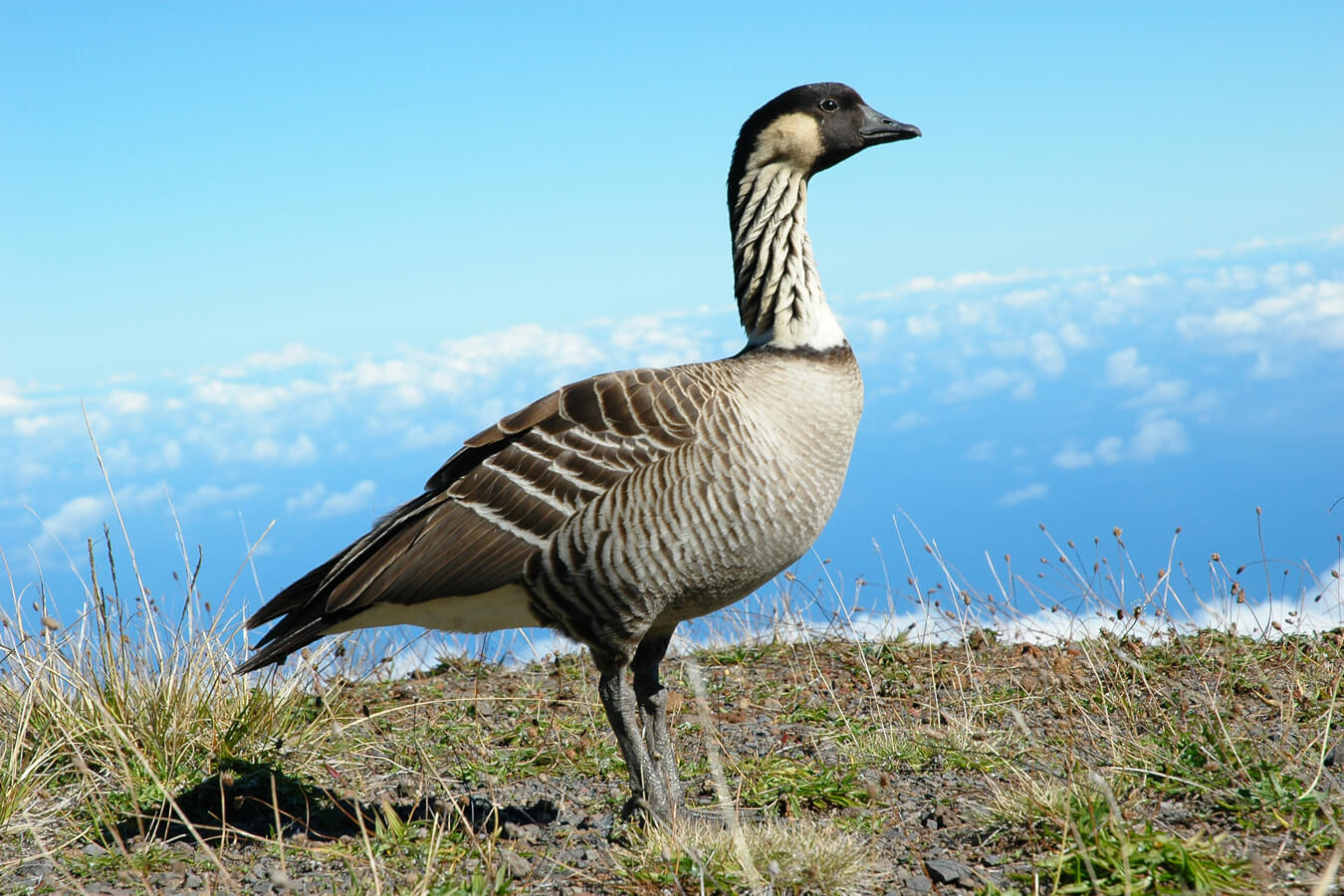
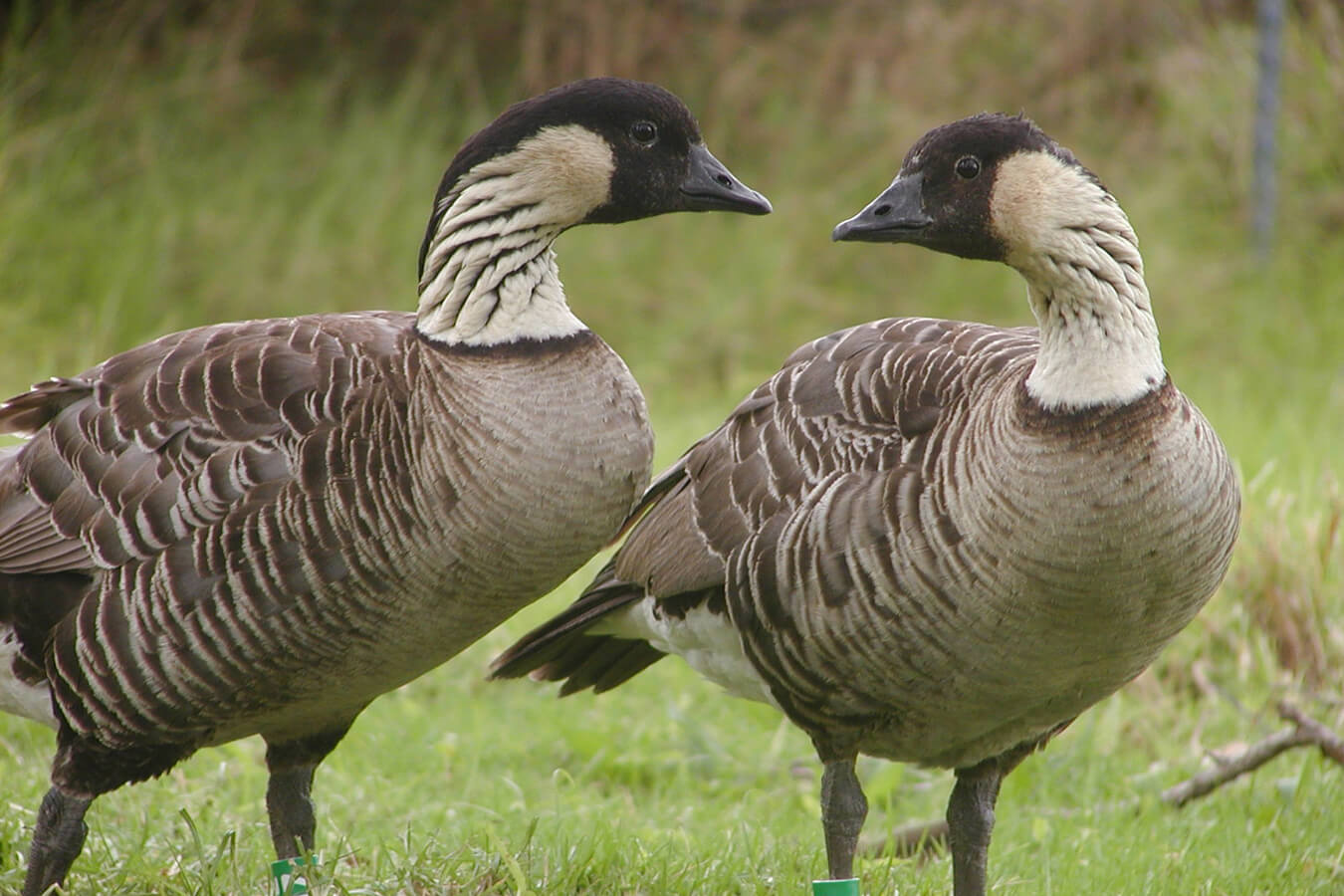
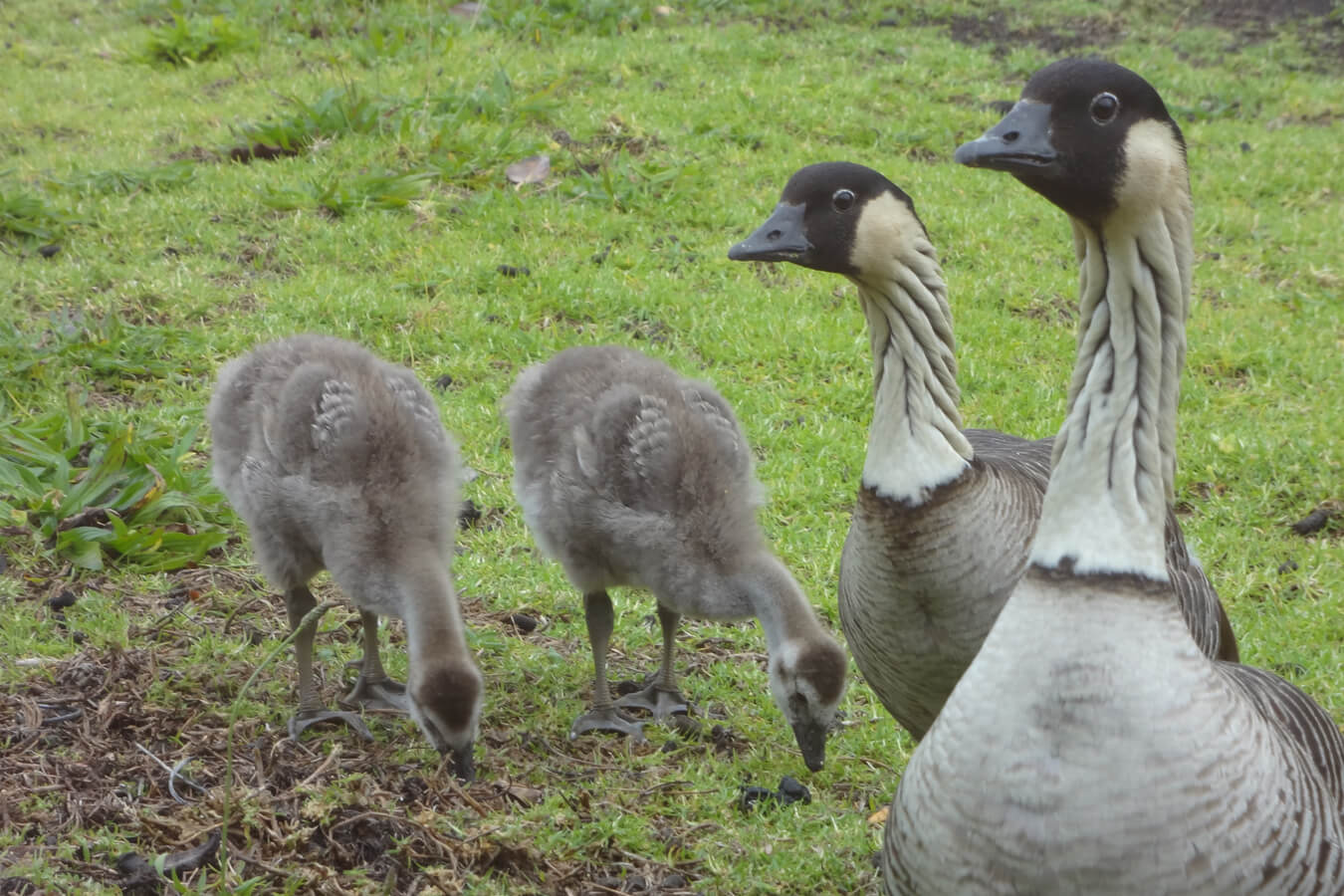
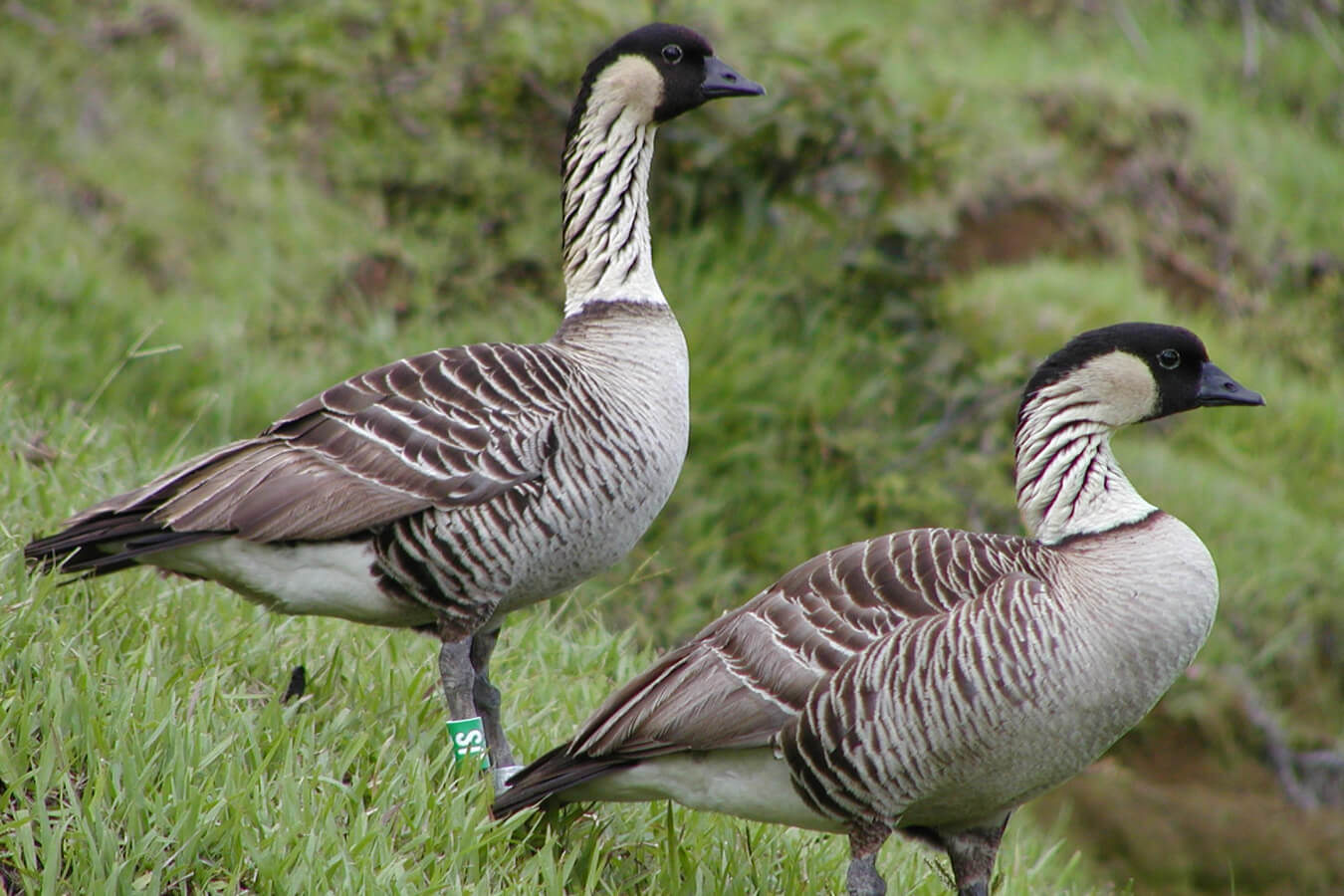
The nēnē is a medium-sized goose. It measures about 25 inches from bill to tail. Males are slightly larger and heavier than females, but both sexes have similar plumage.
Here’s what to look for:
- Head and bill: Black head and bill, with buff-colored cheek patches.
- Neck: Buff-colored and deeply furrowed. These distinctive “stripey” furrows that set the nēnē apart from any other goose.
- Body: Grayish brown, with bold barring on the back, fainter barring underneath, and a white rump.
- Tail, legs, and feet: The tail is black, and so are the legs and webbed feet.
If you’re used to Canada geese, the difference is easy to spot. The nēnē’s neck is not solid black like a Canada goose’s.
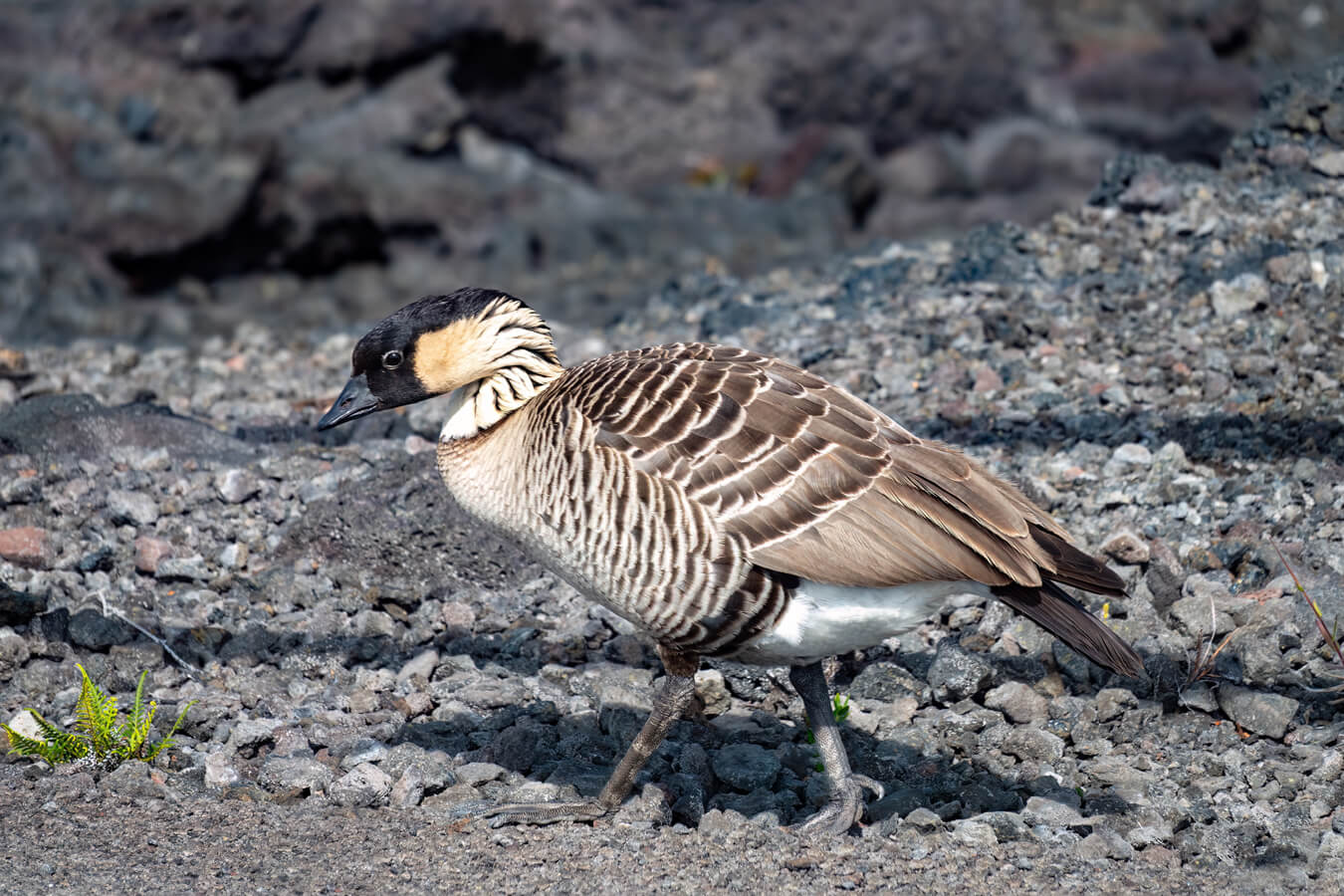
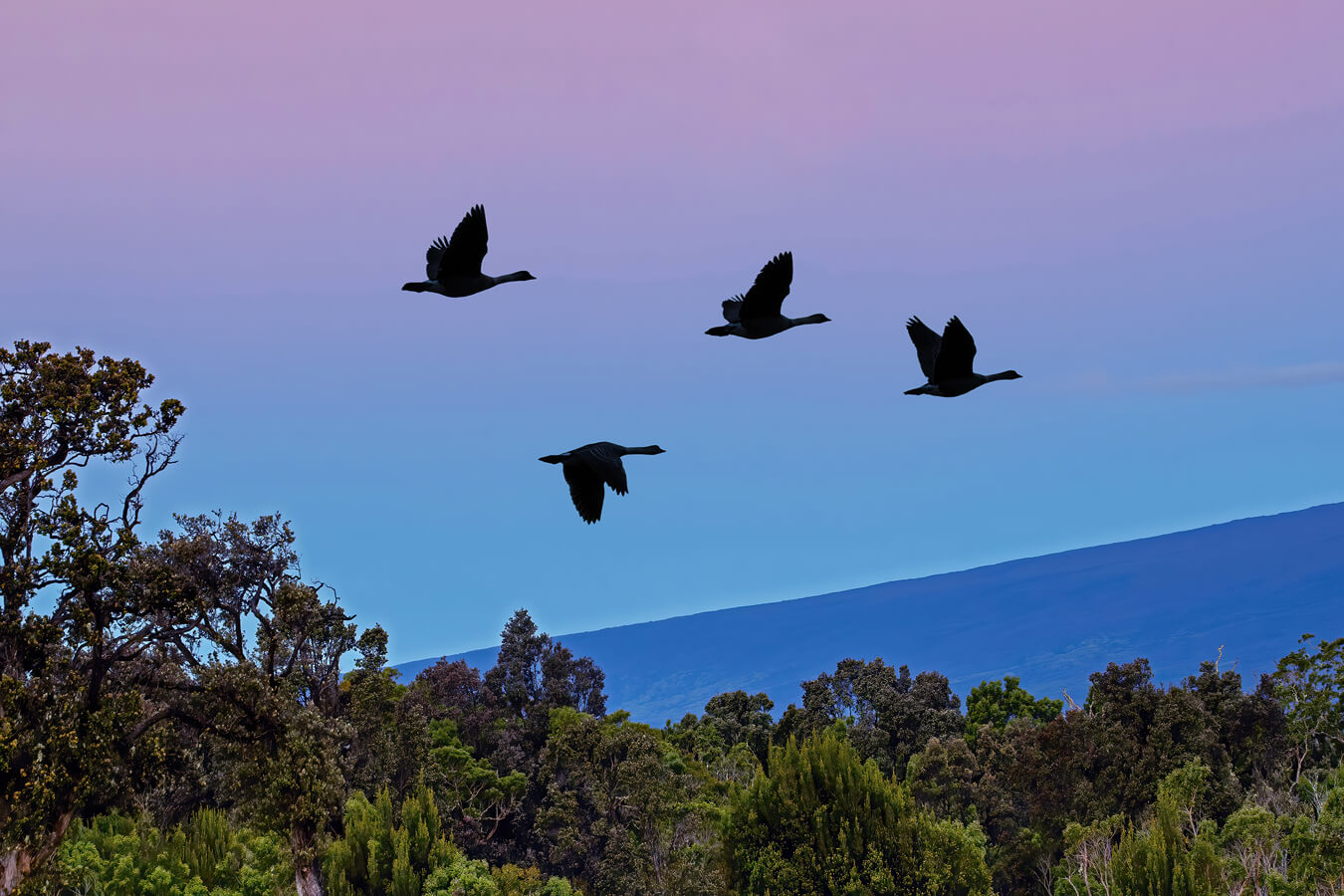
The nēnē’s body is built more for walking than swimming, with short wings, long legs, and partly webbed toes. The webbing on its feet has receded from the toes, an adaptation for walking on lava. Even so, the nēnē is a strong and frequent flyer.
Since males and females look alike, telling them apart can be tricky. A Hawai’i Volcanoes biologist explained in an NPS Voices of Science podcast that nesting season is the best time to try. Before nesting, the female focuses on eating and gets slightly rounder, while the male stays alert and guards her.
Habitat and Range
Nēnē live in a surprising range of habitats. Their habitat ranges from bare upland lava and volcanic desert to native alpine grassland and shrubland, the margins of shrubland and woodland, and non-native grass in pastures and rural areas. Some even turn up on golf courses.
Reintroduced birds now live on Kaua’i, Maui, Moloka’i, and Hawai’i Island, with O’ahu the latest addition. Where nēnē live is largely determined by where captive-bred birds were released.
Kaua’i’s birds have an unusual backstory. The island’s two populations came from both accidental and intentional releases. When Hurricane ‘Iwa struck in 1982, twelve captive birds got loose from Kipu Kai Ranch and went on to breed in the wild; since 1991, more captive-bred geese have been set free at Kilauea Point National Wildlife Refuge.
- Hawai’i Island: Scattered sites from the coast to 7,900 feet. Hawai’i Volcanoes alone has over 200, found from the coast up to roughly 8,000 feet.
- Maui: On Haleakalā between 5,500 and 8,000 feet, and in the West Maui Mountains between 3,000 and 4,000 feet.
- Kaua’i: Low elevations from sea level to 600 feet.
In Hawai’i Volcanoes, nēnē nest in rugged, sparsely vegetated lava flows and shrubby areas that are open and remote. The park’s original reintroduction area, an old pasture surrounded by native shrubland, is still an important foraging spot where birds build up body condition before nesting.
Behavior and Calls
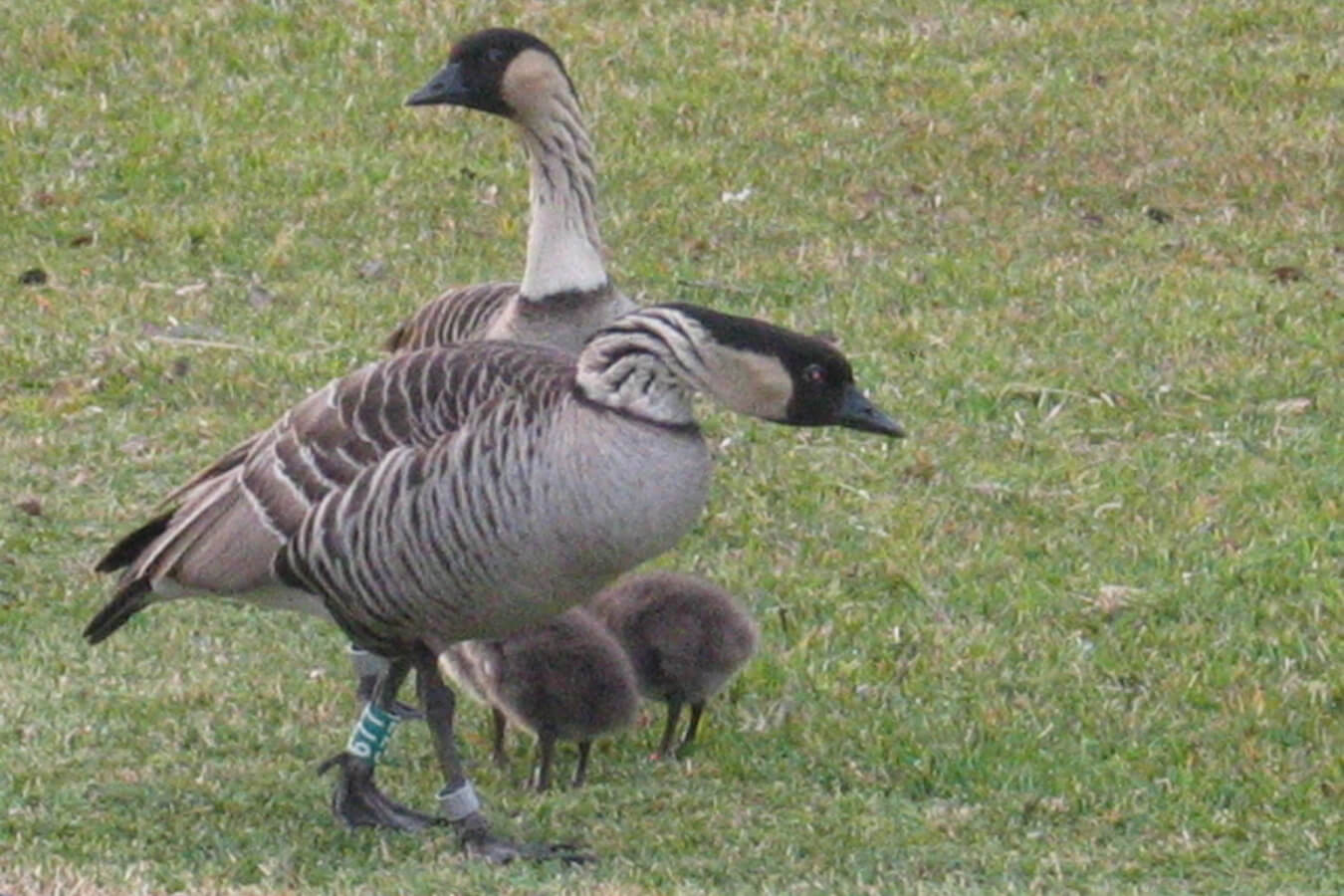
Nēnē are highly social birds. A Hawai’i Volcanoes biologist who has worked with them for nearly 20 years explained that most of the park’s nēnē are banded, so staff know individual birds and can see the relationships between them. Park biologists put leg bands on wild and captive-raised nēnē alike, typically while the birds are still too young to fly.
The name nēnē comes from one of their calls. Nēnē honk in flight like other geese, but on the ground they give the soft, low “nay-nay” call behind their name. Adults also give gentle mewing or mooing notes, raucous cackles when startled, and the familiar trumpeting of a goose.
Pairs communicate constantly. The male gives a trumpeting call while the female answers with a quieter, quicker sound as they parade through an area together. Because they mate for life, pairs develop their own calls and stay in touch about where the other is and what it’s doing.
Nēnē also have an interesting blind spot. They evolved with only avian predators, such as hawks, so they’re keenly alert to anything flying overhead. Danger on the ground is something they have to learn, which helps explain why introduced mammals and cars are such a problem.
Diet
Nēnē are herbivores. They eat over 30 kinds of plants, both native and introduced. Most of what they eat is grass and sedge leaves and seeds, the leaves and blossoms of plants in the daisy family, and assorted fruits.
At Haleakalā, the geese spend the whole day feeding, picking at berries, flowers, leaves, and the tips of grasses. They forage in what is left of native habitat as well as in landscapes changed by people. Nēnē also graze the closely cut grass on road shoulders and drink from puddles of runoff beside the pavement, which unfortunately puts them in the path of traffic.
Good food is especially important for breeding. Upland food is often too poor for goslings to grow well, and poor nutrition for breeding females and goslings limits the species. That’s one reason Hawai’i Volcanoes National Park mows pastures as part of its nēnē management.
Nesting and Goslings
Nēnē have a long nesting season. Recent park sources describe it as October through May, though dates vary: an extended breeding season from October through March at Haleakalā, and September through May in a 2024 update from Hawai’i Volcanoes.
Here’s how the nesting cycle works:
- Pairs: Mates stay together for life.
- Nests: A shallow hollow on the ground, padded with plant material and down and usually tucked beneath shrubs.
- Eggs: Females lay two to five eggs per nest, and a pair may try again if a clutch is lost or abandoned before it hatches.
- Incubation: About 30 days, with the female sitting on the eggs and the male standing guard nearby.
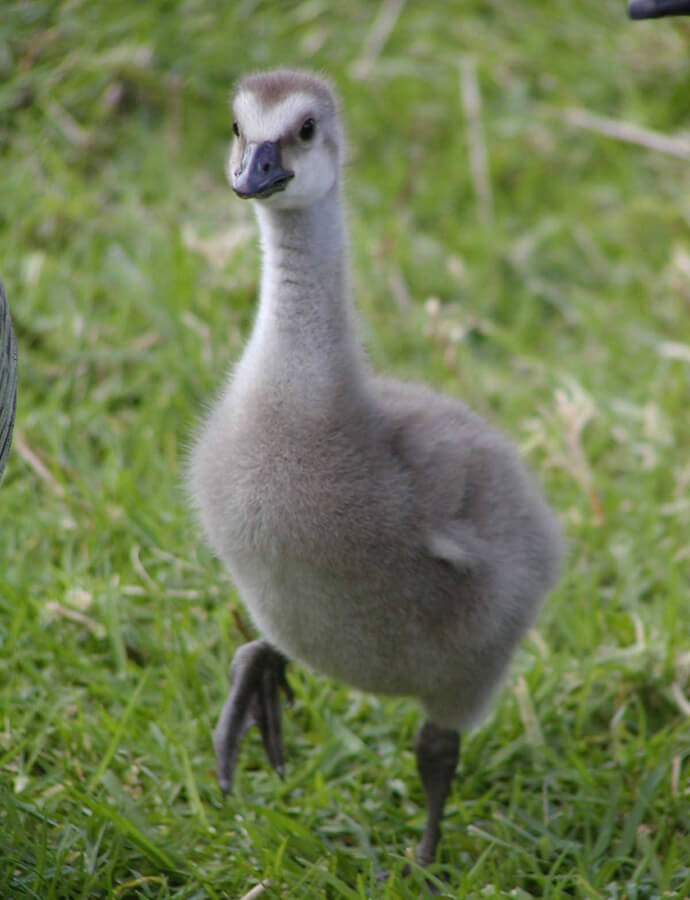
- Goslings: Both parents raise the young, which fledge 10 to 12 weeks after hatching.
In Hawai’i Volcanoes, families start walking to brooding areas the day after the goslings hatch. Once nesting is over, adults molt and can’t fly for four to six weeks, typically regaining flight around the time their young first fly.
Losing a parent during nesting season can be devastating. A Haleakalā wildlife biologist explained in 2022 that losing a mate in the nesting season usually dooms that year’s family, since goslings rarely survive without both parents. Nēnē usually don’t find another mate for the rest of that nesting season.
Nēnē are also long-lived. They can live as long as 30 years, and some of the original breeding pairs from early recovery efforts at Hawai’i Volcanoes were still alive when the park biologist featured in the Voices of Science podcast began working with the birds.
From the Brink of Extinction
Hawaii was once home to many more geese. Seven or more goose species arose in the islands, likely descended from birds resembling the Canada goose. Most could not fly and probably fed on the plants of old Hawaii. Polynesian hunting and changes to lowland habitat wiped them out. The nēnē is the last one left.
When Captain Cook reached the islands in 1778, there may have been around 25,000 nēnē. The population declined after 1800 as birds disappeared from lowland habitats, and the decline sped up between 1850 and 1900. Counts vary, but only about 50 birds remained by the mid-1940s, and about 30 by 1952. At the time of European contact nēnē were only known with certainty on Hawai’i Island, though they probably once lived on all of the main islands.
Many factors drove the decline:
- Predators brought in by people, including dogs, cats, and mongooses.
- Grazing and rooting animals such as cattle, goats, and pigs.
- Hunting, which is now illegal.
- Introduced plants that compete with native food and cover plants.
- Loss of lowland habitat.
Recovery took decades. Captive propagation programs began in 1949, and since 1960, birds raised in captivity have been let go at sites across the state. On Maui, where the geese had disappeared before 1890, Haleakalā was picked as the place to bring them back. A Boy Scout troop helped bring the geese back in 1962, and some 500 geese were set free in the park before the program ended in the late 1970s. Hawai’i Volcanoes began its own captive breeding and reintroduction program in the 1970s, not long after the nēnē gained federal endangered status in 1967.
By the 1980s, Hawai’i Volcanoes shifted its focus from releasing captive-bred birds to improving conditions in the wild, including better habitat and fewer predators. In a 2019 NPS podcast, a park biologist estimated about 250 nēnē in the park and about 3,000 statewide. The U.S. Fish and Wildlife Service reclassified the nēnē from endangered to threatened under the Endangered Species Act in a rule that took effect on January 21, 2020.
Threats Today
Even with the population recovering, nēnē still face serious threats. In the words of Hawai’i Volcanoes, nēnē “will probably always need our help to survive.”
- Vehicles: Vehicles kill more adult nēnē in the park than anything else. At Haleakalā, 11 nēnē were killed by motorists in the four years before July 2026.
- Predators: Feral cats and mongooses prey on both goslings and adults. Dogs, rats, and pigs prey on them too.
- Feeding: Geese that get handouts start begging and walking up to cars that are still moving.
- Other hazards: Golf course fairways draw nēnē, and stray balls can injure or kill them.
Losses add up quickly. At Haleakalā, four nēnē were killed by cars on park roads in one nesting season and six in the next, before the 2014–2015 season. A female killed near Headquarters Visitor Center in December 2014 had a brood patch, a featherless area used to warm eggs, which meant she was nesting.
Haleakalā’s park road is a particular concern. A park biologist explained that the road cuts right through nesting habitat, so the geese cross it often. To discourage the birds from lingering by the road, staff have cleared short grass and filled holes where water pools. In 2013, a park official pointed out that the geese have had thousands of years in Hawaii and cars only about a century, so the birds haven’t adapted to traffic.
How the Parks Protect Nēnē
Both parks actively manage nēnē. At Hawai’i Volcanoes, staff help more goslings survive by trapping predators where the geese nest, keeping pastures mowed, closing brood-rearing areas to visitors, and maintaining fenced, predator-proof pens that wild birds can fly into to rest, feed, or nest. Haleakalā focuses on predator control in known nesting areas, maintaining fences to keep out goats, pigs, and dogs, population monitoring, research, and public education.
Temporary closures are a big part of protecting nesting pairs. In 2019, Hawai’i Volcanoes closed Pu’u Pua’i Overlook, its parking lot, and Devastation Trail for four months so a nēnē pair could raise its gosling to a fledgling. In 2023 and 2024, the park shut part of the Uēkahuna parking lot and a brief stretch of Crater Rim Trail so pairs could nest undisturbed.
Visitors can help too. Haleakalā and the Friends of Haleakalā National Park run the Adopt-A-Nēnē Program together, and the money it raises helps nēnē statewide. At Haleakalā, call 808-985-6170 to report a hurt nēnē or other injured wildlife.
National Park Presence
Of the 63 designated U.S. National Parks, nēnē live in the two Hawaiian parks. For photographers, nēnē can be found in the following parks:
| Park Name | Occurrence | Abundance |
| Haleakalā National Park | Present – Native | Common |
| Hawai’i Volcanoes National Park | Present – Native | Uncommon |
According to National Park Service NPSpecies records, nēnē are common in Haleakalā and uncommon in Hawai’i Volcanoes. Nēnē also live outside the national parks on Kaua’i, Moloka’i, and O’ahu.
Nēnē Photography Tips
Since nēnē are so tied to roads and open grassland, you may see one before you even reach a trailhead. Here are a few places to look:
- Haleakalā: The geese favor grassland and shrubland under 8,500 feet. Look near the backcountry cabins, at Kalahaku Overlook, and along roads.
- Hawai’i Volcanoes: Watch roadsides and parking areas, especially during nesting season. In this park, they range from the shoreline to about 8,000 feet.
Give nēnē plenty of room. In Hawai’i Volcanoes, stay at least 60 feet away. Never feed them, since birds that get handouts gravitate toward parking areas and are often eventually killed by cars. If you see a closure for nesting nēnē, respect it, even if the birds are out of sight.
Drive slowly. At Haleakalā National Park, stick to the speed limit and take special care around the entrance station and the Headquarters Visitor Center. Keep in mind that wind, rain, and poor visibility at the summit can make nēnē hard to spot. When you stop for a goose, switch on your flashers and don’t move until it is fully off the pavement. Before pulling out of a parking space, check around, under, and behind your vehicle for nēnē.
The road up Haleakalā is steep, and cars can pick up speed fast. Use low gear when driving downhill, which helps hold back your vehicle, saves your brakes, and makes it easier to stop for a nēnē. Also, don’t mistake the introduced chukar for a nēnē at the summit, and don’t feed either one.
A telephoto lens is essential for photographing nēnē responsibly. If you already own or want to own a professional-grade mirrored camera like the Canon EOS 5D Mark IV Full Frame Digital SLR, we recommend using a Canon EF 100-400mm f/4.5-5.6L IS II USM Lens zoom lens for wildlife photography. If you have or are interested in a newer mirrorless model like the Canon EOS R5 Full-Frame Mirrorless Camera, we recommend using a Canon RF100-400mm F5.6-8 IS USM for long-distance shots.
Not quite ready to invest in traditional professional-grade camera equipment but want to enhance the quality of your cell phone photographs? Consider using a Moment Tele 58mm Mobile Lens II for improved reach, and use a Moment camera case with a lens mount to attach it to your phone. Since cell phones generally cannot provide the same reach as a dedicated telephoto camera lens, never compensate by moving dangerously close to wildlife.
No photograph is worth disturbing an animal or putting yourself or others at risk.
A Note About Nēnē Taxonomy
Readers researching nēnē may encounter more than one scientific name. This page uses:
Branta sandvicensis (nēnē or Hawaiian goose)
Older sources may use:
Nesochen sandvicensis
Taxonomists now put the nēnē in Branta instead of Nesochen, a genus that held only this one species. The U.S. Fish and Wildlife Service’s 2019 rule also fixed the federal list, dropping Nesochen as the genus because scientists no longer accept it, and added “nene” as another accepted common name. NPSpecies still lists Nesochen sandvicensis as a synonym.
Genetic evidence suggests the nēnē and the Canada goose share a North American ancestor and went their separate ways sometime in the past three million years. Like the other true geese, it is placed in subfamily Anserinae, tribe Anserini.
For consistency throughout National Park Photographer, this page uses the Hawaiian name nēnē while recognizing the other names visitors may encounter.
Final Thoughts
The nēnē is one of the great comeback stories in our National Parks. From about 30 birds in the early 1950s to thousands today, it shows what decades of patient conservation work can accomplish.
That story isn’t finished. Cars, predators, and handouts still threaten nēnē every day. Slowing down, keeping your distance, and never feeding them are some of the easiest ways visitors can help.
If you’re lucky enough to see a nēnē pair grazing near the lava or a family of goslings following their parents across a grassy slope, take a moment to appreciate it. You’re watching a bird that almost disappeared.
Want more information about the amazing wildlife that call our National Parks home? Take a look at our National Park Wildlife page to explore the various parks and the animals in them. Planning on visiting a National Park in the near future? Be sure to follow park regulations, practice Leave No Trace principles, and prioritize both your safety and the well-being of wildlife while exploring.
Joyful Journeys!
Bonnie, Co-Owner, National Park Photographer
Want to learn more about nēnē? Check out the additional resources below!
Nēnē & Hawaiian Bird Books
- Tales of Tutu Nene and Nele
- Lele the Nēnē’s Big Volcano Climb
- 10×42 Binoculars for Wildlife Viewing
- Monocular for Wildlife Viewing
- Camera Bean Bag for Wildlife Photography
Please note, by making purchases through our affiliate links, you are supporting our mission to celebrate and showcase our National Parks and the photographers who frequent them. As an Amazon Associate, National Park Photographer earns from qualifying purchases at no cost to you. We appreciate your support.
References & Additional Resources
- National Park Service — Hawai’i Volcanoes National Park: Nēnē
- National Park Service — Hawai’i Volcanoes National Park: Birds
- National Park Service — Haleakalā National Park: Nēnē, the Hawaiian Goose
- National Park Service — Haleakalā National Park: Birds of the Summit District
- National Park Service — Nēnē: The Hawaiian Goose (Voices of Science)
- National Park Service — Hawai’i Volcanoes National Park: Pu’u Pua’i Overlook & Devastation Trail Now Open
- National Park Service — Hawai’i Volcanoes National Park: Nesting Nēnē Protected by Partial Closure
- National Park Service — Hawai’i Volcanoes National Park: Uēkahuna East Entrance Closed to Protect Nesting Nēnē
- National Park Service — Haleakalā National Park: Encourages Visitors to Slow Down for Wildlife
- National Park Service — Haleakalā National Park: Recent Nēnē Fatalities
- National Park Service — Haleakalā National Park: Two Female Nēnē Killed by Speeding Motorists
- U.S. Fish and Wildlife Service — Reclassifying the Hawaiian Goose From Endangered to Threatened (Federal Register)
- National Park Service — NPSpecies Species Search
Do you want to be featured on National Park Photographer?
Why wait! Contact us today at nationalparkphoto@gmail.com for a chance to be a Featured National Park Photographer!