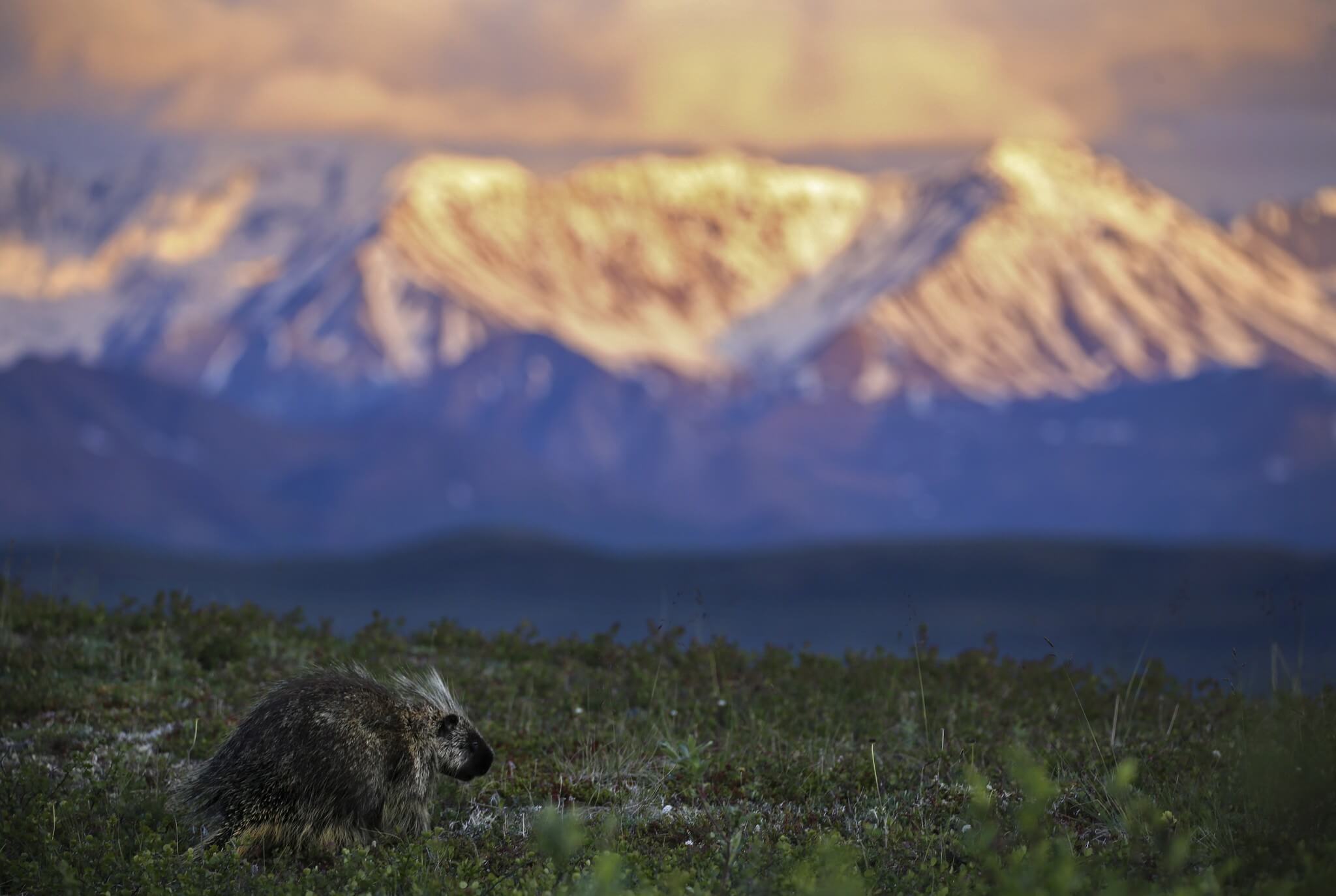
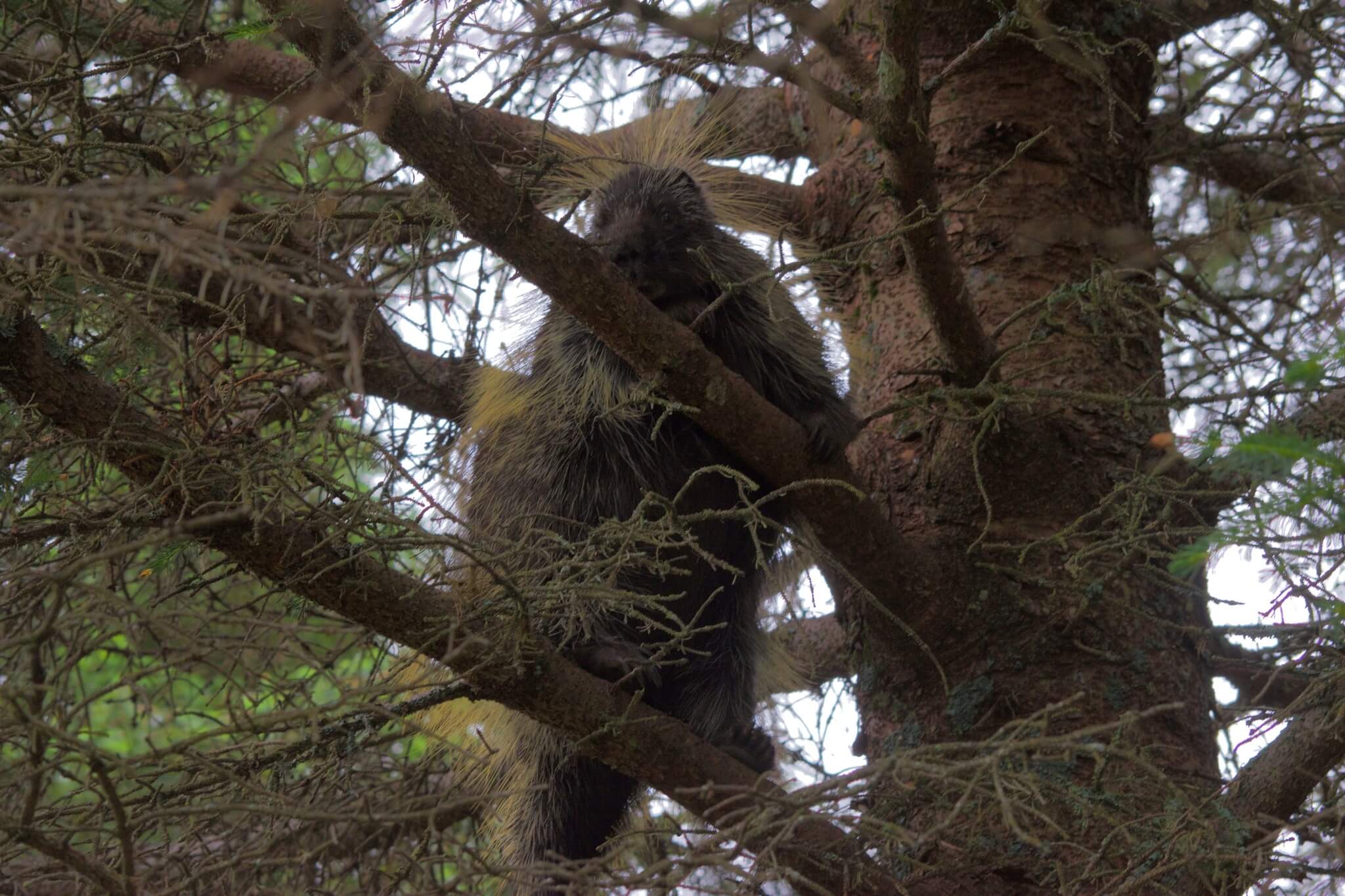
A porcupine is easy to miss. It spends much of the day resting in a tree or tucked into a rock crevice, and from the ground it can look like a dark clump of leaves or a knot in the branches. Once you learn what to look for, porcupines turn up in a surprising number of places, from the cottonwoods along the Little Missouri River in Theodore Roosevelt National Park to the brushy country near Wonder Lake in Denali National Park and Preserve.
The North American porcupine (Erethizon dorsatum) belongs to Erethizontidae, the family of New World porcupines. Among North American rodents, only the beaver grows bigger. No other porcupine is native to the United States or Canada. Its range stretches from Alaska across much of Canada and south into the Northeast, the Great Lakes states, and much of the West. NPSpecies records list porcupines as present in more than 35 National Parks, including Acadia, Denali, Grand Teton, Theodore Roosevelt, Yellowstone, and Zion.
Learning about animals like North American porcupines can significantly enhance wildlife photography skills by providing valuable insights into animal behavior, habitat, and physical characteristics. Understanding an animal’s habits can allow photographers to better anticipate and capture unique and authentic moments. Knowledge of an animal’s habitat may also help in selecting the best locations and times for wildlife viewing and photography, while familiarity with physical characteristics is essential for accurately identifying wildlife in the field. If wildlife photography or simply wildlife viewing are of interest to you, then you’ve come to the right place! Together, let’s learn more about what makes North American porcupines so special.
Physical Characteristics
Built low and heavy, a porcupine walks with its feet turned in and its legs bowed out. Adults usually weigh 10 to 30 pounds and measure about 25 to 31 inches long, including a thick, muscular tail of 7 to 9 inches. Males are larger than females. In Alaska, adult males average 22 to 27 pounds, while females weigh 15 to 18 pounds.
A porcupine’s coat is built in layers:
- Underfur: Short, thick, fine fur that keeps the animal warm and dry.
- Guard hairs: Long hairs, most abundant on the back and tail. Their lighter tips give the coat a yellow or white sheen.
- Quills: Guard hairs modified into stiff, sharp, barbed spines.
- Belly: Sparse black to brown hair, with no quills.
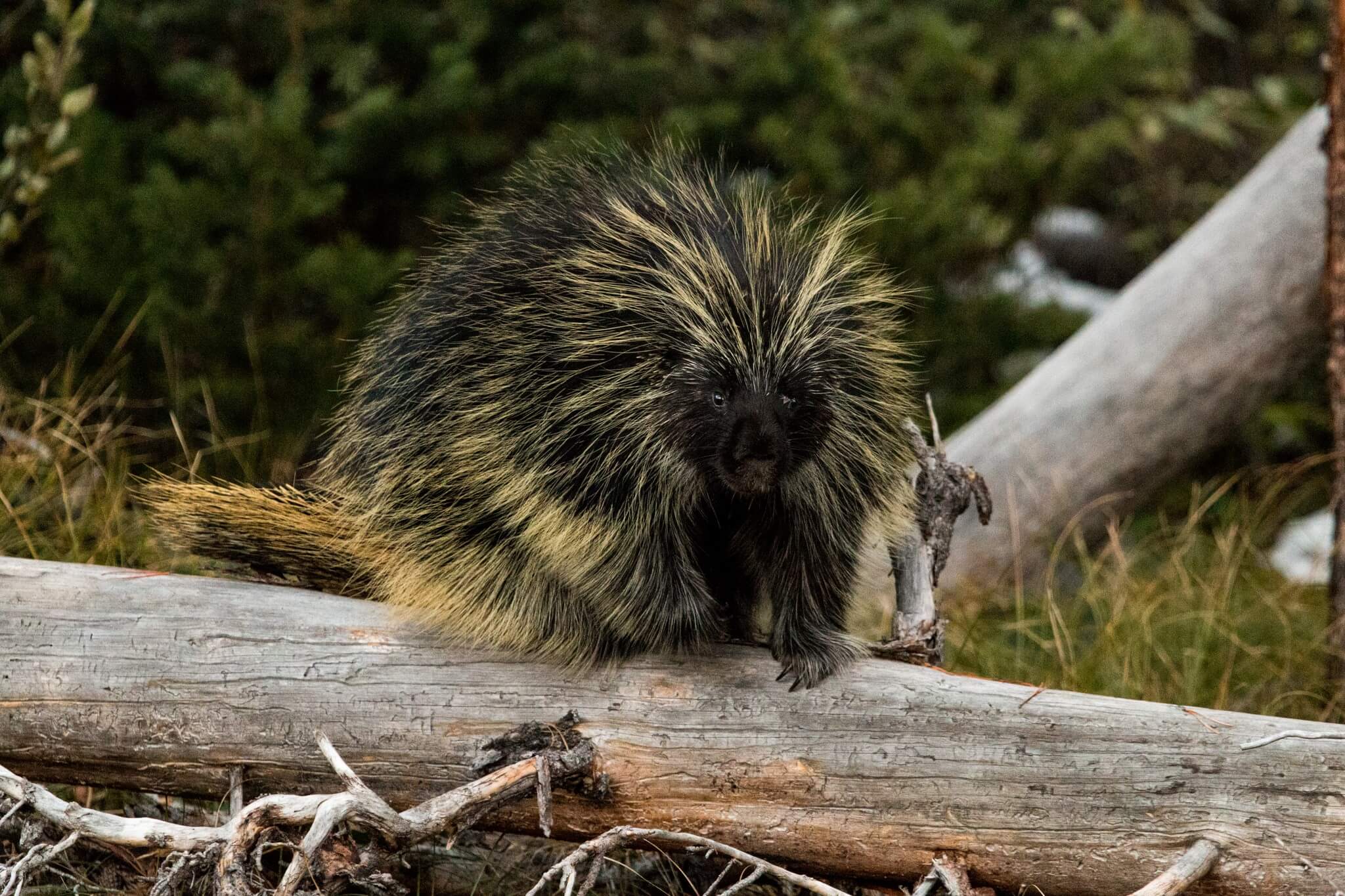
Overall color runs from dark brown to black. Many quills are banded in black and white or pale yellow, and the black-and-white pattern on the lower back and tail works as a warning to predators.
Like other rodents, porcupines have front incisors that keep growing throughout their lives, so constant gnawing is what keeps them from growing too long. The incisors have a reddish-brown front surface. That color comes from iron in the enamel, which makes the teeth stronger for chewing wood. The molars behind them grind down bark, needles, and leaves.
The feet are built for climbing. The soles are bare and pebbly, and long, curved claws help the animal grip bark. Each front foot has four claws and a small, vestigial thumb, while each hind foot has five claws. Tracks are about 3 inches long, with claw marks showing ahead of the pad, and the short legs give the porcupine a slow, rolling, side-to-side walk.
Quills and Defense
An adult porcupine carries about 30,000 quills. They are made of keratin, the same material as hair and fingernails, and most are around 3 inches long, though some reach 4 inches. Quills cover the back, sides, and tail, while the face, belly, and feet have softer fur and coarse hair instead. Each quill is hollow or filled with a spongy core, and the tip is covered with tiny, backward-facing barbs.
Porcupines cannot shoot their quills. The quills are loosely attached, so they pull free on contact and stay in whatever touched them. Once a quill is in skin, the barbs make it hard to remove, and the victim’s own muscle movements can work it deeper. A porcupine grows new quills to replace the ones it loses. Its quills also carry natural antibiotics, which may protect the porcupine when it is stuck by its own quills, such as after a fall from a tree.
A porcupine usually gives plenty of warning before any quills change hands:
- Scent: A patch of skin near the base of the tail, called the rosette, gives off a strong odor that biologists compare to goat or strong cheese. Biologist Uldis Roze identified the compound behind it as R-delta-decalactone.
- Sight: The banded quills around the rosette are easy to see, and the quills seem to glow a little in dim light, the hours when porcupines do most of their moving around.
- Sound: A threatened porcupine chatters and clacks its teeth and may slap its tail on the ground.
- Posture: It turns its back toward the threat, raises its quills, and swings its tail from side to side.
Raising the quills is a deliberate act. A muscle under the skin tightens and stands the quills up, so a relaxed porcupine with flat quills looks very different from one that feels threatened. For photographers, raised quills, a turned back, and chattering teeth are clear signs that you are too close.
Habitat and Range
Porcupines handle a wide range of climates and elevations. Most live in forests, but they also use shrublands, grasslands, and deserts. In Zion National Park, they are most common in high-elevation forests, yet they also live in lower riparian areas and desert.
Good habitat usually offers two things: plants to eat and safe places to rest. By day, a porcupine might rest in a hollow tree or log, the fork of a big tree, a cave, a pile of rocks, or an empty building. In Acadia National Park, porcupines live in both deciduous and boreal forests, find shelter among the rocks and boulders of the granite mountains, and favor hemlocks for cover and food. They eat hemlock needles and small branches but leave the bark alone because of its tannins.
Alaska has porcupines in nearly all of its wooded country. They are absent from Prince of Wales Island and nearby islands in southern Southeast Alaska, and evidence suggests they never colonized those islands after the last ice age.
Some places where porcupines were once seen regularly now have few records. Porcupines used to be spotted among the cottonwoods in the dunefield at White Sands National Park, but there have been almost no reported sightings there since the mid-1990s, and it is uncertain whether they remain. Biologists have also seen numbers drop in parts of Utah and northwestern Montana, and no one is yet sure why.
Behavior and Diet
Porcupines are mostly nocturnal and usually solitary. They spend much of the day resting in trees or sheltered spots and move slowly when they travel on the ground. A typical home range covers about 25 to 35 acres, though some studies have found ranges of 70 acres or more.
Porcupines are strict herbivores, and their menu changes with the seasons:
- Winter: The inner bark of trees and conifer needles. Alaska porcupines get through winter mostly on spruce needles and the inner bark of spruce, birch, and hemlock. Along the Little Missouri River, porcupines favor the inner bark of cottonwood, juniper, and ash.
- Spring and summer: Buds, young leaves, small twigs, grasses, berries, and the leaves of shrubs and wildflowers.
- Minerals: Shed antlers and old bones, which they gnaw for calcium and salt.
Plants contain very little sodium, so porcupines go looking for salt, especially in spring. They chew on natural salt licks, road salt, plywood glue, some paints, and tool handles that carry traces of human sweat. Studies suggest porcupines are picky eaters, too. They learn which foods are most nutritious at different times of year and return to them.
Their feeding leaves clues. Look for pale patches where bark has been stripped away, often far up the trunk or on upper limbs. You may also see small test bites, where a porcupine tasted the bark and decided to move on.
Porcupines are strong climbers. Long, curved claws grip the bark, and stiff bristles under the tail brace the animal like a kickstand. They are not perfect climbers, though. In one study, 30 percent of the porcupines examined had healed bone fractures from falls. They are also good swimmers, since their hollow quills help keep them afloat.
Biologists consider porcupines ecosystem engineers. By pruning tree limbs and dropping clipped branches, they move nutrients from the canopy to the forest floor, and their food choices help shape which plants grow where.
Winter and Seasonal Life
Porcupines do not hibernate. They stay active all winter and spend much of the season feeding in trees. A thick layer of body fat and dense underfur help them handle the cold, and during severe weather several porcupines may share a den. The rest of the year, adults mostly live alone.
Their year follows a steady pattern:
- Spring: Porcupines switch to buds and new leaves and go looking for salt. Young are born in spring or early summer.
- Summer: Leaves, grasses, and berries make up much of the diet. Alaska porcupines feed on fresh birch, aspen, willow, and cottonwood leaves early in the season, then switch as the leaves become loaded with bitter tannins.
- Fall: Breeding season. A male searching for a mate may roam over an area as much as five times larger than usual.
- Winter: Bark and needles carry them through, with dens in rock crevices, hollow logs, or thick tree cover.
Courtship is noisy. Porcupines make sounds ranging from whimpers to screams, and courtship includes a variety of calls and a courtship dance. When more than one male is interested in the same female, they fight with their teeth and quills, and the largest, heaviest male usually wins.
Fall and winter are also good seasons to look for porcupines in deciduous trees. Once the leaves drop, a dark, rounded shape high in a cottonwood is much easier to pick out.
Porcupettes
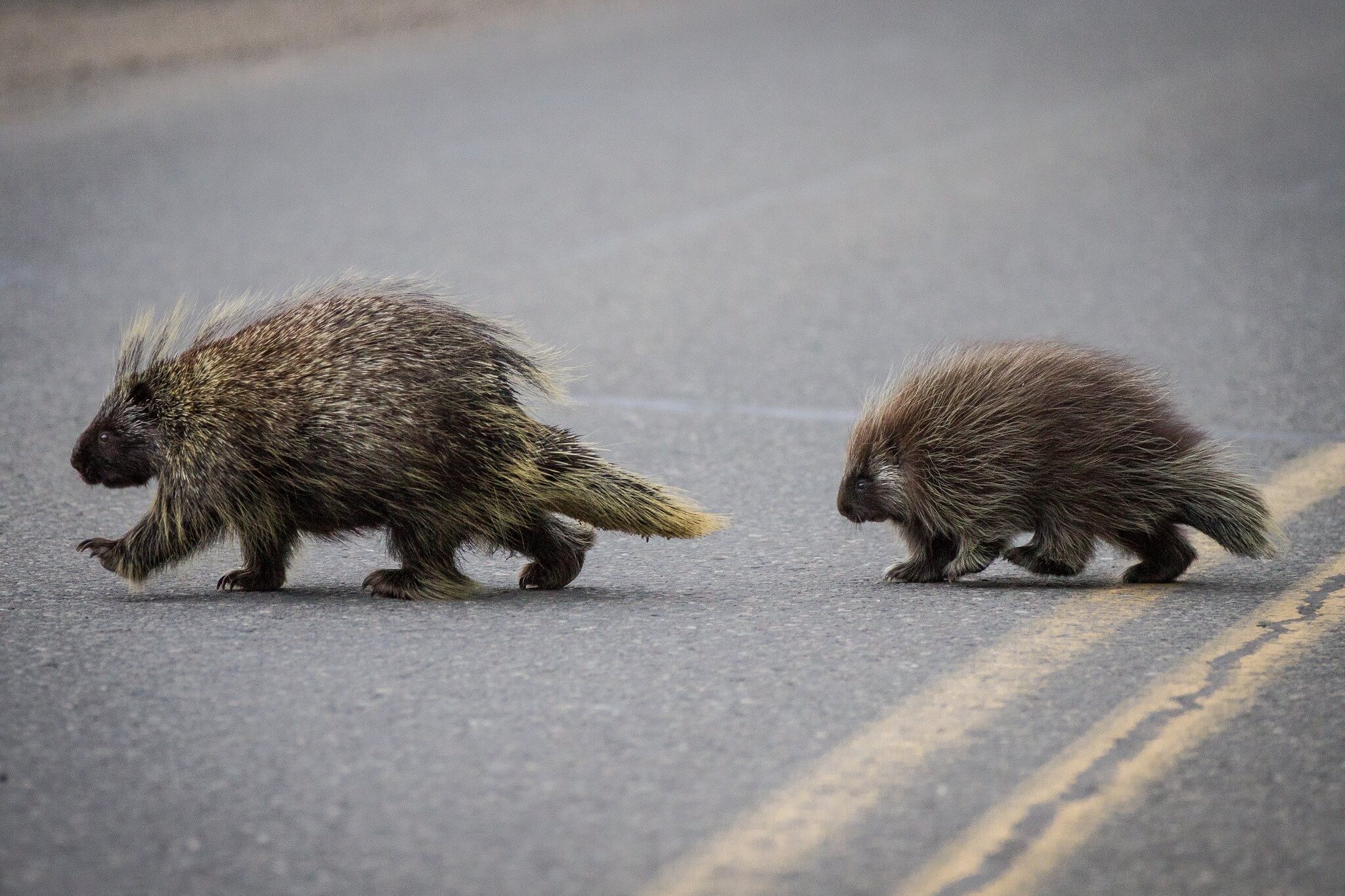
A baby porcupine is called a porcupette. After a pregnancy of about 210 days, which is extremely long for a rodent, a female gives birth to a single young in spring or early summer.
Porcupettes are well developed from the start:
- Size: About 1 to 2 pounds and 10 inches long at birth.
- Eyes: Open at birth.
- Quills: Soft at birth, but they dry and harden within a few hours.
- Movement: Able to follow its mother soon after birth, though it cannot climb large trees for several weeks.
A young porcupine starts eating some plants within a few weeks, but its mother keeps nursing it for about three and a half months. Through the summer, the young porcupine stays close and learns where to find dens and food trees. Weaning is finished by fall. Around October the young porcupine leaves to live on its own, just as its mother is ready to breed again.
Females can breed at about 12 months old and males at about 24 months. Wild porcupines can reach about 18 years of age, which is old for a rodent.
If you come across a porcupette, watch from a distance and never try to pick it up.
Predators
Quills stop most predators, but not all of them. Animals known to hunt porcupines include:
- Fishers: These members of the weasel family stand about the same height as a porcupine, which lets them attack face to face. A fisher bites at the porcupine’s quill-free face again and again, then flips it over to reach the belly.
- Mountain lions: They also kill porcupines by flipping them onto their backs.
- Other predators: Bobcats, coyotes, wolves, lynx, wolverines, bears, and great horned owls.
A failed attack can be costly. Young, inexperienced predators sometimes end up with a mouthful of quills, and some animals have starved because quills kept them from eating. Trying to paw the quills out can drive them deeper.
Fishers once lived across Washington, including the Olympic Peninsula, but decades of over-trapping wiped them out of the state by the early 20th century. In January 2008, 12 fishers from British Columbia were released in Olympic National Park, and 78 more followed over the next three years. Follow-up work from 2013 through 2016 confirmed that 10 of the released fishers had survived and that the population now included two later generations of offspring.
Porcupines, Pets, and People
Porcupines rarely bother people, but dogs are another story. In December 2018, a husky on a winter hike up Cadillac Mountain in Acadia National Park pulled toward a porcupine and came away with hundreds of quills in the roof of its mouth, gums, snout, and paws. Park rangers helped get the dog to a veterinarian, and it recovered.
Leashes help prevent this. Acadia National Park requires pets to stay on a leash of six feet or less. Even a brief slip can go badly: on Parkman Mountain, two dogs ran into a porcupine after their owner lost hold of the leash. If a pet is quilled, get it to a veterinarian rather than trying to pull the quills yourself.
The salt drive gets porcupines into trouble too. They gnaw on axe handles, plastic tubing, plywood, and painted surfaces, and in Alaska they are known for raiding gardens at night. Strawberry leaves are a favorite, and a porcupine can strip an entire row.
People have lived alongside porcupines for a long time. The name comes from the Latin words porcus and spina, meaning thorny pig, and older nicknames include quillpig, quillback, and porky. In Maine, porcupine quills have been used in Wabanaki art for generations.
National Park Presence
Porcupines live in many of the 63 designated U.S. National Parks. For photographers, porcupines can be found in the following parks:
According to National Park Service NPSpecies records, porcupines are listed as common in Crater Lake, Glacier, Grand Canyon, Grand Teton, Kenai Fjords, Theodore Roosevelt, Wind Cave, and Yellowstone National Parks. In many other parks, abundance is listed as uncommon, rare, or unknown, which partly reflects how hard a nocturnal, tree-dwelling animal is to count. NPSpecies lists porcupines as non-native at Acadia National Park and Olympic National Park, even though both parks fall within the species’ natural range. White Sands National Park still lists porcupines as present, despite almost no reported sightings since the mid-1990s.
North American Porcupine Photography Tips
Park pages and NPS photos point to several good places to look:
- Theodore Roosevelt: Cottonwood stands along the Little Missouri River. Look high in the trees in fall and winter, and watch the roadsides when driving through the park at night.
- Denali: The Denali Park Road and the area around Wonder Lake.
- Acadia: Park Loop Road near the Ocean Path and Gorham Mountain, and the forests and rocky slopes throughout the park.
- Lake Clark: Trees near the ranger station at Silver Salmon Creek.
- Zion: Higher-elevation forests, where trees with bark stripped high on the trunk are a good sign.
Give porcupines plenty of space. A porcupine that turns its back, raises its quills, or chatters its teeth is telling you to back off. Never try to move one off a trail or road, and keep pets leashed. Yellowstone National Park, for example, requires visitors to stay at least 25 yards from most wildlife, and many other parks have similar rules.
Timing matters. Because porcupines are mostly nocturnal, early morning and evening offer the best chance of finding one on the move. During the day, scan trees for a dark, rounded shape and look for fresh bark scars. A resting porcupine often stays put, which gives you time to work on composition. Try to find an angle that shows the face, and use the soft light near sunrise or sunset to bring out the pale quill tips.
A telephoto lens is essential for photographing North American porcupines responsibly. If you already own or want to own a professional-grade mirrored camera like the Canon EOS 5D Mark IV Full Frame Digital SLR, we recommend using a Canon EF 100-400mm f/4.5-5.6L IS II USM Lens zoom lens for wildlife photography. If you have or are interested in a newer mirrorless model like the Canon EOS R5 Full-Frame Mirrorless Camera, we recommend using a Canon RF100-400mm F5.6-8 IS USM for long-distance shots.
Not quite ready to invest in traditional professional-grade camera equipment but want to enhance the quality of your cell phone photographs? Consider using a Moment Tele 58mm Mobile Lens II for improved reach, and use a Moment camera case with a lens mount to attach it to your phone. Since cell phones generally cannot provide the same reach as a dedicated telephoto camera lens, never compensate by moving dangerously close to wildlife.
No photograph is worth disturbing an animal or putting yourself or others at risk.
A Note About Porcupine Taxonomy
Readers researching porcupines may encounter several scientific names. This page uses:
Erethizon dorsatum
However, some National Park Service records and older references use subspecies names, including:
Erethizon dorsatum epixanthum, Erethizon dorsatum couesi, Erethizon epixanthum, and Erethizon dorsatus
Lassen Volcanic National Park’s NPSpecies record uses Erethizon dorsatum epixanthum as its main name, with the common name yellow-haired porcupine. Several other western parks, including Big Bend, Carlsbad Caverns, Great Basin, Rocky Mountain, and Yosemite National Parks, list epixanthum as a synonym, and Guadalupe Mountains National Park lists couesi. The species name dorsatum comes from the Latin word for back, fitting for an animal whose back is covered in quills.
For consistency throughout National Park Photographer, this page uses Erethizon dorsatum while recognizing the other names visitors may encounter.
Final Thoughts
Porcupines are slow, quiet, and easy to overlook, but they shape the forests they live in and hold their own against most of the predators that share those forests. They are also one of the few large mammals you might find simply by looking up.
Whether it’s a porcupine high in a cottonwood along the Little Missouri River, a parent and young crossing the Denali Park Road, or one resting on a branch at Silver Salmon Creek, a porcupine sighting rewards a patient photographer. Move slowly, scan the trees, and give every porcupine plenty of room.
Want more information about the amazing wildlife that call our National Parks home? Take a look at our National Park Wildlife page to explore the various parks and the animals in them. Planning on visiting a National Park in the near future? Be sure to follow park regulations, practice Leave No Trace principles, and prioritize both your safety and the well-being of wildlife while exploring.
Joyful Journeys!
Bonnie, Co-Owner, National Park Photographer
Want to learn more about North American porcupines? Check out the additional resources below!
North American Porcupine Books & Field Guides
- The North American Porcupine
- Peterson Field Guide to Mammals of North America
- Mammal Tracks & Sign: A Guide to North American Species
- 10×42 Binoculars for Wildlife Viewing
- Monocular for Wildlife Viewing
- Camera Bean Bag for Wildlife Photography
Please note, by making purchases through our affiliate links, you are supporting our mission to celebrate and showcase our National Parks and the photographers who frequent them. As an Amazon Associate, National Park Photographer earns from qualifying purchases at no cost to you. We appreciate your support.
References & Additional Resources
- National Park Service — Acadia National Park: Acadia Porcupines
- National Park Service — Acadia National Park: Keep Your Distance: Porcupine Leaves Lasting Impression
- National Park Service — Fast Facts: Porcupines
- National Park Service — Theodore Roosevelt National Park: Porcupine
- National Park Service — Zion National Park: Porcupine
- National Park Service — White Sands National Park: Porcupine
- National Park Service — Jewel Cave National Monument: Porcupine
- National Park Service — Olympic National Park: Fisher Reintroduction
- National Park Service — Yellowstone National Park: Safety
- Alaska Department of Fish and Game — North American Porcupine Species Profile
- Alaska Department of Fish and Game — Alaska’s Thorny Pig
- National Park Service — NPSpecies Species Search
Do you want to be featured on National Park Photographer?
Why wait! Contact us today at nationalparkphoto@gmail.com for a chance to be a Featured National Park Photographer!