Few animals in our National Parks are as famous, or as rarely seen, as the mountain lion. Known also as the cougar, puma, panther, and catamount, this big cat ranges from deserts to dense forests and high mountain valleys. Most visitors will never see one. When a lion does appear, it is often a brief glimpse along a park road at dawn or dusk, or a photo from a remote camera.
Mountain lions (Puma concolor) are the top predators in many western parks. They hunt deer and elk, help keep those herds in balance, and move quietly across territories that can cover hundreds of square miles. You can find them in parks such as Yellowstone, Glacier, Yosemite, Big Bend, Grand Canyon, Black Canyon of the Gunnison, and Capitol Reef. In Everglades, the same species survives as the endangered Florida panther.
Learning about animals like mountain lions can significantly enhance wildlife photography skills by providing valuable insights into animal behavior, habitat, and physical characteristics. Understanding an animal’s habits can allow photographers to better anticipate and capture unique and authentic moments. Knowledge of an animal’s habitat may also help in selecting the best locations and times for wildlife viewing and photography, while familiarity with physical characteristics is essential for accurately identifying wildlife in the field. If wildlife photography or simply wildlife viewing are of interest to you, then you’ve come to the right place! Together, let’s learn more about what makes mountain lions so special.
Physical Characteristics
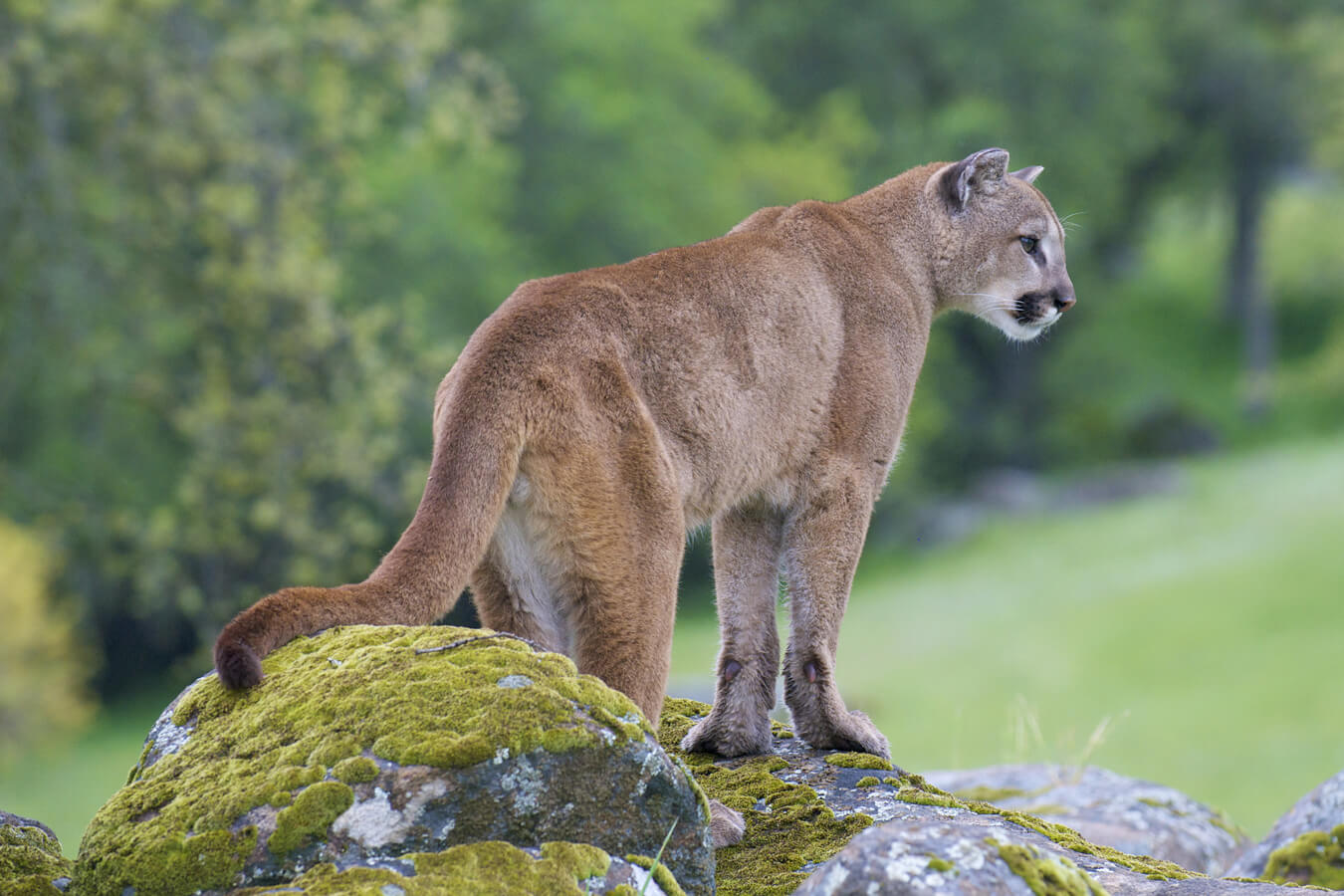
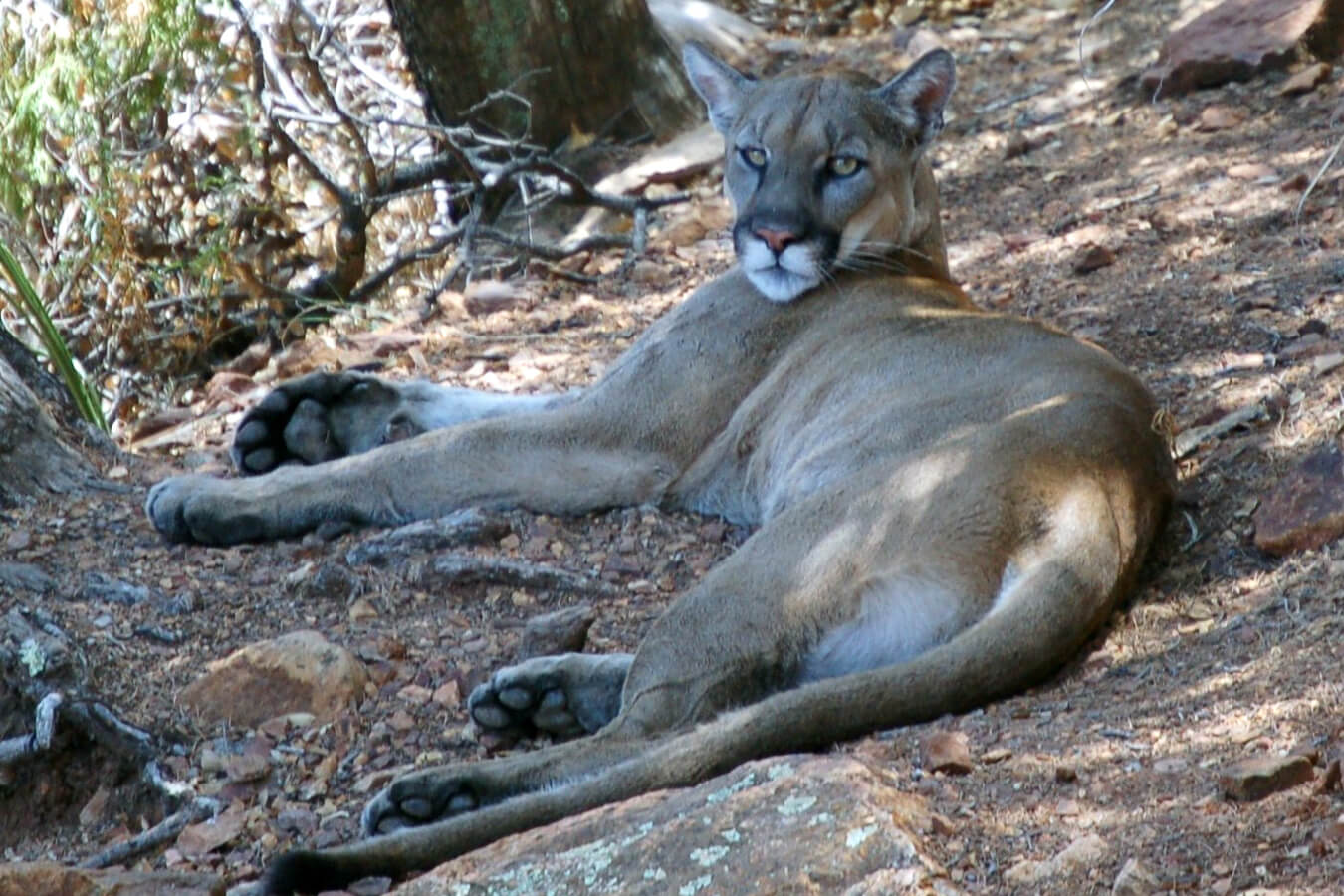
Mountain lions are big cats with long bodies, round heads, and erect ears. Adults stand about two to three feet tall at the shoulder and measure six to seven and a half feet from nose to tail tip. In Rocky Mountain National Park, males can reach up to 200 pounds and eight feet long, with about a third of that length in the tail. Females are typically smaller.
Weights vary by region. Yellowstone’s adult males weigh 145 to 170 pounds and its females 85 to 120. Yosemite’s lions run lighter, at 130 to 150 pounds for males and 65 to 90 for females, with males reaching more than eight feet long and females about seven feet.
The coat is unspotted and tawny to tan-brown, with pale, almost white fur on the throat, belly, and insides of the legs. Black marks the tail tip and the backs of the ears. Powerful neck and jaw muscles let a lion grasp and carry prey, and long hind legs make it an impressive jumper. A mountain lion can leap as high as 18 feet straight up, cover 40 feet in a single bound, and run 45 miles per hour in short bursts.
Their senses are tuned for low light. Mountain lions can see with one-sixth of the light humans need. They have sharp, retractable claws, and their teeth include carnassials, blade-like teeth built to slice meat. Despite their size, mountain lions cannot roar. They can let out a penetrating scream instead.
Among North American cats, only the jaguar grows bigger than the cougar, and the jaguar’s range reaches into Arizona and New Mexico. Some park pages, including Glacier’s, simply call the mountain lion the largest feline in North America.
Habitat and Range
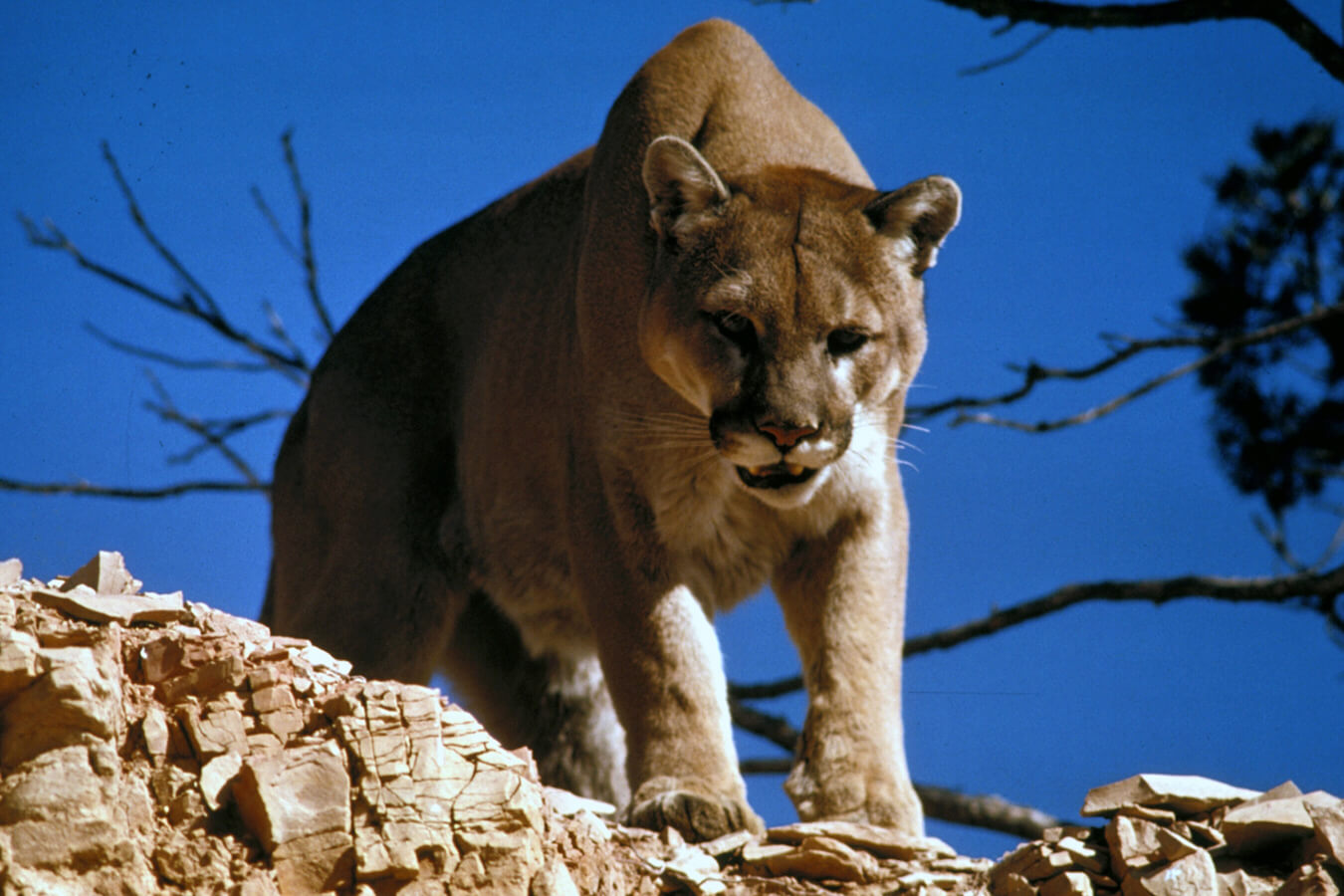
Mountain lions have one of the widest ranges of any land mammal in the Americas. Their range stretches from Canada’s Yukon all the way to the southern Andes, across many kinds of habitat.
In the parks, they use almost every kind of landscape. In Glacier National Park, lions turn up in nearly every habitat but favor woodland, where cover lets them creep close to prey. At Grand Canyon, the forested North and South Rims are where they spend most of their time. In Yellowstone, they favor broken, rocky ground and forest, where there is cover for stalking prey and for avoiding wolves and bears. In California, the cats range across 10,000 feet of elevation, from the coast to the high country, and roughly half of the state is thought to be ideal lion habitat.
Their home ranges are huge. Few mammals in the Western Hemisphere use as much ground as a mountain lion. Sizes vary by park: in Rocky Mountain, seasonal territories can reach 500 square miles and shift with the migration of elk and deer, while at Grand Canyon a typical home range is about 150 square miles, which means most of its lions live both in the park and on surrounding Forest Service lands. In the Santa Monica Mountains, an adult male typically covers about 150 square miles and an adult female about 50.
Light snow and year-round prey make Yellowstone’s northern range ideal cougar country. Cougars also live in much of the park’s interior in summer but leave in winter when prey moves to lower elevations.
Behavior
Mountain lions are solitary. Apart from mating and when a female is raising young, they travel and hunt alone. Males always travel alone. Male territories don’t overlap, yet one male can usually cross another’s ground without a fight, and females live in ranges that touch or share space with male territories.
Lions mark their areas carefully. They leave mounds scented with urine and scratch marks on trees, markers known as scrapes. A female’s scrape tells males whether she is ready to mate; a male’s scrape announces him to females and tells rival males the area is already claimed.
Competition can be deadly. Adult males defend their ground and may kill rival males they find there. In non-hunted populations like Yellowstone’s, the males that have lived in an area the longest are dominant and sire most of the litters.
Their busiest hours, at first and last light, line up with when deer are moving. They are primarily nocturnal, but at Capitol Reef National Park they stay active in every season and at any hour, peaking around sunrise and sunset.
Hunting and Diet
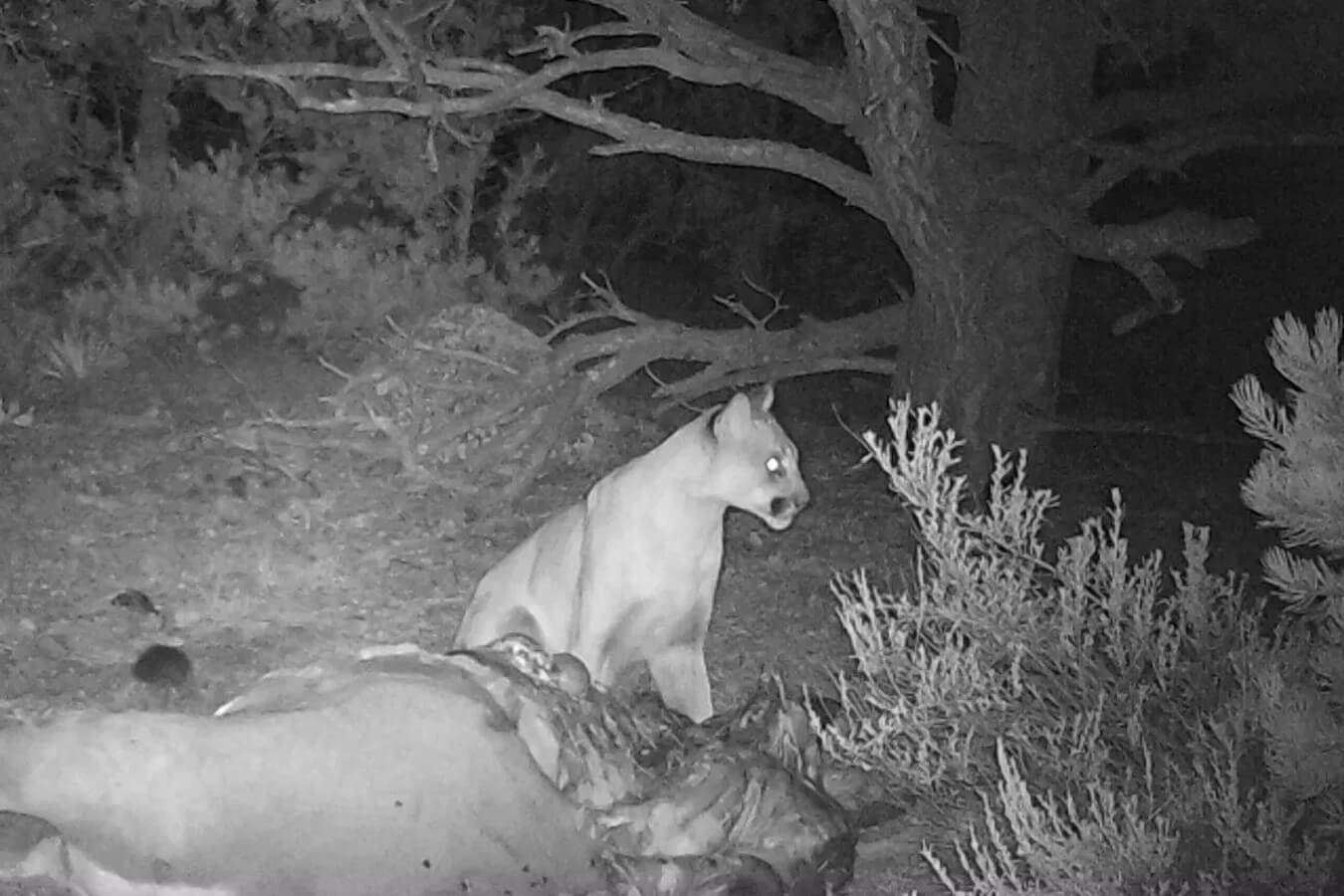
Mountain lions are ambush hunters. A lion can manage a short burst of speed, but its body is made for creeping up on prey. A lion moves quietly through trees, boulders, or other cover until it is within about 30 feet, then leaps onto the prey’s back with a suffocating neck bite. The fatal bite lands on the throat or where the skull meets the neck.
Deer and elk are the main prey. At Grand Canyon, lions prey primarily on mule deer and elk, animals that can be four or five times bigger than they are, and armed with hooves, antlers, and horns. Glacier’s lions prey on bighorn sheep, moose, elk, and deer, and they take smaller animals too. In Yellowstone, elk made up 74 percent of 473 known or probable cougar kills documented between 1998 and 2005, and more than half of those elk were calves.
Lions also take smaller animals when the chance comes. The list of smaller prey includes skunks, marmots, squirrels, rabbits, and porcupines, and in Yellowstone also red squirrels, grouse, and even moose. In Yosemite, lions have been seen chasing, killing, or eating raccoons and coyotes in developed areas.
A big kill lasts a while. A lion may haul a carcass over 1,000 feet before stopping, then cover it with branches and leaves and return to feed several times. In Yellowstone, a cougar typically feeds on an elk or deer for three to four days, then spends four to five days looking for its next kill. Research there found that a cougar killed an elk or deer roughly once every 9.4 days. In the Santa Monica Mountains, a lion usually eats around one deer a week, and mule deer made up 87 percent of more than 700 kills analyzed by researchers.
Lions don’t always keep their meals. Both black bears and grizzlies steal cougar kills, and wolves displace cougars from about 6 percent of their elk carcasses. Coyotes sometimes attempt it, too, and some end up killed by the cat.
Raising Kittens
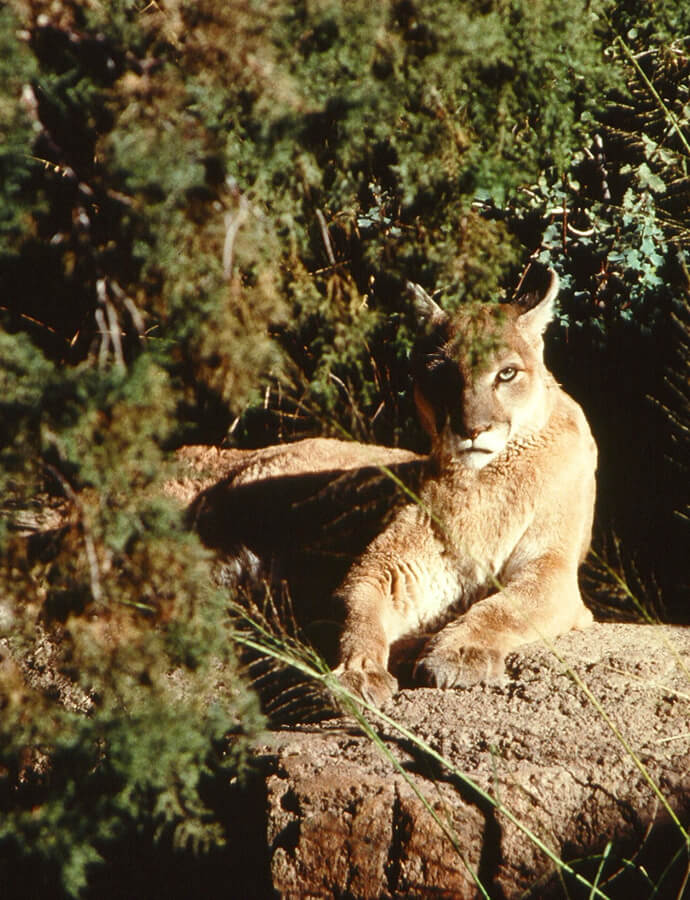
Mating and births can happen in any month, though most populations have a busy season. In Yellowstone, breeding happens mainly from February through May, and the bulk of kittens arrive from June to September. A female typically gives birth about once every two years, following roughly three months of pregnancy. Litter sizes vary by source: two or three cubs at Rocky Mountain, three to four kittens in Yellowstone, and one to six cubs at Grand Canyon. Only the mother raises them.
Kittens are born with spots, blue eyes, and ringed tails. A newborn weighs roughly a pound and puts on about another pound each week for its first eight to ten weeks. The mother dens in a secure spot with plenty of rock or vegetation, making short hunting trips and returning to nurse. After eight to ten weeks, she hunts over a larger area and moves the kittens to her kills.
Kittens start following their mother on hunts at six weeks and can hunt well on their own by six months. In Yellowstone, most young lions head off on their own at 14 to 18 months. About 99 percent of young males leave, traveling 50 to 400 miles, while 70 to 80 percent of young females disperse 20 to 150 miles. As a result, Yellowstone’s resident adult males mostly come from somewhere else, which helps maintain genetic diversity.
Survival is not easy. In Yellowstone, about half of kittens survive their first year, adult males live an average of eight to ten years, and females twelve to fourteen. The average in Rocky Mountain is about 10 to 13 years.
History, Ecology, and Research
Mountain lions were once targeted for removal. Early in the 1900s, wolves and cougars were hunted down across the lower 48, national parks included. Cougars were largely eliminated from Yellowstone by the 1930s. The species survived in the West thanks to its secretive nature and rugged habitat, and cougars naturally returned to Yellowstone by the early 1980s. In California, lions were a bountied predator from 1907 to 1963 before Proposition 117 banned almost all killing of mountain lions in 1990.
Today, lions play an important role. By feeding on mule deer and elk, mountain lions keep those herds in check, which protects the plants that provide habitat for many other species. At Grand Canyon, the lion is the region’s only remaining large predator.
Parks are also some of the best places to study them. Yellowstone has run cougar research since 1987, and biologists estimated 29 to 45 cougars on the northern range between 2014 and 2017. Since 2016, GPS collars have tracked four to seven cougars a year. In Yosemite, a 2003 study of 18 known lions estimated about one mountain lion per 25 square miles and found no aggressive behavior toward visitors. Vehicle strikes are a common cause of death for Grand Canyon’s lions, so drive with care, especially on East Rim Drive.
Near Los Angeles, the National Park Service has followed 112 lions in the Santa Monica Mountains and nearby areas since 2002. Roads and development have isolated the population, and genetic diversity there is among the lowest ever documented in the West. Vehicle strikes have killed at least 32 lions in the study area, and 28 of 29 lions tested were exposed to rat poison. A wildlife crossing over the 101 Freeway is meant to reconnect the population.
Mountain Lion Safety
Attacks are rare. Lightning poses a far greater risk to you than a mountain lion does. Still, lions can be unpredictable. Visitors to Big Bend National Park report more than 150 lion sightings each year, mostly along roads, and several encounters there have ended in attacks since 1984. Young lions that have just been pushed out to hunt for themselves account for most attacks.
Lower your risk before you go. Hike in groups and keep children close, never letting them run ahead. Wild lions held in captivity have shown particular interest in children. Talk or make other noise as you hike, particularly beside noisy water. Avoid carcasses, since lions may return to a kill over several days, and never feed deer or other wildlife, which can draw lions into developed areas. Rocky Mountain asks hikers to keep 120 feet or more, roughly three bus lengths, between themselves and a mountain lion.
If you meet a lion, your job is to show it that you are not food and could fight back:
- Do not approach. Give the lion a way to escape.
- Do not run. Running can trigger a lion’s instinct to chase.
- Stand tall and do not crouch or bend over. Pick up small children without bending down or turning away.
- Make yourself look larger by raising your arms or opening your jacket, and speak firmly in a loud voice.
- Back away slowly. If it keeps coming, throw sticks or rocks at it.
- If attacked, fight back while staying on your feet. People have driven off attacking lions using whatever they had, from rocks and sticks to hats, jackets, garden tools, and their bare hands.
Most NPS pages advise keeping eye contact with the lion. Let a ranger know about any lion you see or run into.
National Park Presence
Mountain lions live in many of the 63 designated U.S. National Parks. For photographers, mountain lions can be found in the following parks:
According to National Park Service NPSpecies records, mountain lions are listed as common in Great Basin, Mesa Verde, and Olympic. Most other parks list them as uncommon, rare, or of unknown abundance, which reflects how hard these cats are to see and count. The Everglades record is the Florida panther (Puma concolor coryi). Mountain lions are listed as historical in Shenandoah and Indiana Dunes and as unconfirmed in Great Smoky Mountains and Voyageurs. Grand Teton and Petrified Forest list them as probably present, so those parks are not in the table above.
Mountain Lion Photography Tips
Photographing a wild mountain lion takes luck, not planning. Never search for a lion, follow tracks to a den, or approach a kill. A lion’s presence is often revealed only by its tracks or scat, and Yellowstone biologists rely on remote cameras to study these secretive cats.
Your best odds are from a vehicle. In Big Bend, most of the 150-plus yearly sightings happen along park roads. Plan drives for early morning and evening, when lions are moving most. In Yellowstone, the northern range holds cougars year-round.
If you see a lion, stay in your car or at a safe distance, keep your group together, and let the cat move on. A long lens lets you photograph from far away. Report the sighting to a ranger afterward. Even when you don’t see a lion, tracks, scrapes, and scratch marks on trees are worth photographing as signs of a hidden predator.
A telephoto lens is essential for photographing mountain lions responsibly. If you already own or want to own a professional-grade mirrored camera like the Canon EOS 5D Mark IV Full Frame Digital SLR, we recommend using a Canon EF 100-400mm f/4.5-5.6L IS II USM Lens zoom lens for wildlife photography. If you have or are interested in a newer mirrorless model like the Canon EOS R5 Full-Frame Mirrorless Camera, we recommend using a Canon RF100-400mm F5.6-8 IS USM for long-distance shots.
Not quite ready to invest in traditional professional-grade camera equipment but want to enhance the quality of your cell phone photographs? Consider using a Moment Tele 58mm Mobile Lens II for improved reach, and use a Moment camera case with a lens mount to attach it to your phone. Since cell phones generally cannot provide the same reach as a dedicated telephoto camera lens, never compensate by moving dangerously close to wildlife.
No photograph is worth disturbing an animal or putting yourself or others at risk.
Cougar, Puma, Panther, or Catamount?
Mountain lions have more common names than almost any other animal in North America. NPS pages use cougar, puma, panther, catamount, and even painter. Yellowstone’s NPSpecies record lists catamount, cougar, mountain lion, and puma, while Great Smoky Mountains lists the animal as panther.
All of these names refer to the same species. In Florida, the name panther stuck, and the state’s surviving population is known as the Florida panther. In the West, mountain lion and cougar are the most common names, which is why you will see both used on park pages.
A Note About Mountain Lion Taxonomy
Readers researching mountain lions may encounter several scientific names. This page uses:
Puma concolor
Because this cat goes by so many common names, National Park Service records and older references may list it as:
Felis concolor, Puma concolor coryi, Puma concolor oregonensis, Felis concolor kaibabensis, Puma concolor stanleyana, and Puma concolor hippolestes
Older sources placed the mountain lion in the genus Felis, and Glacier’s mammal page still uses Felis concolor. NPSpecies lists many regional subspecies names as synonyms: coryi for the Florida panther in Everglades, oregonensis for Olympic and Mount Rainier, kaibabensis for Great Basin and Zion, stanleyana for Big Bend, hippolestes for Badlands, missoulensis for Wind Cave, and azteca for Saguaro and Guadalupe Mountains.
For consistency throughout National Park Photographer, this page uses Puma concolor while recognizing the other names visitors may encounter.
Final Thoughts
Mountain lions are the hidden predators of our National Parks. They shape deer and elk herds, cross territories hundreds of miles wide, and leave behind tracks and scrapes far more often than they show themselves.
Their story is also one of recovery. After being nearly eliminated from places like Yellowstone, cougars returned on their own. Park research from Yellowstone to the Santa Monica Mountains continues to show what these cats need to survive, from connected habitat to safe road crossings.
If you are lucky enough to see one, enjoy the moment from a safe distance, keep your group together, and report the sighting to a ranger.
Want more information about the amazing wildlife that call our National Parks home? Take a look at our National Park Wildlife page to explore the various parks and the animals in them. Planning on visiting a National Park in the near future? Be sure to follow park regulations, practice Leave No Trace principles, and prioritize both your safety and the well-being of wildlife while exploring.
Joyful Journeys!
Bonnie, Co-Owner, National Park Photographer
Want to learn more about mountain lions? Check out the additional resources below!
Mountain Lion Books & Field Guides
- Path of the Puma: The Remarkable Resilience of the Mountain Lion
- Peterson Field Guide to Mammals of North America
- Glacier and Waterton Lakes National Parks Map (National Geographic Trails Illustrated)
- Mammal Tracks & Sign: A Guide to North American Species
- 10×42 Binoculars for Wildlife Viewing
- Monocular for Wildlife Viewing
- Camera Bean Bag for Wildlife Photography
Please note, by making purchases through our affiliate links, you are supporting our mission to celebrate and showcase our National Parks and the photographers who frequent them. As an Amazon Associate, National Park Photographer earns from qualifying purchases at no cost to you. We appreciate your support.
References & Additional Resources
- National Park Service — Yellowstone National Park: Cougar
- National Park Service — Rocky Mountain National Park: Mountain Lion
- National Park Service — Rocky Mountain National Park: Wildlife Safety
- National Park Service — Grand Canyon National Park: Mountain Lion
- National Park Service — Glacier National Park: Mammals
- National Park Service — Glacier National Park: Mountain Lion Safety
- National Park Service — Yosemite National Park: Mountain Lions
- National Park Service — Big Bend National Park: Mountain Lions
- National Park Service — Black Canyon of the Gunnison: Mammals
- National Park Service — Capitol Reef National Park: Mammals
- National Park Service — Mountain Lion Safety
- National Park Service — Lassen Volcanic National Park: Mountain Lion Safety
- National Park Service — Santa Monica Mountains: Lions in the Santa Monica Mountains
- National Park Service — Everglades National Park: Florida Panther Species Profile
- National Park Service — NPSpecies Species Search
Do you want to be featured on National Park Photographer?
Why wait! Contact us today at nationalparkphoto@gmail.com for a chance to be a Featured National Park Photographer!