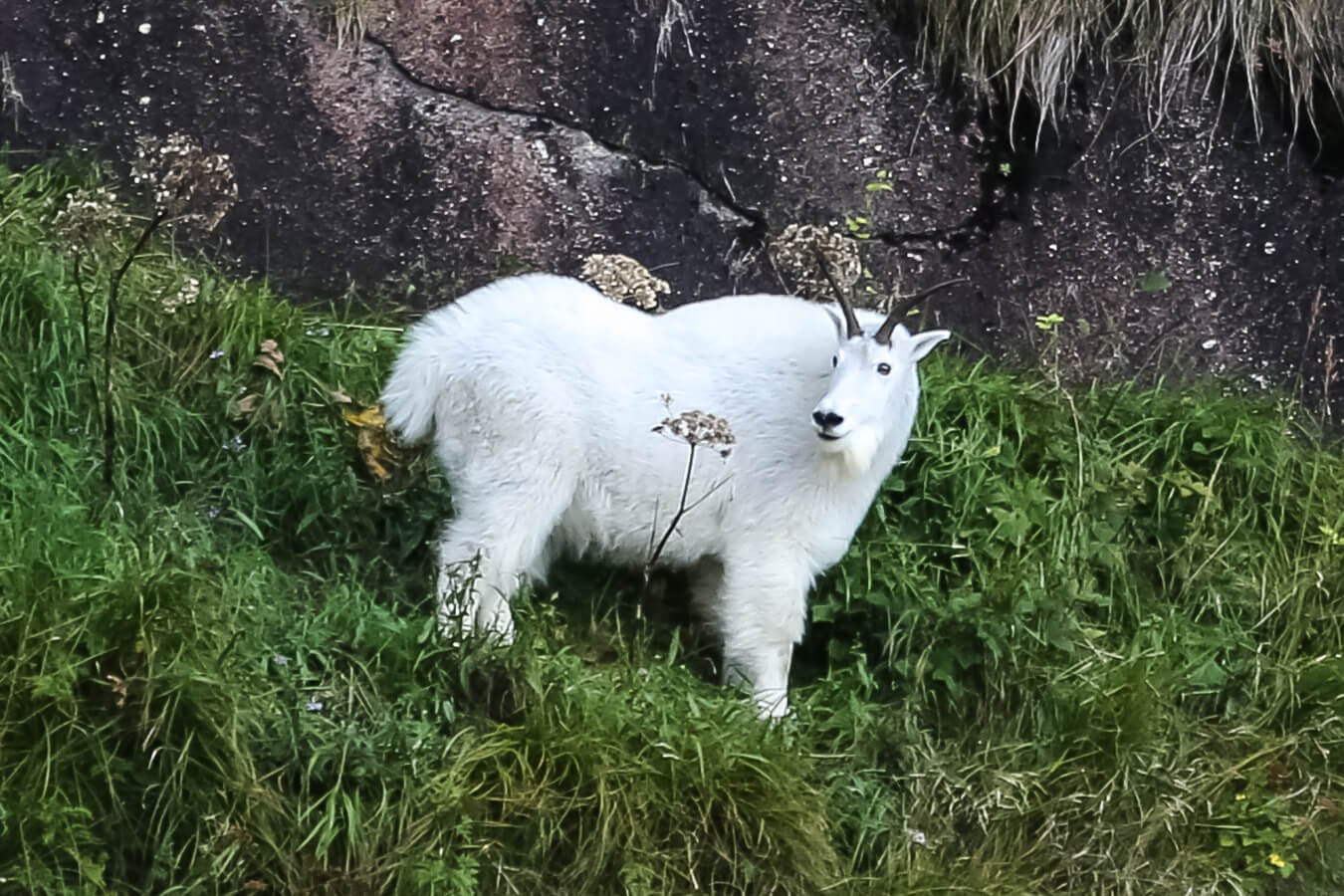
Mountain goats (Oreamnos americanus) live where few other animals can follow. Wrapped in shaggy white coats and armed with black dagger-like horns, they walk narrow ledges and nearly vertical cliffs as if they were sidewalks. Seeing one silhouetted against a glacier or a sheer rock face is one of the great experiences of mountain parks in the Northwest and Alaska.
Despite the name, mountain goats are not true goats. They are the only living member of their genus, and their nearest kin are Asia’s gorals and serows and Europe’s chamois. In some parks they are native icons, and in others they are introduced animals that managers have worked to remove. Mountain goats can be found in Glacier, Glacier Bay, Kenai Fjords, Mount Rainier, North Cascades, and other parks.
Learning about animals like mountain goats can significantly enhance wildlife photography skills by providing valuable insights into animal behavior, habitat, and physical characteristics. Understanding an animal’s habits can allow photographers to better anticipate and capture unique and authentic moments. Knowledge of an animal’s habitat may also help in selecting the best locations and times for wildlife viewing and photography, while familiarity with physical characteristics is essential for accurately identifying wildlife in the field. If wildlife photography or simply wildlife viewing are of interest to you, then you’ve come to the right place! Together, let’s learn more about what makes mountain goats so special.
Physical Characteristics
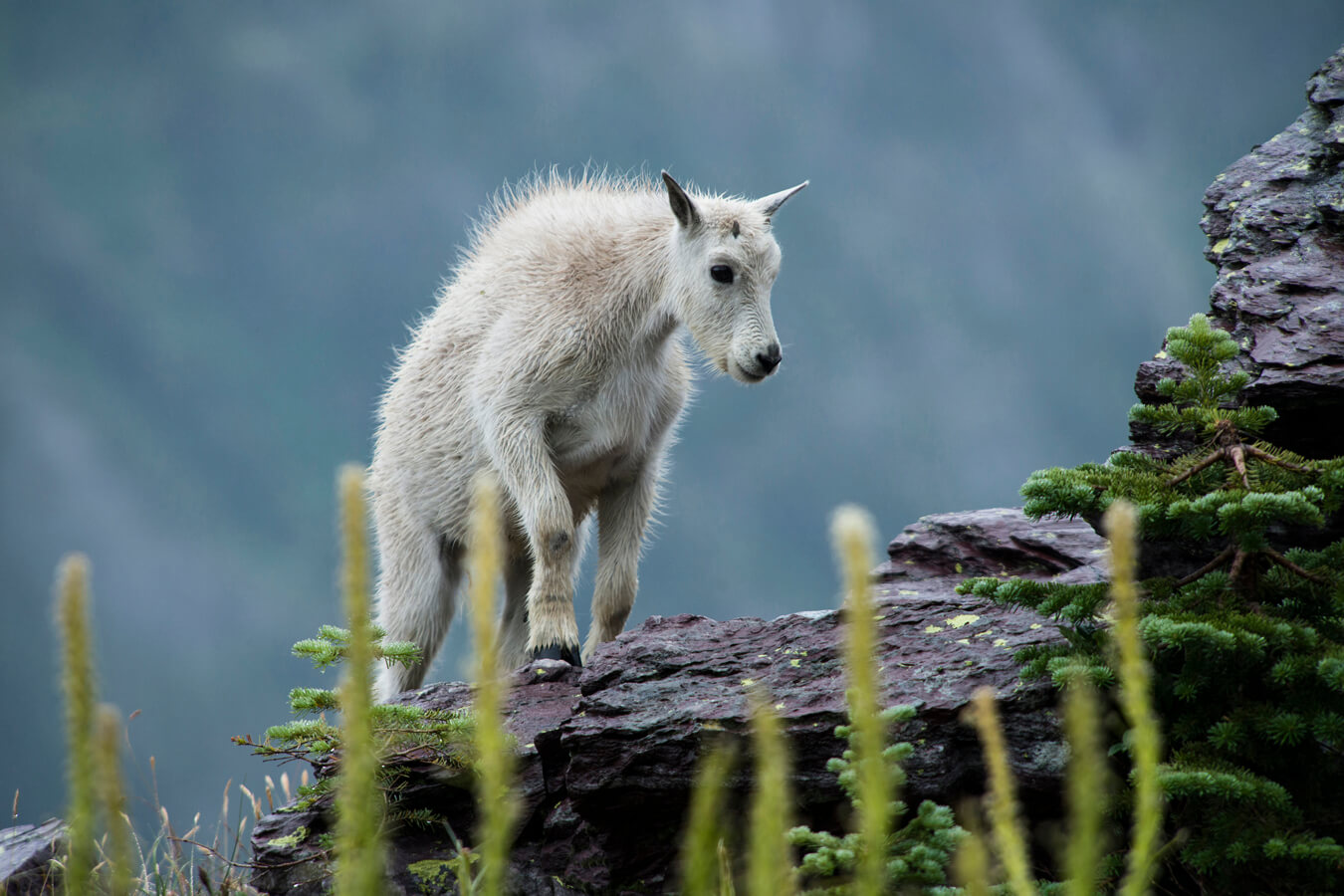
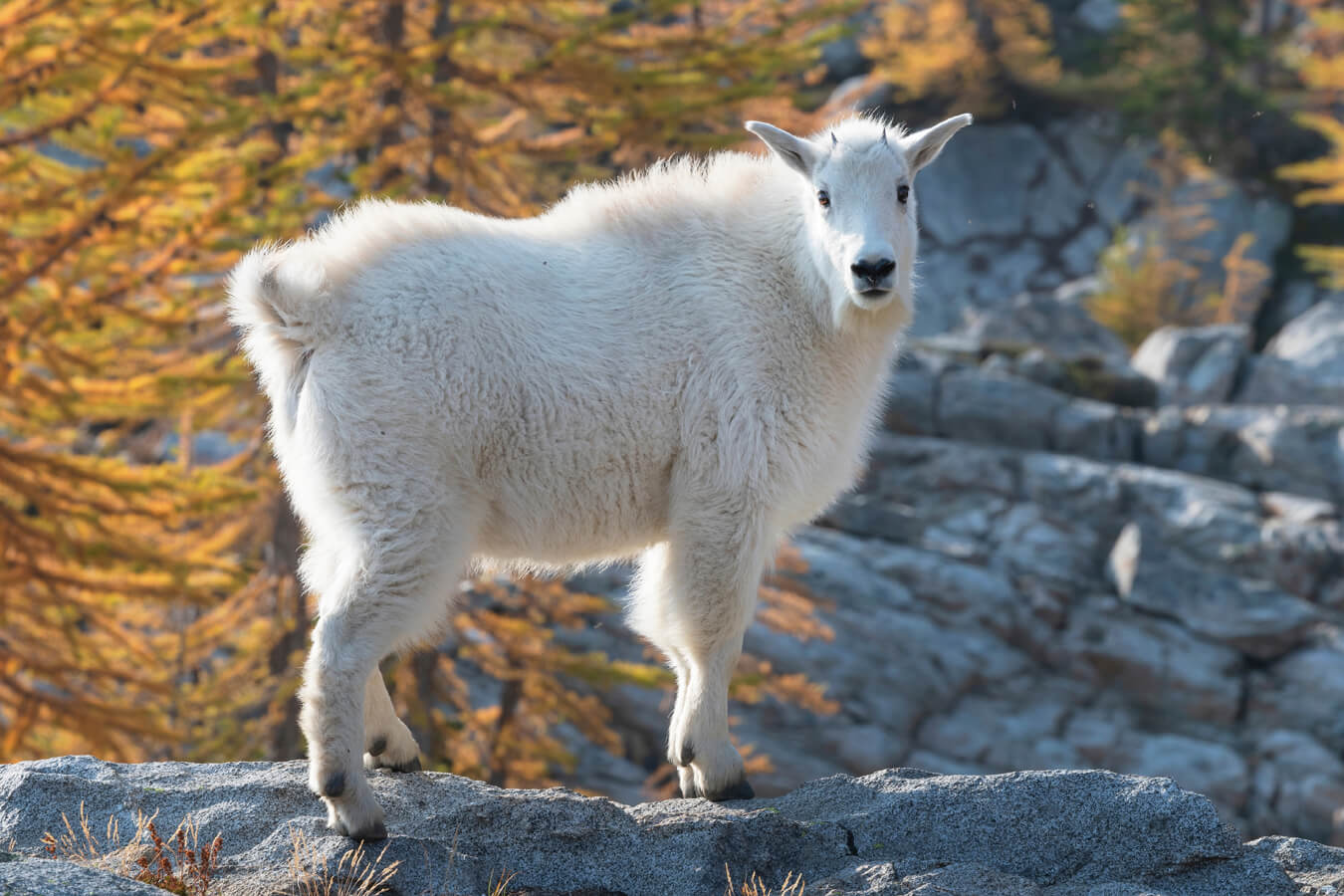
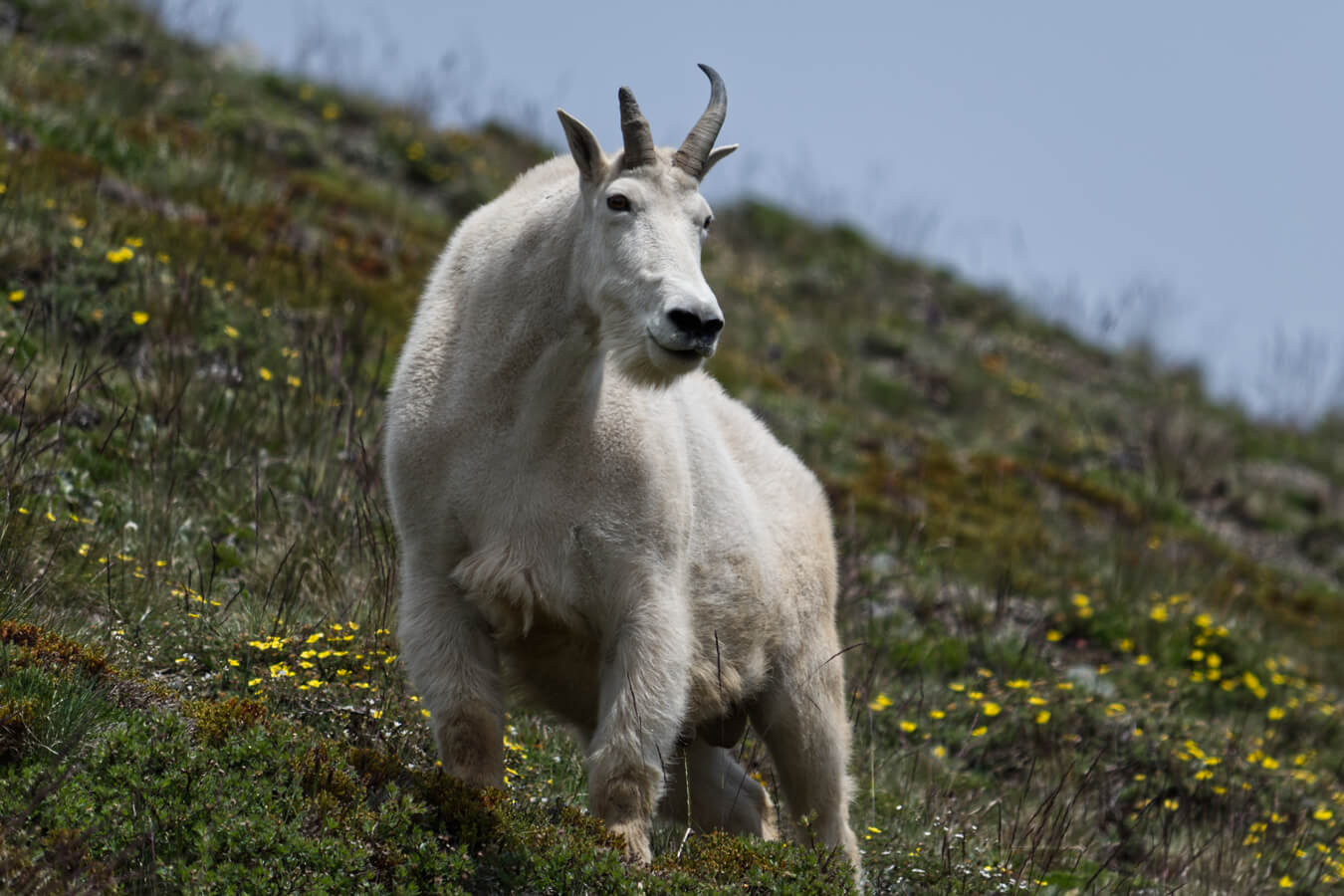
Mountain goats are big, compact, and muscular. Mature males, called billies, can weigh 300 pounds or more, and females, called nannies, about 150 pounds. Young are called kids. Males and females are hard to tell apart, since both wear shaggy white coats and curved black horns.
Both males and females have horns. They are black, shiny, and about 8 to 12 inches long. Like the horns of bighorn sheep, they grow annual rings that can be used to estimate age. One ring means a goat is two years old, two rings mean three, and the count continues from there. Compared with a male’s, a female’s horns are slimmer and straighter, and they are sometimes longer.
Their coat is built for brutal weather. A thick woolly underlayer topped by long, hollow guard hairs lets mountain goats ride out cold as deep as 50 below zero (Fahrenheit) and 100-mile-per-hour winds. At Kenai Fjords National Park, the coarse, hollow guard hairs grow nearly eight inches long.
The hooves are the real secret. Each hoof divides into two toes that work separately and can splay apart for grip. Soft, flexible inner pads with a hard outer edge grip rock, and dewclaws add traction. Powerful front shoulders carry them up slopes of 60 degrees or steeper. Those strong shoulder muscles also help them dig for food in winter.
Goats reach maturity at around two and a half, and wild ones typically live about a decade.
Habitat and Distribution
Mountain goats are found only in the northern latitudes of North America. Kenai Fjords places them in the steep, broken mountains of the continent’s northwest, a range that runs from Idaho and Washington up through British Columbia to Southcentral Alaska. Within it, herds are patchy and can be found anywhere from the coast to more than 10,000 feet up. Alaska’s goats occupy the southeastern Panhandle, and their range continues up the coastal mountains to Cook Inlet.
Cliffs are always nearby. Mountain goats live mainly in alpine and subalpine environments, but they also retreat into thick forest and creek bottoms to escape heat, cold, and wind. In North Cascades National Park in western Washington, goats summer above 5,000 feet near cliffs, snowfields, and wind. In winter, bands move down to south-facing old-growth forest with rocky outcrops, where warm exposure and valley winds keep ledges free of snow.
Glacier National Park is thought to have one of the largest mountain goat populations in the Lower 48. Estimates put the Kenai Peninsula’s mountain goats at 3,600 to 4,600 animals. In Kenai Fjords, mountain goats are the only white hoofed animals. Dall sheep live farther inland, where snow is drier. Goats are stronger and larger and better able to reach food in the park’s heavy, wet snow.

Behavior and Social Structure
Mountain goats live in loose family groups. A typical band is made up of a few adult nannies plus their kids and yearlings. Billies are accepted into these groups when summer food is abundant and again during the fall rut. When winter comes, the top-ranking nannies take the best ground. At Kenai Fjords, nannies and kids form bands of 5 to 20 animals, and billies are generally loners outside the rut.
Daily routines follow the weather. Goats usually feed in the morning, bed down at midday, and then graze for hours from late afternoon into the evening. On hot summer days, goats may rest on snow banks and forage after dark, especially under a full moon.
The rut begins in November. Billies dig urine pits where they wallow and scent their coats, eat very little, and become more threatening toward other males. They follow nannies at a distance and approach only when a female is ready to breed. Females first breed at about two years of age, though older, dominant billies usually do the breeding.
Gestation takes about six months. Kids are born in late May and June. At Kenai Fjords, pregnant nannies climb down steep cliffs to secluded beaches to give birth, usually to a single kid and rarely to twins. Within 10 to 14 days, the kid is ready to climb steep cliffs. On Resurrection Bay cruises, nannies are often spotted near the water along the stretch from Caines Head to Callisto Head, nicknamed “goat alley.”
Diet and Foraging
Mountain goats are generalist herbivores. They will eat almost any plant, conifers, mosses, and lichens included. Their menu runs from grasses, herbs, sedges, moss, lichen, and twigs to conifer foliage, ferns, shrubs, and deciduous trees.
Their diet shifts with the seasons. As spring turns to early summer, goats climb with the fresh green-up. Summer finds them in high meadows, feeding on sedges, grasses, wildflowers, lichens, and low shrubs. Winter is lean. In Glacier, goats spend winter up on steep cliffs that shed snow or collect little of it, living on lichens, shrubs, and whatever plants are left. At Kenai Fjords, winter pushes goats downslope, and their diet shifts toward hemlock and lichen.
Salt and minerals are a strong draw. In Kenai Fjords, goats work down to the intertidal zone in late winter and early spring and eat kelp to restore salt and minerals after a poor winter diet. In Glacier, mountain goats gather at Walton Goat Lick, a natural mineral seep along US Highway 2. That craving for salt has a downside, too. Goats will seek salt from human sources, including urine and sweat.
Role in the Ecosystem
Life on the cliffs protects mountain goats from most predators. Predators include wolverines, eagles, wolves, bears, and cougars, and first-year kids are the most vulnerable. Where an eagle could swoop in and knock a kid off a ledge, its mother stays right behind it. Still, falls and avalanches kill more mountain goats than predators do. Wolves in particular are poor goat hunters, because they usually can’t reach goats in the terrain where they live.
Survival is hard. On average, 60 to 70 percent of kids die in their first year, and half of the survivors die in their second. Causes include avalanches, falls, predation, parasites, and harsh winters. Because of this slow life history, mountain goat populations have a harder time recovering from declines than most hoofed animals.
Where they are native, mountain goats are an indicator of a healthy alpine ecosystem. Glacier biologists have watched declines in areas next to the park, including fewer goats at Walton Goat Lick. Glacier sits near the southern edge of the goat’s native range and is warming at higher elevations at three times the global average. If warming continues, goat populations at the southern end of the range could disappear.
Native and Non-Native Mountain Goats
The species is native to Alaska, to Washington’s Cascades, and to a handful of other places in the Lower 48, Glacier among them. But some U.S. populations exist only because people introduced them, and in several parks they are a management problem.
Olympic National Park is the best-known example. About a dozen mountain goats were released near Lake Crescent between 1925 and 1929, before the park was established. The Olympic Mountains had long been isolated from the Cascades, so goats, pikas, bighorn sheep, and ptarmigan never reached them naturally. By 1983, the population had grown to over 1,000 animals. The goats damaged soils, threatened rare plants, and sought salt from people. In 2010, a mountain goat gored and killed a hiker in the park.
Olympic’s 2018 management plan aimed to remove goats from the peninsula entirely. From 2018 to 2020, 325 goats were caught with help from helicopters and relocated to their native range in the Cascades. In all, 548 goats were removed during the active phase, which ended in 2022, and more than 59 percent were translocated. The park is now in a maintenance phase. Of five sightings reported from 2023 through 2025, just one was confirmed.
Yellowstone and Grand Teton face a similar issue. In Yellowstone, goats descended from animals released in the Absaroka and Madison ranges during the 1940s and 1950s had settled in the park by the 1990s. About 200 to 300 now live in and next to the park. Grand Teton’s goats descend from an introduced population in Idaho’s Snake River Range. The park began removing them in 2020 to protect a small, isolated native bighorn sheep herd, because mountain goats can carry bacterial diseases lethal to bighorn.
Mountain Goat Safety
Mountain goats may look calm, but they are large, powerful animals with sharp horns. Distance rules vary from park to park. Glacier National Park asks visitors to stay at least 25 yards (75 feet) from mountain goats, including when taking photos.
Their hunger for salt is the biggest safety issue. Goats in some parks have learned to seek salt from human sources. In Olympic National Park, goats sought salts found in human urine, which made them dangerous to people. Never feed a mountain goat or let one approach you for salt. If a goat approaches you on a trail, move away and give it plenty of space. Glacier’s research found that goats used to people may give up natural mineral licks and even stay near humans for protection from predators, and their young learn the same behavior.
North Cascades reminds visitors that human presence can make goats burn energy they need to survive. Keep a polite distance, never chase goats for a better angle, and don’t block their route along a ledge or trail.
National Park Presence
Mountain goats live in parks across the Northern Rockies, Pacific Northwest, and Alaska, though some of those populations are not native. For photographers visiting the 63 designated U.S. National Parks, mountain goats have NPSpecies records in the following parks:
| Park Name | Occurrence | Abundance |
| Bryce Canyon National Park | Present – Unknown | Unknown |
| Glacier Bay National Park and Preserve | Present – Native | Common |
| Glacier National Park | Present – Native | Common |
| Kenai Fjords National Park | Present – Native | Common |
| Mount Rainier National Park | Present – Native | Common |
| North Cascades National Park | Present – Native | Uncommon |
| Olympic National Park | Present – Non-native | Rare |
| Wrangell-St. Elias National Park and Preserve | Present – Native | Unknown |
| Yellowstone National Park | Present – Non-native | Uncommon |
According to National Park Service NPSpecies records, mountain goats are Common in Glacier, Glacier Bay, Kenai Fjords, and Mount Rainier, and Uncommon in North Cascades. NPSpecies lists Yellowstone’s goats as non-native and Olympic’s as non-native and invasive, and lists Grand Teton’s goats as probably present and non-native, so Grand Teton is not in the table above. Bryce Canyon’s record lists mountain goats as Present, with unknown abundance and nativeness, based on an October 2001 photo voucher. Goats are established nearby: the Utah Division of Wildlife Resources reports that they naturally settled on its Mount Dutton unit, which the state bounds on the south by Highway 12, the road to Bryce Canyon, with observations since at least the early 2000s, and that it added goats there in 2013 and 2015. The Olympic record may not yet reflect the removal effort. Denali and Rocky Mountain have records of goats adjacent to, but not inside, the park.
Mountain Goat Photography Tips
Mountain goats are white animals in bright, high places, so watch your exposure. Snowy coats against dark rock or blue sky can blow out quickly. Overcast days and soft early or late light help hold detail in the fur. Goats are most active foraging in the morning and late afternoon, while midday often finds them resting.
Some locations are reliable. Glacier visitors have their best luck at Logan Pass and at the Goat Lick Overlook beside US Highway 2. Bring binoculars and scan the area around the mineral seep. At Kenai Fjords, look for goats from the Harding Icefield Trail in late spring and summer, or from a Resurrection Bay boat tour along “goat alley.” In the North Cascades region, distant goats sometimes show up in views from Artist Point and similar overlooks.
Include the landscape. A goat on a cliff with glaciers or fjords behind it tells the whole story, while a tight portrait of a goat begging for salt doesn’t. Never approach goats on narrow ledges or trails, and don’t encourage them to come closer.
Your photos can also help science. Glacier’s High Country Citizen Science project trains volunteers in mountain goat ecology and in identifying age and sex. Volunteers complete one-hour surveys at 37 sites, and each survey includes a verification photo that helps biologists confirm the sex, age, and number of goats. If you see goats in North Cascades, report the sighting; visitor reports help managers assess how projects such as trail construction might affect goats.
A telephoto lens is essential for photographing mountain goats responsibly. If you already own or want to own a professional-grade mirrored camera like the Canon EOS 5D Mark IV Full Frame Digital SLR, we recommend using a Canon EF 100-400mm f/4.5-5.6L IS II USM Lens zoom lens for wildlife photography. If you have or are interested in a newer mirrorless model like the Canon EOS R5 Full-Frame Mirrorless Camera, we recommend using a Canon RF100-400mm F5.6-8 IS USM for long-distance shots.
Not quite ready to invest in traditional professional-grade camera equipment but want to enhance the quality of your cell phone photographs? Consider using a Moment Tele 58mm Mobile Lens II for improved reach, and use a Moment camera case with a lens mount to attach it to your phone. Since cell phones generally cannot provide the same reach as a dedicated telephoto camera lens, never compensate by moving dangerously close to wildlife.
No photograph is worth disturbing an animal or putting yourself or others at risk.
Why Are They Called Mountain Goats?
The name fits the look of a bearded, horned animal living among the cliffs, but biologically it is misleading. Mountain goats belong to a group of bovids known as goat-antelopes rather than the subfamily of true goats. As North Cascades National Park puts it, “Mountain goats are not really goats at all.”
Even European explorers were confused. Captain Cook obtained mountain goat hides but assumed they came from an unknown bear. Alaska Natives wove goat fur into blankets and used the hide to make shoe soles that would not slip, and Alutiiq craftsmen steamed and carved goat horns into serving utensils.
A Note About Mountain Goat Taxonomy
Readers researching mountain goats may encounter more than one name for the same animal. This page uses:
Oreamnos americanus
A few alternate names appear in older references and some National Park Service records:
Rocky Mountain goat
Mountain goats are the only living species in the genus Oreamnos. They are more closely related to the chamois, gorals, and serows of Eurasia than to domestic goats. NPSpecies records for Yellowstone and Grand Teton list “Rocky Mountain goat” as an alternate common name.
For consistency throughout National Park Photographer, this page uses Oreamnos americanus and “mountain goat.” Dall sheep, the other white hoofed animal of Alaska’s mountains, are a separate species.
Final Thoughts
Mountain goats are the climbers of our National Parks. Split hooves, thick wool, and powerful shoulders let them live on cliffs and ridges where winter never really lets go, from Glacier’s Continental Divide to the fjords of Kenai.
Their story is also more complicated than most. In Glacier and Alaska, they are native animals facing a warming climate and growing human pressure. In Olympic, Yellowstone, and Grand Teton, they are introduced animals that can harm alpine plants and threaten native bighorn sheep.
Seeing a mountain goat on a cliff face is a highlight of any park visit, and it comes with responsibility. By keeping our distance, never feeding goats or letting them take salt from us, and using telephoto lenses instead of moving closer, photographers and visitors can enjoy mountain goats while keeping them wild.
Want more information about the amazing wildlife that call our National Parks home? Take a look at our National Park Wildlife page to explore the various parks and the animals in them. Planning on visiting a National Park in the near future? Be sure to follow park regulations, practice Leave No Trace principles, and prioritize both your safety and the well-being of wildlife while exploring.
Joyful Journeys!
Bonnie, Co-Owner, National Park Photographer
Want to learn more about mountain goats? Check out the additional resources below!
Mountain Goat Books & Field Guides
- A Beast the Color of Winter: The Mountain Goat Observed
- Wild Republic Mountain Goat Plush
- Peterson Field Guide to Mammals of North America
- Glacier and Waterton Lakes National Parks Map (National Geographic Trails Illustrated)
- 10×42 Binoculars for Wildlife Viewing
- Monocular for Wildlife Viewing
- Camera Bean Bag for Wildlife Photography
Please note, by making purchases through our affiliate links, you are supporting our mission to celebrate and showcase our National Parks and the photographers who frequent them. As an Amazon Associate, National Park Photographer earns from qualifying purchases at no cost to you. We appreciate your support.
References & Additional Resources
- National Park Service — Mountain Goat Resource Brief (Glacier)
- National Park Service — Glacier National Park: Mountain Goats
- National Park Service — Glacier National Park: Mammals
- National Park Service — Glacier National Park: Goat Lick Overlook
- National Park Service — Kenai Fjords National Park: Mountain Goat
- National Park Service — North Cascades National Park: Mountain Goats
- National Park Service — Olympic National Park: Mountain Goat Capture and Translocation
- National Park Service — Yellowstone National Park: Mountain Goat
- National Park Service — Grand Teton: Park Plan Aids in Conservation of Native Bighorn Sheep
- National Park Service — Grand Teton: Aerial Operations to Cull Non-Native Mountain Goats
- National Park Service — NPSpecies: Bryce Canyon National Park Mountain Goat
- Utah Division of Wildlife Resources — Mountain Goat Unit Management Plan: Mount Dutton
- National Park Service — NPSpecies Species Search
Do you want to be featured on National Park Photographer?
Why wait! Contact us today at nationalparkphoto@gmail.com for a chance to be a Featured National Park Photographer!