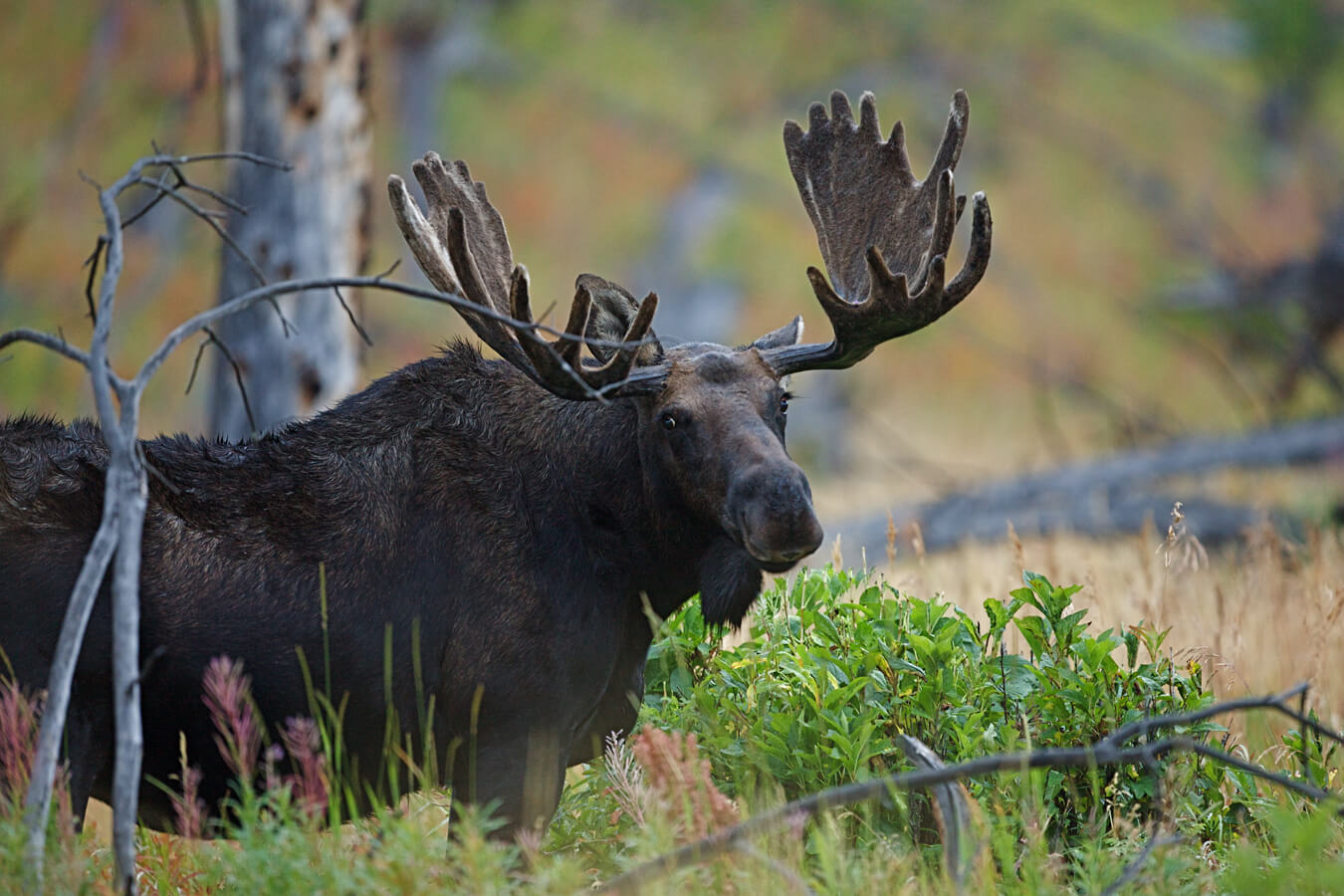
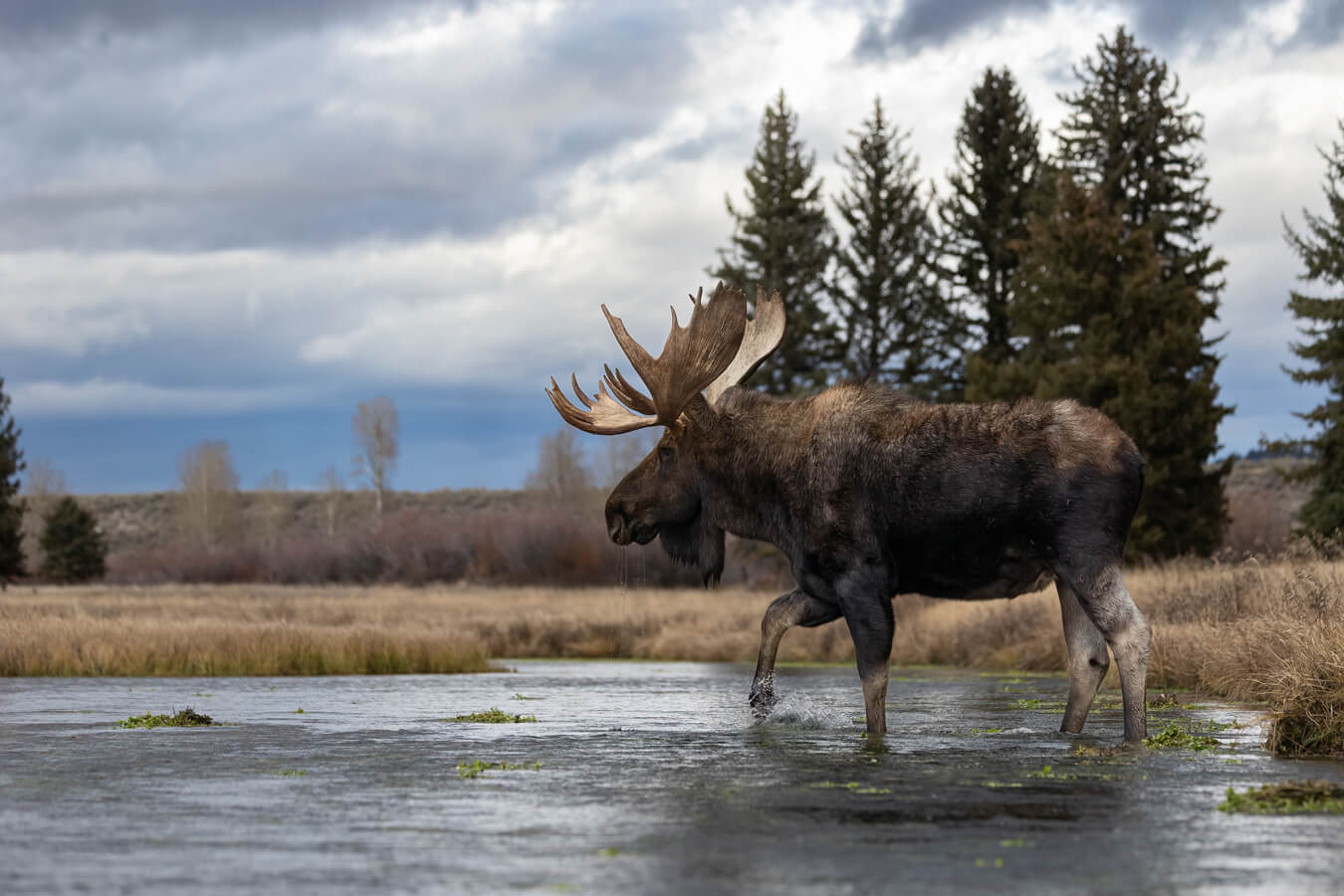
Moose (Alces alces) are the biggest deer in the world, and nothing else in our National Parks looks quite like them. Long legs, a humped shoulder, a drooping nose, and the dangling flap of skin called a “bell” give moose an almost prehistoric look. A big bull with palmate antlers wading through a willow-lined river is one of the most memorable sights a park visitor can have.
Moose are also more dangerous than they look, and much more mobile than their size suggests. They swim, wade into deep lakes to feed, and can run up to 35 miles per hour. From the Shiras moose of the Rockies to the giants of Alaska, they can be found in parks such as Denali, Grand Teton, Isle Royale, Rocky Mountain, Wrangell-St. Elias, and Yellowstone.
Learning about animals like moose can significantly enhance wildlife photography skills by providing valuable insights into animal behavior, habitat, and physical characteristics. Understanding an animal’s habits can allow photographers to better anticipate and capture unique and authentic moments. Knowledge of an animal’s habitat may also help in selecting the best locations and times for wildlife viewing and photography, while familiarity with physical characteristics is essential for accurately identifying wildlife in the field. If wildlife photography or simply wildlife viewing are of interest to you, then you’ve come to the right place! Together, let’s learn more about what makes moose so special.

Physical Characteristics
Size varies a great deal by region. In Rocky Mountain National Park, adults measure five to seven feet at the shoulder, a big bull can reach 1,500 pounds, and cows run about three-quarters of that. Denali National Park and Preserve puts bulls at 900 to 1,400 pounds and cows at 700 to 1,100, standing 5 to 6½ feet at the shoulder, and its biggest moose can reach 1,600 pounds, three to four times the weight of a Denali grizzly. The Shiras moose of Yellowstone and Rocky Mountain is the smallest of the continent’s four subspecies; bulls top out near 1,000 pounds and cows at 750 to 900.
Moose are chocolate-brown to nearly black. Their legs and muzzles are often tan. Bulls and cows alike have a shoulder hump, a large rounded nose, and a bell of skin under the throat. Long legs let moose wade into water, travel through deep snow, swim, run, and kick predators.
Only bulls grow antlers. They are broad and flattened, much like an open hand with the tines rising like fingers. A rack can span up to five feet and weigh up to 77 pounds. In Yellowstone, new antlers begin growing in April or May and are covered in velvet until they reach full size in August. Bulls then scrape the velvet off against saplings and brush. Yearlings grow forked antlers six to eight inches long, and prime adult bulls grow the largest racks. Bulls drop their antlers in late fall or early winter, saving energy for the cold months. In Yellowstone, that is usually from late December to late January, though young bulls may keep them until March.
Their bodies are built for cold. A moose’s large body mass and dark coat help it hold heat and its long legs carry it through deep snow, which suits island winters well. The same traits make summer heat hard to tolerate, which is why moose on Isle Royale spend hot days in lakes, ponds, shaded forests, and bogs.
Without antlers, cows and bulls can be hard to tell apart. Look for the white patch beneath a female’s tail. Moose can live a long time for a large mammal, though estimates vary: up to 20 years in Yellowstone, and 15 to 25 in Rocky Mountain.
Habitat and Distribution
Moose are wetland animals. They live in forested areas near lakes, marshes, rivers, and willow flats. They are wetland specialists that depend on wetlands and riparian corridors. In Denali, moose live in forests often close to lakes and marshes.
Shiras moose range from southeastern British Columbia to southern Colorado. They are better adapted to deep snow than Yellowstone’s other hoofed animals. Greater Yellowstone moose also depend on mature spruce and fir forests for winter survival. Some migrate to lower elevations west and south of the park, while many climb, up to 8,500 feet, to spend the winter in old stands of subalpine fir and Douglas-fir.
Moose history differs from park to park. Moose appear to have been rare in Yellowstone before the late 1800s, and the first documented report on the northern range came in 1913. Isle Royale had no moose until the early 1900s. In Colorado, the state moved 24 moose into North Park, west of Rocky Mountain National Park, in 1978 and 1979. The first moose was seen in the park in 1980. Moose now turn up in all of Rocky Mountain’s major drainages, and the park’s 2025 estimate was 240 animals.
In Alaska, roughly 1,800 moose live in Denali north of the Alaska Range. At Wrangell-St. Elias National Park and Preserve, lakes and willow bogs are good places to find moose.
Behavior and Social Structure
Unlike most members of the deer family, moose are usually solitary. They are not territorial and tolerate other animals nearby, but they seldom move around in groups bigger than two or three. The strongest bond is between a cow and her calf. Moose rut is one of the few times they gather in small groups.
Moose can surprise you. As Rocky Mountain’s population grows, summer herds of moose, unusually large for these solitary animals, have been seen in the park. Elsewhere, moose more often gather in winter for a break from deep snow. Denali’s moose stay on their home ground through winter, often in willow marshes, where pawing for food in deep snow leaves networks of trails called “yards.”
Breeding is at its height from late September into early October. Both sexes are vocal. In Yellowstone, cows call with long groans, and rival bulls trade deep, repeated grunts before they lock antlers. Denali’s cows have a nasal, bawling call. Bulls also urinate in wallows and roll in them, and the bell holds the scent so the wind can spread it. Most fights end when the weaker bull backs off unhurt, though once in a while a bull dies of its wounds. Cows choose bulls based on antler size.
Gestation lasts about eight months. Calves are born in late May or June. Calves are born unspotted and reddish brown. Twins are common among Denali’s cows, and triplets happen now and then. In Yellowstone, single calves are most common. Newborns weigh 25 to 35 pounds and stay with their mother for about a year.
Diet and Foraging
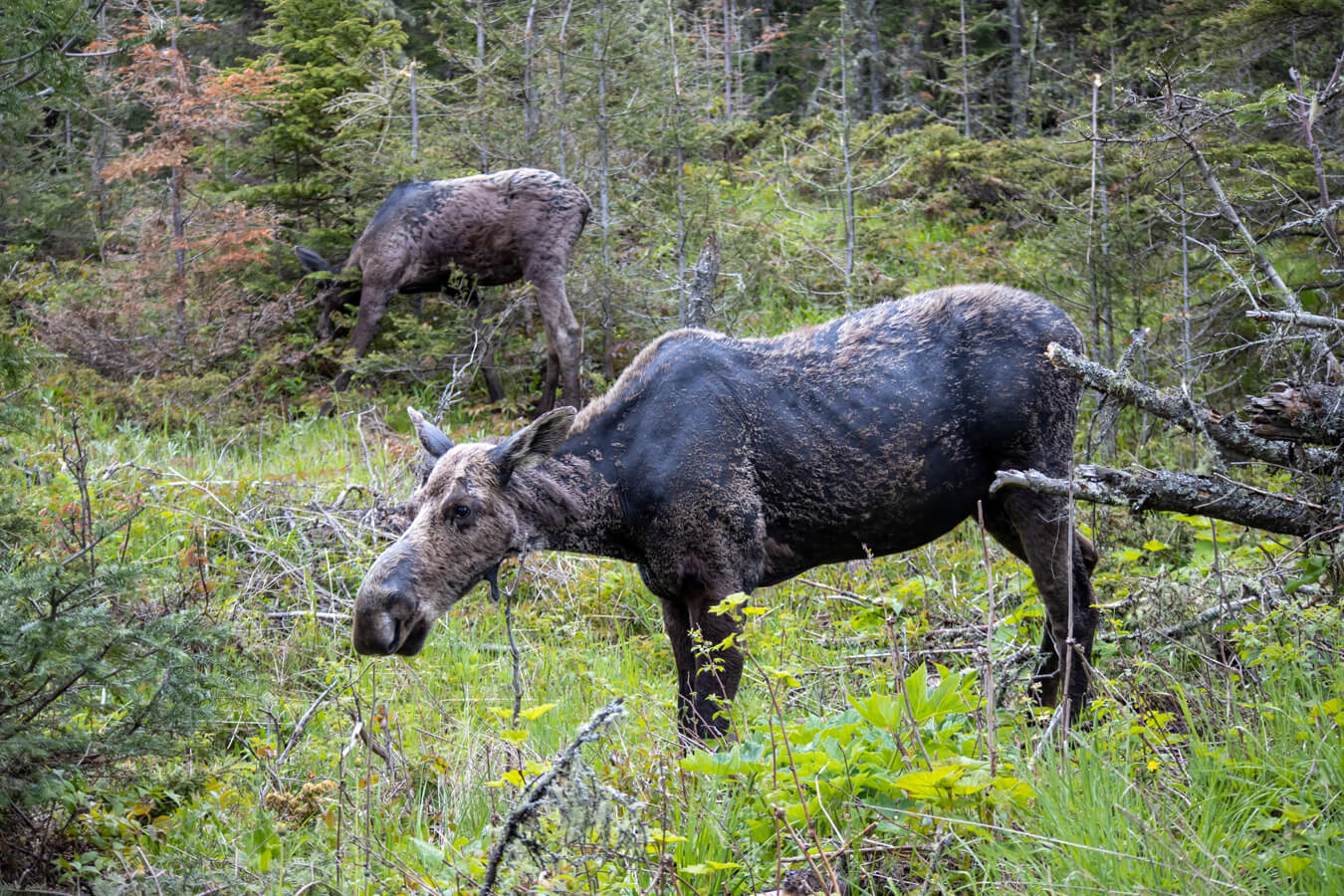
Moose are browsers. Their food is woody browse: the bark, buds, twigs, and leaves of shrubs and trees. Willow is the staple. In Yellowstone, willow comes first, followed by gooseberry and buffaloberry, with a strong preference for subalpine fir in winter. In Rocky Mountain National Park, riparian willow makes up 91 percent of a moose’s summer diet.
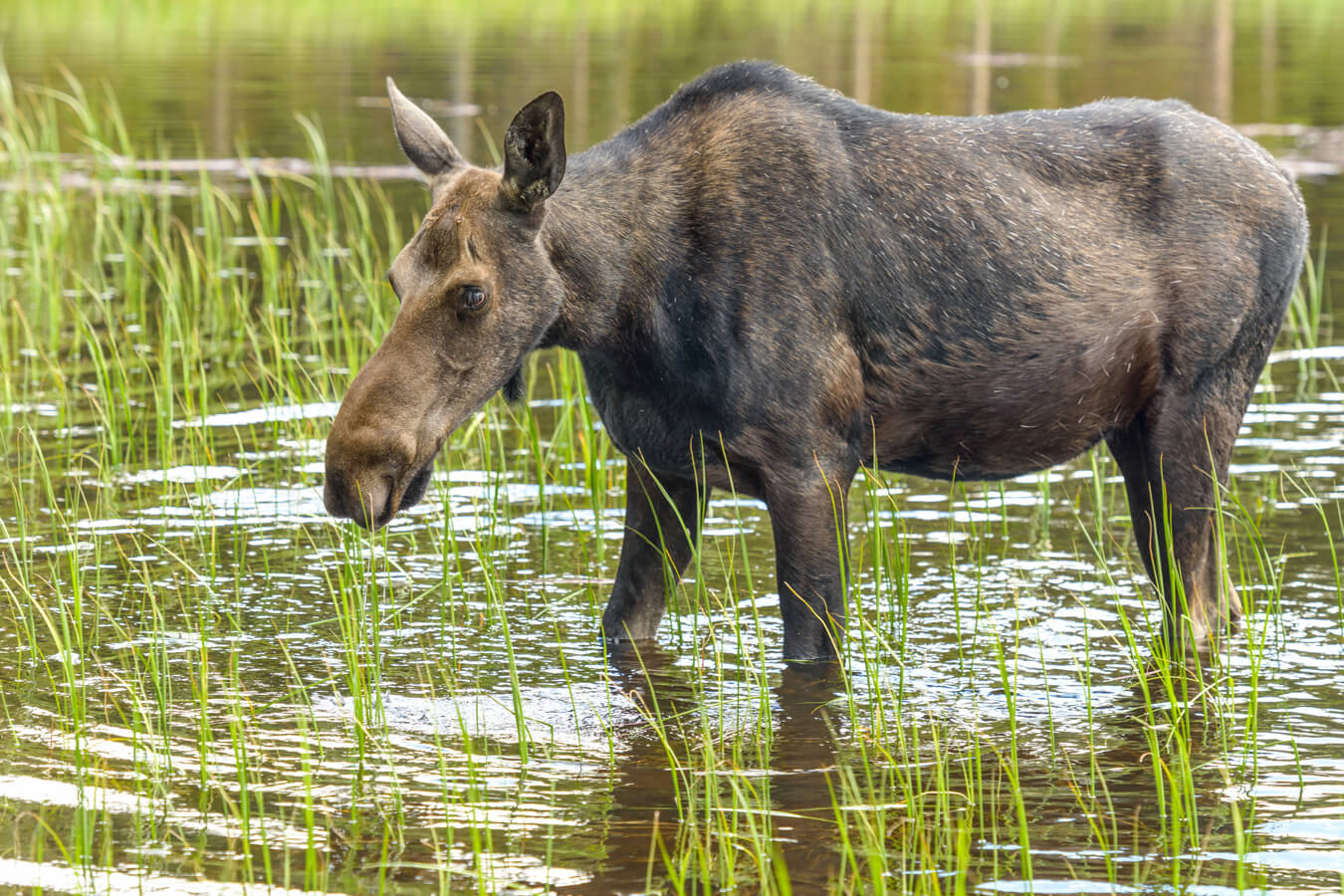
Aquatic plants matter, too. Moose wade into lakes and ponds for water lilies, duckweed, and burweed. These plants are high in protein and sodium. Moose, like bighorn sheep, visit mineral licks to restore the sodium they used up during winter. On Isle Royale, moose commonly feed in inland lakes and beaver ponds in summer, which also helps them stay cool.
Moose eat a lot. Intake estimates vary. In Yellowstone, an adult eats 10 to 12 pounds a day in winter, and summer intake can climb to 50 pounds. Rocky Mountain’s figures run higher, up to 60 pounds a day in the Kawuneeche Valley and up to 70 pounds a day parkwide. Moose remember their favorite feeding spots. Research has tracked moose coming back to one particular willow patch at nearly the same date every winter.
Role in the Ecosystem
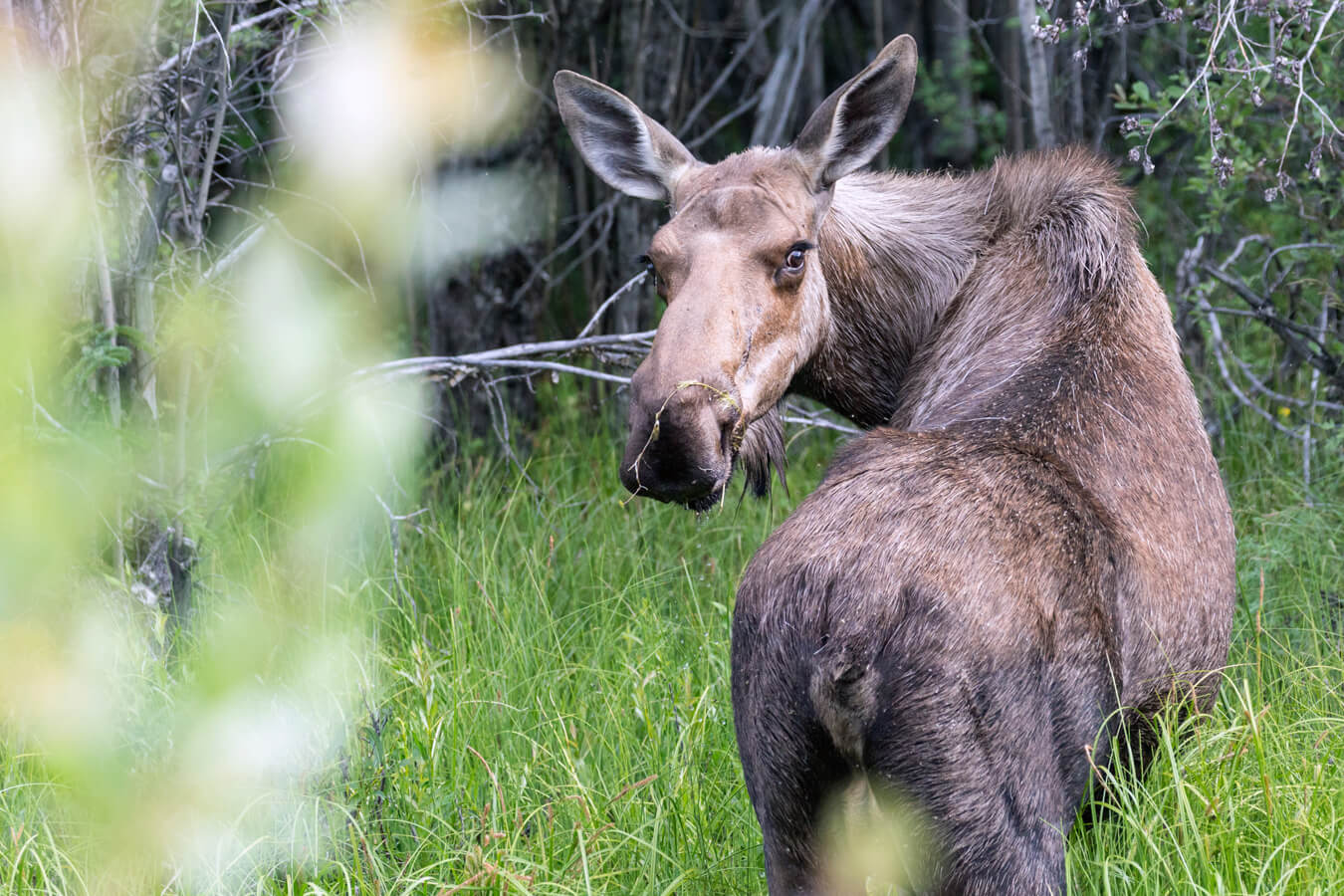
Moose are an important prey species for large predators. Isle Royale is the classic example. Wolves are the island’s only moose predator. By culling the old, the young, and the sick, wolves keep the herd in balance, and a healthy herd in turn feeds the wolves through winter. Since 1980, the island’s moose population has ranged from about 500 to 2,400. When moose become too numerous, they over-browse the island’s vegetation, and winter starvation follows.
In Denali, moose face weather, predation by wolves and bears, and human development. In Yellowstone, bear and wolf predation on calves may limit population growth, but low pregnancy rates suggest food is the bigger limit. Big herds of elk and bison eat willow too, which leaves less for moose.
Where predators are missing, moose can reshape habitat. With wolves and grizzlies gone from the region, Rocky Mountain’s moose have few predators. Over an average summer, a single moose eats roughly the willow of 15 elk. That affects willow-beaver wetlands, which the park is working to restore.
Moose Populations: Ups and Downs
Moose numbers rise and fall. Long-term research points to a common pattern in North American moose: numbers boom, collapse, and then level off for a time.
Yellowstone’s moose increased in the early 1900s, helped by predator control, fire suppression, and hunting restrictions. Decades of putting out fires likely mattered most, since moose in Greater Yellowstone rely on old conifer forest to get through winter. A population of roughly 1,000 in the 1970s had shrunk to about 200 by 1996. The 1988 fires burned mature fir forests, and many old moose died the following winter. A recent study estimated 150 to 186 moose in northern Yellowstone between 2013 and 2015, with moderate annual growth. Today, fewer than 200 moose live in the park.
Rocky Mountain is the opposite story. The park’s moose density rose 49 percent from 2020 to 2025, and about 1 in 15 Colorado moose now lives in the park. Statewide, Colorado’s moose population grew from about 2,400 in 2014 to about 3,600 in 2025. The park uses thermal infrared aerial surveys, first tested in 2019 and 2020, to count moose hidden in dense vegetation.
Moose Safety
Moose look slow and gentle, but they are one of the most dangerous animals you can meet in a park. A moose will charge anything it sees as a threat and may kick or trample. They can be unpredictable, cows with calves most of all, and some have chased visitors. Bulls in the fall rut are aggressive, too.
Find out the required viewing distance for the park you are visiting before heading out. Grand Teton requires at least 25 yards from moose and other wildlife except bears and wolves. Denali asks for at least 25 yards, or two bus lengths. Rocky Mountain asks for 120 feet or more, about three bus lengths, between you and a moose.
Watch for warning signs. Ears laid back, a direct stare, or raised hair on the neck all mean trouble, and so does a “head high” or “head low” posture. Retreat when you see them. Stay well clear of the space between a mother and her calf. If you surprise a moose, ease away and put a tree or boulder between you. If a moose charges, run hard, change direction, and keep objects between yourself and the animal. Keep dogs away from moose, since moose may react dramatically to them.
National Park Presence
Moose are found in parks from Maine to Alaska. For photographers visiting the 63 designated U.S. National Parks, moose can be found in the following parks:
| Park Name | Occurrence | Abundance |
| Acadia National Park | Present – Native | Rare |
| Denali National Park and Preserve | Present – Native | Common |
| Gates of the Arctic National Park and Preserve | Present – Native | Common |
| Glacier Bay National Park and Preserve | Present – Native | Common |
| Glacier National Park | Present – Native | Common |
| Grand Teton National Park | Present – Unknown | Common |
| Isle Royale National Park | Present – Native | Common |
| Katmai National Park and Preserve | Present – Native | Unknown |
| Kenai Fjords National Park | Present – Native | Common |
| Kobuk Valley National Park | Present – Native | Abundant |
| Lake Clark National Park and Preserve | Present – Native | Common |
| North Cascades National Park | Present – Native | Rare |
| Rocky Mountain National Park | Present – Unknown | Uncommon |
| Theodore Roosevelt National Park | Present – Native | Rare |
| Voyageurs National Park | Present – Native | Common |
| Wrangell-St. Elias National Park and Preserve | Present – Native | Uncommon |
| Yellowstone National Park | Present – Unknown | Uncommon |
According to National Park Service NPSpecies records, moose are Abundant in Kobuk Valley and Common in Denali, Grand Teton, Isle Royale, Glacier, Glacier Bay, Kenai Fjords, Lake Clark, Gates of the Arctic, and Voyageurs. They are Rare in Acadia, North Cascades, and Theodore Roosevelt. Nativeness is listed as Unknown for Grand Teton, Rocky Mountain, and the species-level Yellowstone record. Yellowstone also has a separate NPSpecies record for Alces alces shirasi, the Yellowstone moose, listed as Present, Uncommon, and Native.
Moose Photography Tips
Moose can be seen at almost any time of day, but dawn and dusk are often best. On Isle Royale, they are most active at those times and spend hot afternoons in cool forests and bogs. Look for water and willow. In Grand Teton, try Oxbow Bend, the Snake River from Jackson Lake Dam south to Moose, and Blacktail Pond. At all of them, moose feed on the willows along the banks. The Moose-Wilson Road winds through forest and marsh, too. In Rocky Mountain, visitors see moose fairly often along Highway 34 in the Kawuneeche Valley, and more often on the east side. In Yellowstone, your best chances are in the park’s southwest corner and in the drainages of the Gallatin and Lewis rivers, Pelican Creek, and Soda Butte Creek. On Isle Royale, try Washington Creek at Windigo, Ojibway Lake, Feldtmann Lake, and Hidden Lake at Tobin Harbor.
A moose may stay in one area for days or weeks, so a moose you find one morning may still be nearby later. Use pullouts to view wildlife and take photos, and never stop in the middle of the road. Fall brings bulls in full antlers and the drama of the rut, but that is also when bulls are most aggressive. Give them extra distance.
A telephoto lens is essential for photographing moose responsibly. If you already own or want to own a professional-grade mirrored camera like the Canon EOS 5D Mark IV Full Frame Digital SLR, we recommend using a Canon EF 100-400mm f/4.5-5.6L IS II USM Lens zoom lens for wildlife photography. If you have or are interested in a newer mirrorless model like the Canon EOS R5 Full-Frame Mirrorless Camera, we recommend using a Canon RF100-400mm F5.6-8 IS USM for long-distance shots.
Not quite ready to invest in traditional professional-grade camera equipment but want to enhance the quality of your cell phone photographs? Consider using a Moment Tele 58mm Mobile Lens II for improved reach, and use a Moment camera case with a lens mount to attach it to your phone. Since cell phones generally cannot provide the same reach as a dedicated telephoto camera lens, never compensate by moving dangerously close to wildlife.
No photograph is worth disturbing an animal or putting yourself or others at risk.
Why Are They Called Moose?
Names can get confusing with moose. NPSpecies records for Grand Teton and Yellowstone list “Eurasian elk” as an alternate common name for the moose, because in Europe this same animal is often called an elk. The animal North Americans call an elk is a different species, which some people also call wapiti.
Moose vocabulary is simple. A male moose is a bull, a female is a cow, and a youngster is a calf. The “bell” is the hanging dewlap of skin and hair on the throat.
A Note About Moose Taxonomy
Readers researching moose may encounter more than one scientific name for the same animal. This page uses:
Alces alces
Some National Park Service records and older works refer to moose by other names, such as:
Alces americanus, Alces alces shirasi, and Alces alces gigas
Some scientists treat North American moose as a separate species, Alces americanus, which appears as a synonym in the Wrangell-St. Elias NPSpecies record. That record also lists Alces alces gigas, the Alaska moose. Yellowstone and Rocky Mountain refer to their moose as Shiras moose (Alces alces shirasi), the smallest of four North American subspecies.
For consistency throughout National Park Photographer, this page uses Alces alces while recognizing the other names visitors may encounter.
Final Thoughts
Moose are among the most remarkable animals in our National Parks. They wade, swim, browse willows for hours, and grow huge antlers every summer only to drop them a few months later.
Their populations tell very different stories. In Yellowstone, fire, competition, and habitat loss have kept moose numbers low. On Isle Royale, moose and wolves rise and fall together. In Rocky Mountain, a population that began with two dozen moose released nearby now reaches every major drainage.
Seeing a moose in the wild is a highlight of any park visit, and it comes with responsibility. By keeping our distance, never getting between a cow and calf, watching for warning signs, and using telephoto lenses instead of moving closer, photographers and visitors can enjoy moose safely. Responsible wildlife viewing and photography help keep these giants wild.
Want more information about the amazing wildlife that call our National Parks home? Take a look at our National Park Wildlife page to explore the various parks and the animals in them. Planning on visiting a National Park in the near future? Be sure to follow park regulations, practice Leave No Trace principles, and prioritize both your safety and the well-being of wildlife while exploring.
Joyful Journeys!
Bonnie, Co-Owner, National Park Photographer
Want to learn more about moose? Check out the additional resources below!
Moose Books & Field Guides
- If You Give a Moose a Muffin
- Mary Meyer Marlon Moose Plush
- Douglas Sigmund Moose Plush
- Peterson Field Guide to Mammals of North America
- Isle Royale National Park Map (National Geographic Trails Illustrated)
- 10×42 Binoculars for Wildlife Viewing
- Monocular for Wildlife Viewing
- Camera Bean Bag for Wildlife Photography
Please note, by making purchases through our affiliate links, you are supporting our mission to celebrate and showcase our National Parks and the photographers who frequent them. As an Amazon Associate, National Park Photographer earns from qualifying purchases at no cost to you. We appreciate your support.
References & Additional Resources
- National Park Service — Yellowstone National Park: Moose
- National Park Service — Rocky Mountain National Park: Moose
- National Park Service — Moose Research in Rocky Mountain National Park
- National Park Service — Rocky Mountain National Park: Wildlife Safety
- National Park Service — Denali National Park and Preserve: Moose
- National Park Service — Denali National Park and Preserve: Wildlife Safety
- National Park Service — Isle Royale National Park: Moose
- National Park Service — Grand Teton National Park: Wildlife Viewing
- National Park Service — Grand Teton National Park: Moose-Wilson Road
- National Park Service — Wrangell-St. Elias National Park and Preserve: Mammals
- National Park Service — NPSpecies Species Search
Do you want to be featured on National Park Photographer?
Why wait! Contact us today at nationalparkphoto@gmail.com for a chance to be a Featured National Park Photographer!