Most ducks avoid fast water. Harlequin ducks go looking for it. In spring, these small sea ducks leave the ocean and fly inland to rushing mountain streams, where they ride standing waves, dive into whitewater, and rest on boulders that would wash any other duck downstream. The drake, painted in slate blue, chestnut, and bold white stripes, is one of the most striking birds in North America.
The harlequin duck (Histrionicus histrionicus) belongs to Anatidae, the duck, goose, and swan family, and to the group known as sea ducks. It breeds along cold, fast rivers in Alaska, western Canada, the northern Rockies, the Pacific Northwest, eastern Canada, Greenland, Iceland, and northeast Asia, and spends the winter on rocky ocean coasts. NPSpecies records list harlequin ducks as present in 23 National Parks, including Acadia, Denali, Glacier, Mount Rainier, and Yellowstone.
Learning about animals like harlequin ducks can significantly enhance wildlife photography skills by providing valuable insights into animal behavior, habitat, and physical characteristics. Understanding an animal’s habits can allow photographers to better anticipate and capture unique and authentic moments. Knowledge of an animal’s habitat may also help in selecting the best locations and times for wildlife viewing and photography, while familiarity with physical characteristics is essential for accurately identifying wildlife in the field. If wildlife photography or simply wildlife viewing are of interest to you, then you’ve come to the right place! Together, let’s learn more about what makes harlequin ducks so special.
Physical Characteristics
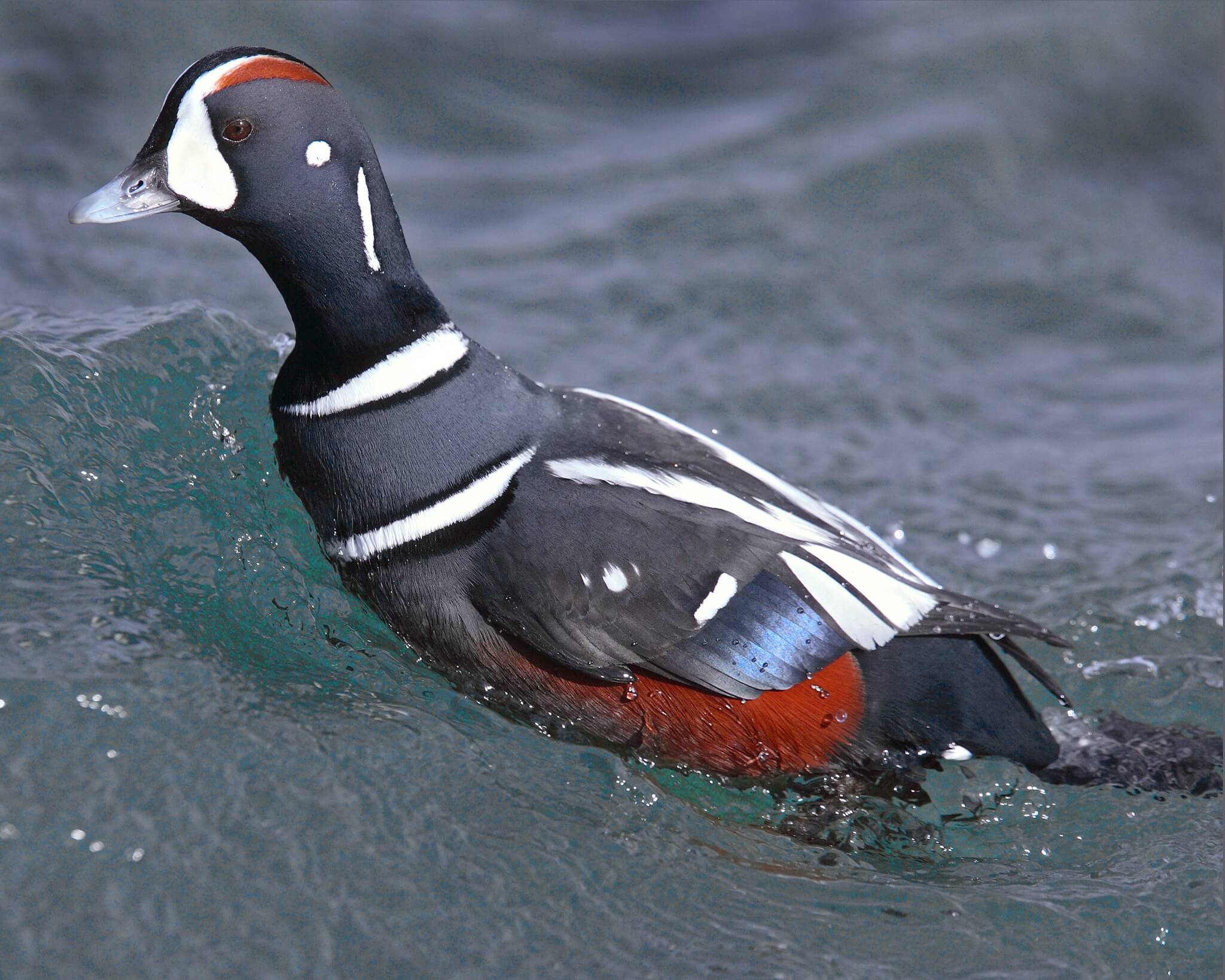
Harlequin ducks are small and compact, about 15 to 21 inches long, and usually weigh around 1 to 1.5 pounds. Drakes are a little larger than hens. They have a short, small bill, a steep forehead, and a long, pointed tail, which helps them steer in strong currents.
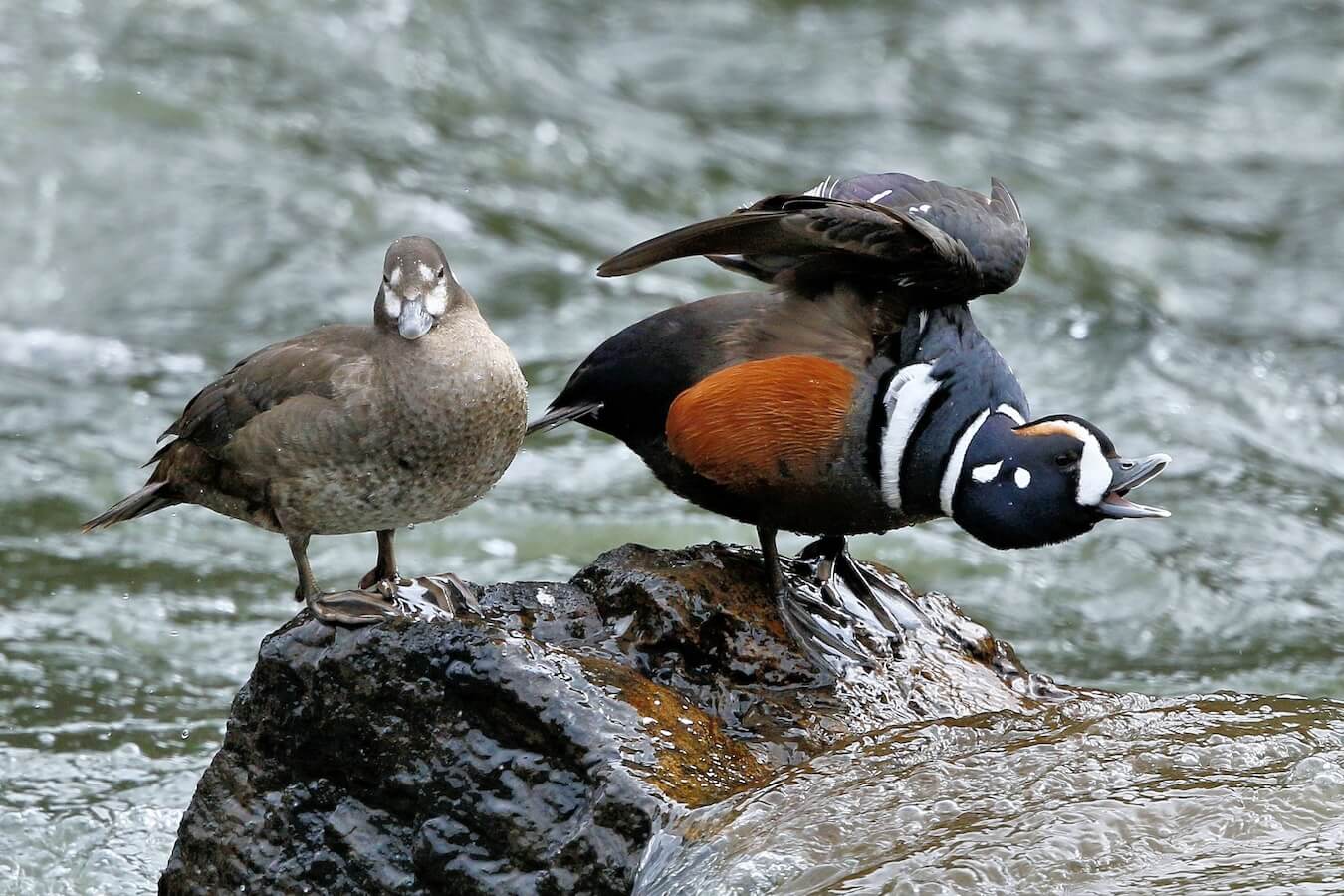
Drakes in breeding plumage are hard to mistake:
- Body: Deep slate blue, which can look almost black in poor light.
- Flanks: Rich chestnut along the sides.
- Markings: Bold white crescents, spots, and stripes outlined in black on the head, neck, chest, and back.
- Head: A white crescent in front of the eye, a white spot near the ear, and a chestnut stripe along the top of the crown.
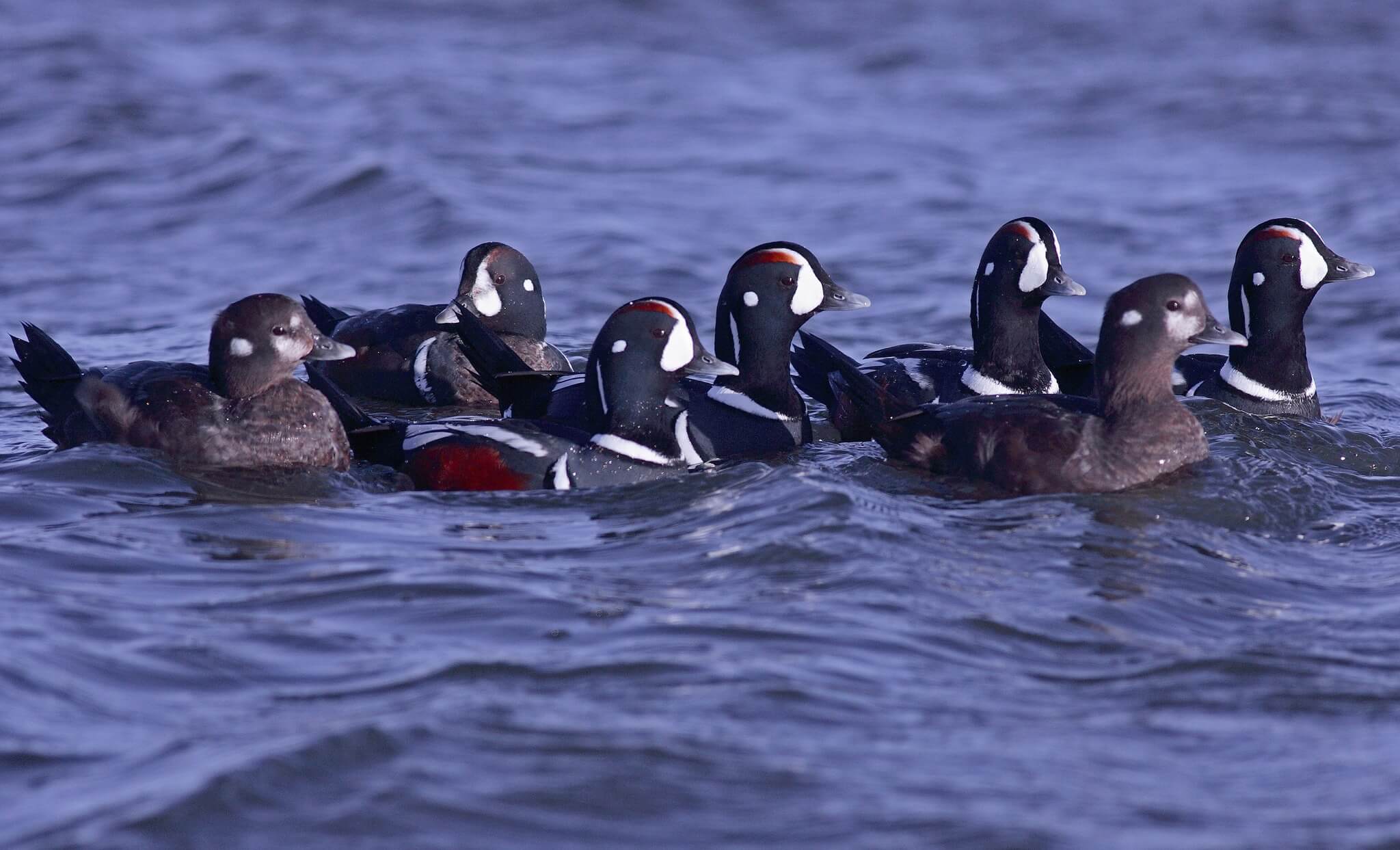
Hens are much plainer. They are dusky brown with paler underparts and three white spots on each side of the head: two in front of the eye and one behind it. The pattern is subtle, but once you know it you can pick out a hen even at a distance. In late summer, drakes molt into a duller plumage that looks a lot like the hen’s, with only traces of white.
In flight, harlequins look small and dark, with quick wingbeats. They usually fly low and fast over the water, following the bends of a stream or the line of a rocky shore rather than cutting overland. Pairs and small groups often fly in a tight line, one bird just behind the other.
The name comes from Harlequin, a character in Italian comedy who wore a costume of bright patches. Over the years these ducks have also been called “lords and ladies,” “painted ducks,” and “sea mice,” a reference to their high, squeaky calls.
Built for Whitewater
Harlequin ducks are among the few ducks in the world that make their living in fast, turbulent water. Their bodies and behavior show it:
- Dense plumage: Tightly packed feathers trap air, keeping the birds warm and buoyant in icy water.
- Strong legs and feet: Powerful legs help them swim against the current and walk along the stream bottom.
- Diving skill: They dive to the bottom of rapids and riffles to feed, often staying under for 15 to 30 seconds.
- Toughness: Studies of harlequin duck skeletons have found many healed fractures, a sign of how rough their lives in waves and rapids can be.
Watching a harlequin feed is like watching a kayaker read a river. The ducks slip into eddies behind rocks to rest, then dart out into the current, dive, and pop up again downstream. When they need a break, they climb out onto midstream boulders and preen.
On the coast, they live in an even rougher place. In winter, harlequins feed in the surf zone along rocky shores, diving among the breaking waves where few other birds can manage.
Habitat and Range
Harlequin ducks spend most of the year at sea and only a few months inland. Their two main habitats are very different:
- Breeding streams: Clear, cold, fast-flowing rivers and creeks in mountains or forested valleys, usually with rocks, riffles, and little human disturbance.
- Wintering coasts: Rocky ocean shorelines, reefs, and islands with heavy surf, often in the same areas year after year.
In North America, there are two separate populations. The Pacific population is much larger and breeds from Alaska south through the Rocky Mountains and the Cascades, then winters along the coast from the Aleutian Islands to Oregon and northern California. The Atlantic population breeds in eastern Canada and Greenland and winters along the coast from Atlantic Canada to New England, with some birds reaching farther south.
In national parks, this gives harlequins an unusual range. They nest on streams in Denali, Glacier, Grand Teton, Mount Rainier, North Cascades, and Yellowstone, live year-round along the coasts of Glacier Bay, Kenai Fjords, and Katmai, and spend the winter on the rocky shores of Acadia. The Yellowstone population is near the southern edge of the species’ range in the Rockies, and Yellowstone lists it as uncommon.
Diet
Harlequin ducks find almost all their food by diving. What they eat depends on where they are:
- On breeding streams: Aquatic insects, especially caddisfly, stonefly, and mayfly larvae, plus blackfly larvae and other invertebrates found on the stream bottom.
- On the coast: Crabs, snails, limpets, mussels, barnacles, and other small animals that cling to rocks.
- Fish eggs: In Alaska and the Pacific Northwest, harlequins often feed on salmon eggs during spawning runs.
On rivers, harlequins forage by diving and walking along the bottom against the current, turning over pebbles and probing between rocks for insect larvae. On the coast, they pry snails and limpets from rocks and swallow small crabs whole.
Timing their arrival to food is part of the harlequin’s strategy. Hens need a lot of energy to produce eggs, and the spring hatch of aquatic insects on mountain streams gives them a rich food source just when they need it most. Pairs often spend their first weeks on a stream simply feeding before the hen begins to nest.
Because they depend on clean, insect-rich water, harlequin ducks can be a good sign of a healthy stream. Changes in water quality, flow, or insect populations can affect how well they breed.
Pairs and Courtship
Harlequin ducks usually pair up on the wintering grounds, months before the breeding season. Courtship takes place in groups along the coast. Drakes swim around the hens, bob their heads, and give whistling and squeaking calls, and pairs form gradually through the winter and early spring.
Their voice is unlike most ducks. Instead of quacking, harlequins give high squeaks, whistles, and short trills that can be hard to hear over the roar of a river. On a quiet stretch of water, though, a pair calling back and forth can sound more like songbirds or small mammals than ducks.
Pairs then fly inland together, often returning to the same stream every year. Many harlequins pair with the same mate for several years, finding each other again on the wintering grounds. Hens often return to the stream where they hatched.
On the breeding streams, pairs are often seen resting together on rocks or feeding side by side in the current. The drake stays close to the hen and guards her from other males while she feeds and prepares to nest. This is the best time to see drakes in full color inland, since they will leave the streams soon after nesting begins.
Nesting and Ducklings
The hen builds her nest on the ground close to the stream, usually hidden under shrubs, in a pile of driftwood, among rocks, or in a hollow along the bank. She lines it with down plucked from her breast. She usually lays 5 to 7 eggs and incubates them alone for about four weeks.
Once the eggs hatch, the young develop quickly:
- First day: Ducklings leave the nest soon after hatching and follow their mother into the water.
- First weeks: They stay in calmer side channels and eddies, feeding on insects near the surface and along the shore.
- About six weeks: They begin to fly.
- Late summer: Hens and young head down to the coast, often weeks after the drakes.
Breeding success varies a lot from year to year. Floods from heavy snowmelt or rain can wash away nests and ducklings, and predators such as mink, otters, gulls, and ravens take eggs and young. Many hens do not nest every year, which means a population can take a long time to recover after a decline.
Migration and Molt
Harlequin ducks have one of the more interesting migration patterns among ducks. Drakes stay on the breeding streams only a few weeks. Once the hen begins incubating, the drake leaves and heads straight back to the ocean, where large numbers of males gather to molt.
Their trips can be remarkably fast. In May 2018, as part of a larger study of harlequin ducks across the West, researchers caught and banded seven harlequins in Yellowstone, four males and three females, and fitted the males with satellite transmitters. Three of the males left the park in June and reached their wintering grounds off the Pacific coast within five or six days. The fourth left in early July and appears to have died during migration along the Fraser River in British Columbia.
Tracking studies like this one help answer questions that are hard to study from the riverbank. They show which stretches of coast Yellowstone’s harlequins depend on in winter, how long the trip takes, and where the birds stop along the way. That matters for a small population, since protecting the breeding streams in the park does little good if the wintering coast is in trouble.
During the molt, harlequins lose their flight feathers all at once and cannot fly for several weeks. They spend this time in sheltered coastal waters, where they can feed and stay safe from predators. Hens and young of the year arrive on the coast later in the summer or early fall and molt there as well.
Harlequins tend to be faithful to their wintering sites, returning to the same stretch of rocky shoreline year after year. This loyalty makes them easy to find for those who know where to look, but it also means local problems such as oil spills can hit a population hard.
Harlequin Ducks and Conservation
Across most of their range, harlequin ducks are not considered at risk, but they face several challenges because of their small numbers, slow breeding, and loyalty to particular places.
The Atlantic population declined sharply in the 20th century, and in eastern Canada it was once listed as endangered. Protection from hunting and other conservation measures helped it recover, and its status has since been improved. In the Pacific, the 1989 Exxon Valdez oil spill in Prince William Sound killed many harlequin ducks, and the local population took decades to recover.
Other threats include:
- Disturbance: Anglers, rafters, and hikers along breeding streams can flush nesting hens and separate families.
- Dams and water changes: Changes to stream flow can affect food and nesting sites.
- Oil and pollution: Coastal spills and contamination threaten wintering flocks.
- Climate change: Changes in snowmelt timing and stream flow may affect breeding success.
In the lower 48 states, harlequin ducks are a species of concern in several states, including Montana and Wyoming. National parks protect some of the best remaining breeding streams, and in places such as Yellowstone and Glacier, harlequins are monitored to track how they are doing.
National Park Presence
Harlequin ducks live in many of the 63 designated U.S. National Parks. For photographers, harlequin ducks can be found in the following parks:
According to National Park Service NPSpecies records, harlequin ducks are listed as common in Acadia, Denali, Glacier Bay, Kenai Fjords, Mount Rainier, Olympic, and Wrangell-St. Elias and as uncommon in Glacier, Grand Teton, Katmai, Lake Clark, North Cascades, and Yellowstone. Several other parks list them as occasional or rare visitors. Great Smoky Mountains National Park lists the harlequin duck as rare and non-native, which most likely reflects a stray bird far outside its usual range, so treat that record with caution.
Many of these parks see harlequins only in one season. In Acadia they are winter visitors, gathering in the surf along the rocky outer coast from late fall to spring. In Yellowstone, Grand Teton, and Glacier they are mostly spring and summer residents on rivers and streams. In the Alaska parks they can be found much of the year, on inland streams in summer and along the coast in other seasons.
Harlequin Duck Photography Tips
Park pages and NPS photos point to several good places to look:
- Yellowstone: LeHardy Rapids on the Yellowstone River, about 3 miles north of Fishing Bridge, from late April or early May through late May or early June, with the best viewing around mid-May.
- Glacier: Fast-moving creeks and rivers in spring and early summer, especially McDonald Creek.
- Denali: Clear, rocky streams in summer.
- Kenai Fjords and Glacier Bay: Rocky shorelines, often seen from boat tours.
- Acadia: Rocky ocean coasts in winter, where Atlantic harlequins gather in the surf.
Keep your distance. Harlequin ducks are sensitive to disturbance on their breeding streams, and a hen flushed off her nest or separated from her ducklings may not return quickly. Stay on trails and boardwalks, avoid walking along the stream bank toward the birds, and use a long lens. Yellowstone National Park, for example, requires visitors to stay at least 25 yards from most wildlife.
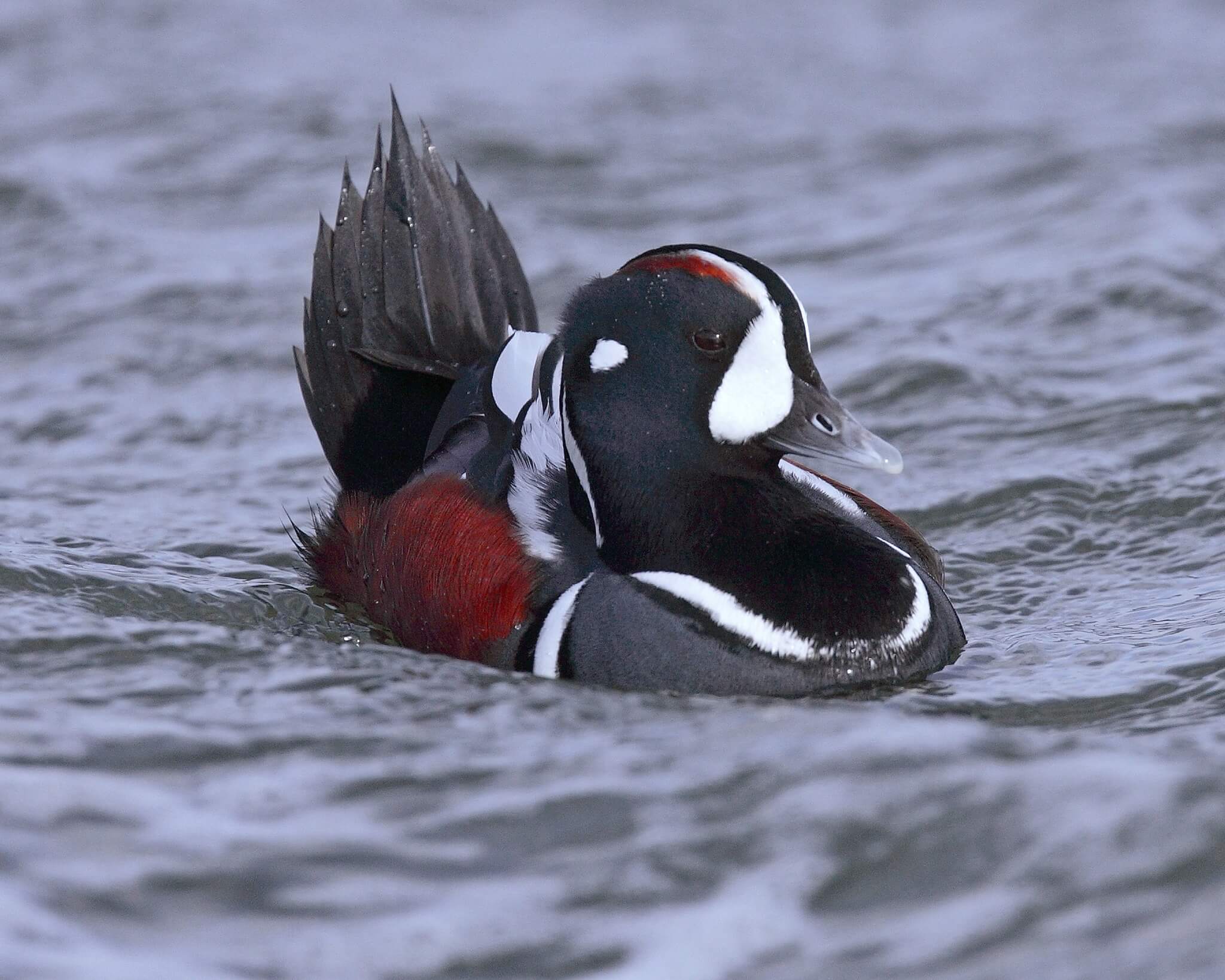
Timing matters. Spring is the best time to see drakes in full breeding plumage inland, and they leave the streams by early summer. Soft, even light helps with the drake’s dark blue feathers and bright white marks, which can be hard to expose in harsh sun. Use a fast shutter speed to freeze splashing water, or a slower one to blur the current around a resting bird. Shooting from a low angle near the water gives a more intimate view, as long as you stay a safe distance away.
A telephoto lens is essential for photographing harlequin ducks responsibly. If you already own or want to own a professional-grade mirrored camera like the Canon EOS 5D Mark IV Full Frame Digital SLR, we recommend using a Canon EF 100-400mm f/4.5-5.6L IS II USM Lens zoom lens for wildlife photography. If you have or are interested in a newer mirrorless model like the Canon EOS R5 Full-Frame Mirrorless Camera, we recommend using a Canon RF100-400mm F5.6-8 IS USM for long-distance shots.
Not quite ready to invest in traditional professional-grade camera equipment but want to enhance the quality of your cell phone photographs? Consider using a Moment Tele 58mm Mobile Lens II for improved reach, and use a Moment camera case with a lens mount to attach it to your phone. Since cell phones generally cannot provide the same reach as a dedicated telephoto camera lens, never compensate by moving dangerously close to wildlife.
No photograph is worth disturbing an animal or putting yourself or others at risk.
A Note About Harlequin Duck Taxonomy
Readers researching harlequin ducks may encounter several names. This page uses:
Histrionicus histrionicus
The harlequin duck is the only living species in the genus Histrionicus. The name comes from the Latin word for an actor, a nod to the bird’s colorful costume. Linnaeus first described it in 1758 as Anas histrionica, before it was moved to its own genus.
Visitors may also see regional names. Acadia National Park’s species records refer to the “Eastern Harlequin Duck,” while Mount Rainier National Park uses “Western Harlequin Duck,” reflecting the separate Atlantic and Pacific populations. Some authorities have also recognized a Pacific subspecies, Histrionicus histrionicus pacificus, although it is not widely accepted.
For consistency throughout National Park Photographer, this page uses Histrionicus histrionicus while recognizing the other names visitors may encounter.
Final Thoughts
Harlequin ducks live at the meeting of mountains and sea. A drake resting on a boulder at LeHardy Rapids in May may be bobbing in the Pacific surf a week later, and a hen raising ducklings on a Denali stream will spend the winter along a rocky Alaska coast.
Whether it’s a pair resting along the Yellowstone River, a flock of drakes in a Denali stream, or a group bobbing in the Acadia surf, a harlequin sighting is a reward for patience. Look for movement in the whitewater, keep your distance, and enjoy the show.
Want more information about the amazing wildlife that call our National Parks home? Take a look at our National Park Wildlife page to explore the various parks and the animals in them. Planning on visiting a National Park in the near future? Be sure to follow park regulations, practice Leave No Trace principles, and prioritize both your safety and the well-being of wildlife while exploring.
Joyful Journeys!
Bonnie, Co-Owner, National Park Photographer
Want to learn more about harlequin ducks? Check out the additional resources below!
Harlequin Duck Books & Field Guides
- Waterfowl Identification: The LeMaster Method
- Ducks, Geese, and Swans of North America
- North American Duck & Geese Identification Set (Waterproof Quick Reference Guide)
- The Sibley Guide to Birds, 2nd Edition
- 10×42 Binoculars for Wildlife Viewing
- Monocular for Wildlife Viewing
- Camera Bean Bag for Wildlife Photography
Please note, by making purchases through our affiliate links, you are supporting our mission to celebrate and showcase our National Parks and the photographers who frequent them. As an Amazon Associate, National Park Photographer earns from qualifying purchases at no cost to you. We appreciate your support.
References & Additional Resources
- National Park Service — Yellowstone National Park: LeHardys Rapids
- National Park Service — Yellowstone Bird Program 2018 Annual Report
- National Park Service — Mount Rainier National Park: Birds
- National Park Service — Acadia National Park: Birds
- National Park Service — Yellowstone National Park: Safety
- Montana Field Guide: Harlequin Duck
- National Park Service — NPSpecies Species Search
Do you want to be featured on National Park Photographer?
Why wait! Contact us today at nationalparkphoto@gmail.com for a chance to be a Featured National Park Photographer!