For many visitors, a white-tailed deer is the first wild animal they see in a National Park. In Great Smoky Mountains National Park, Shenandoah National Park, and Acadia National Park alike, whitetails rank among the mammals visitors see most often, usually along with squirrels. They may be familiar, but they still make excellent subjects for wildlife photography.
The white-tailed deer (Odocoileus virginianus) is a member of the deer family, Cervidae. No deer in North America is more common. Their range runs west from the Atlantic to the Rockies and south from Canada through Central America, reaching as far as the Florida Keys. NPSpecies records list them as present in more than 20 National Parks, including Acadia, Shenandoah, Great Smoky Mountains, Mammoth Cave, New River Gorge, and Voyageurs.
Learning about animals like white-tailed deer can significantly enhance wildlife photography skills by providing valuable insights into animal behavior, habitat, and physical characteristics. Understanding an animal’s habits can allow photographers to better anticipate and capture unique and authentic moments. Knowledge of an animal’s habitat may also help in selecting the best locations and times for wildlife viewing and photography, while familiarity with physical characteristics is essential for accurately identifying wildlife in the field. If wildlife photography or simply wildlife viewing are of interest to you, then you’ve come to the right place! Together, let’s learn more about what makes white-tailed deer so special.
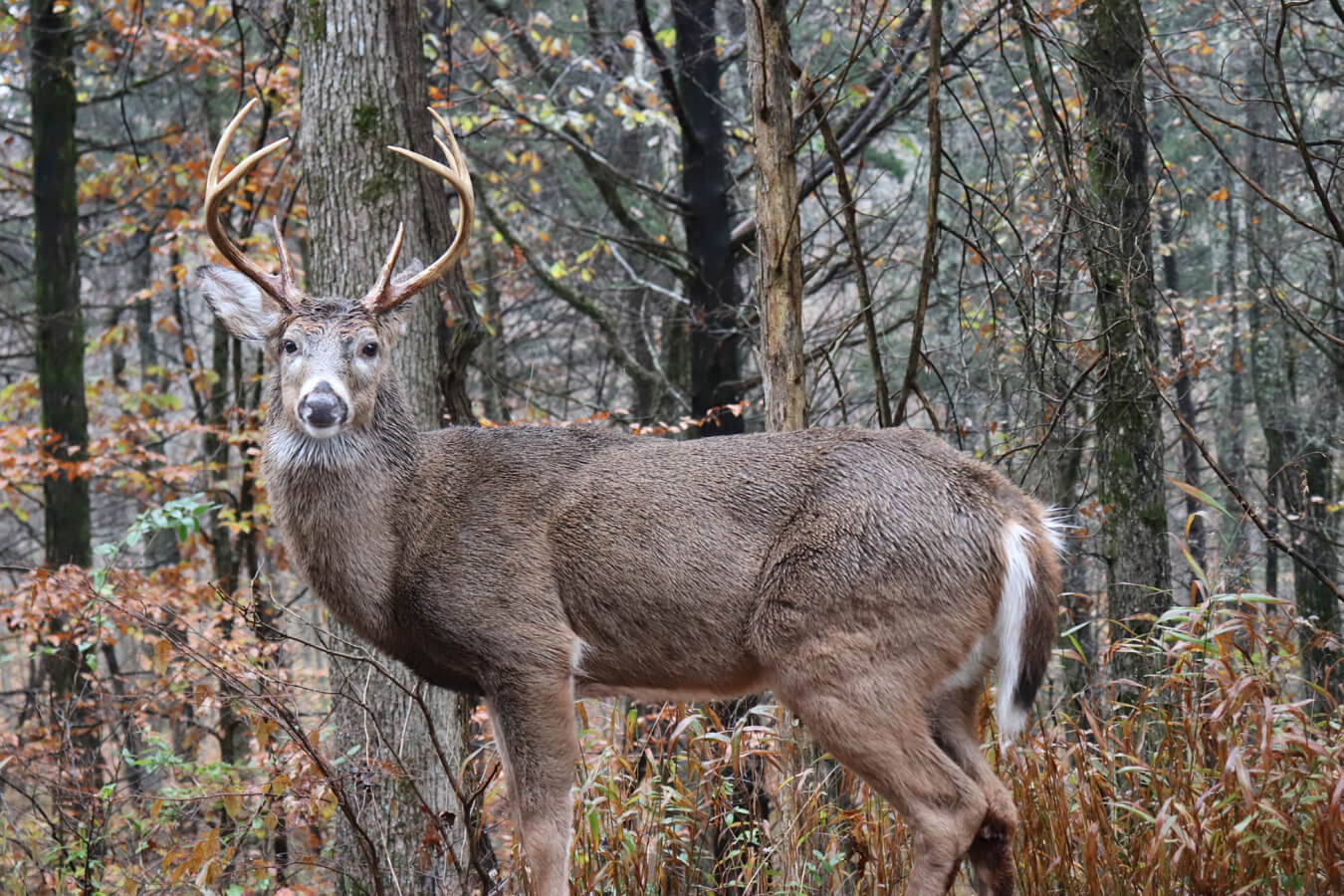
Physical Characteristics
Size figures differ a little by park. In Yellowstone and at Devils Tower National Monument, adults weigh 150 to 250 pounds and stand about 3½ feet at the shoulder. Jewel Cave National Monument breaks it down by sex: a mature buck may weigh 200 to 300 pounds and stand 2.5 to 3 feet at the shoulder, while does weigh 90 to 200 pounds.
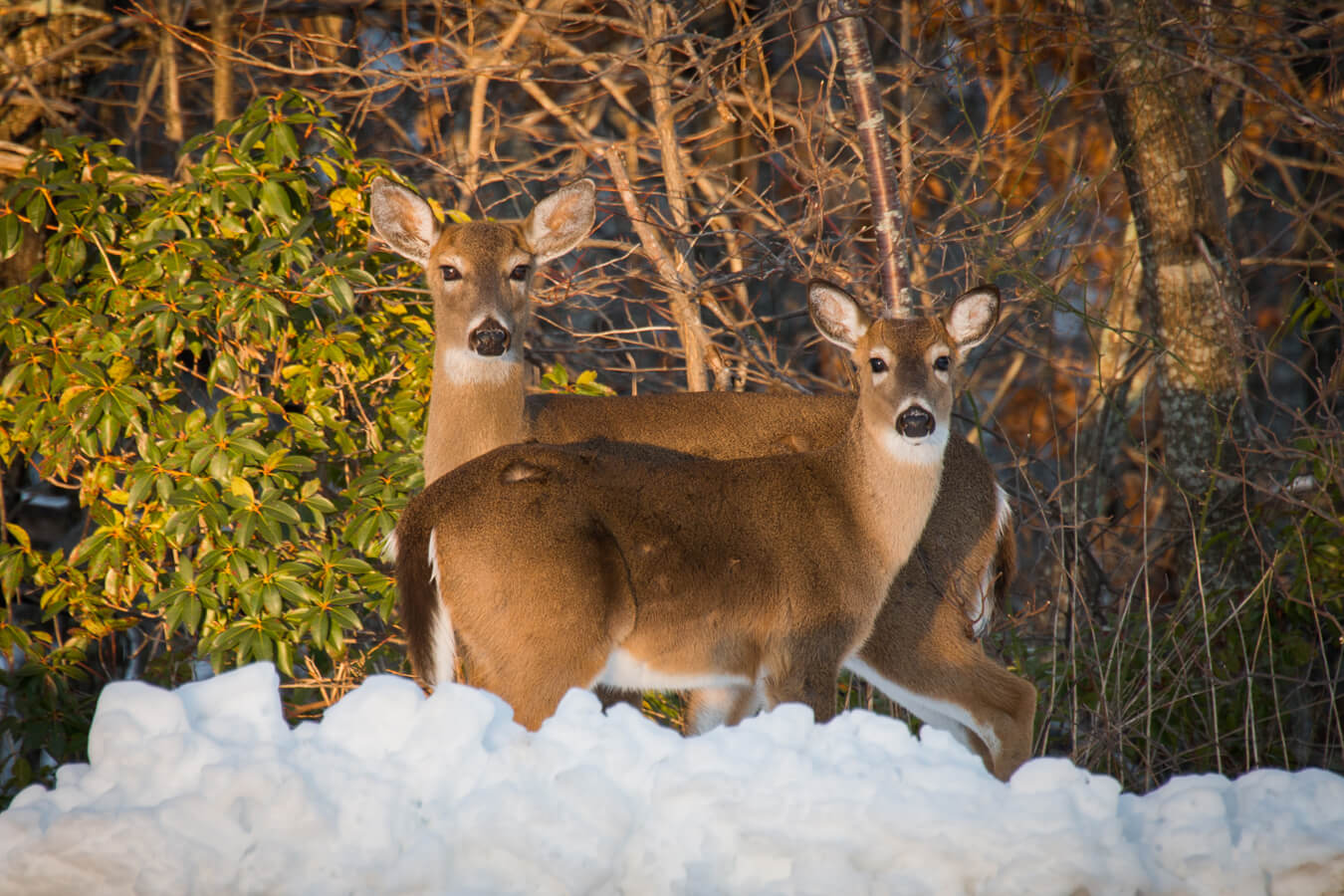
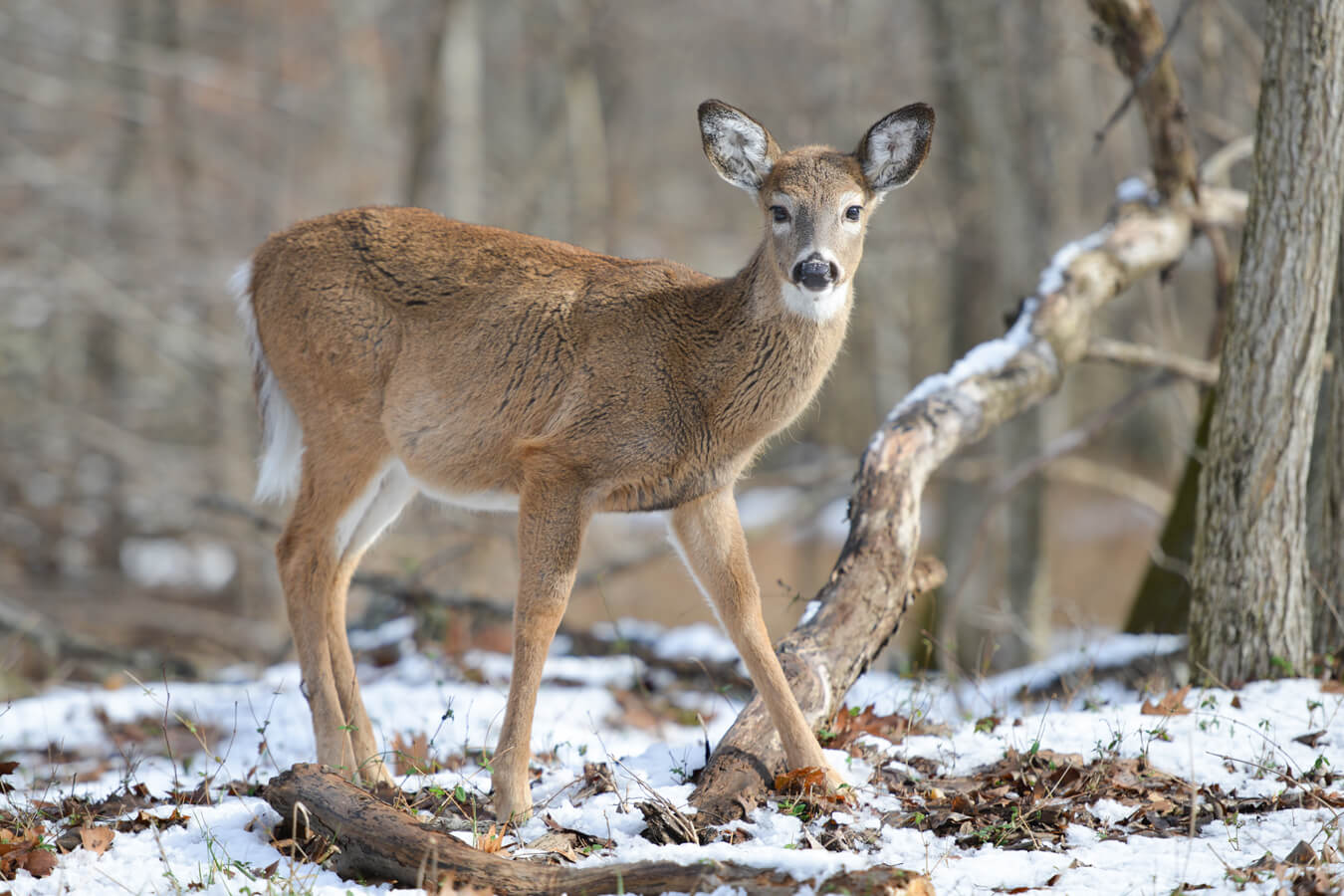
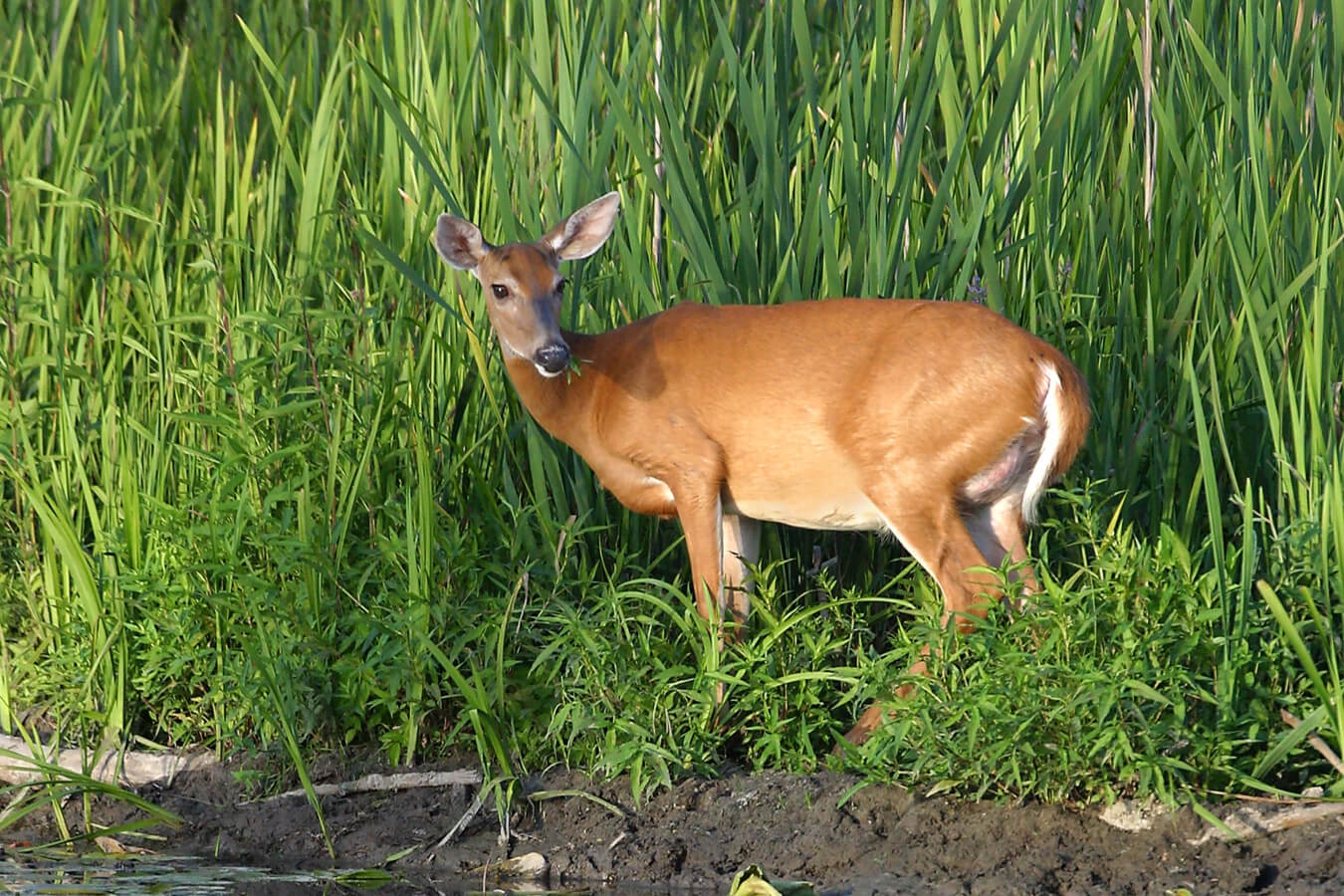
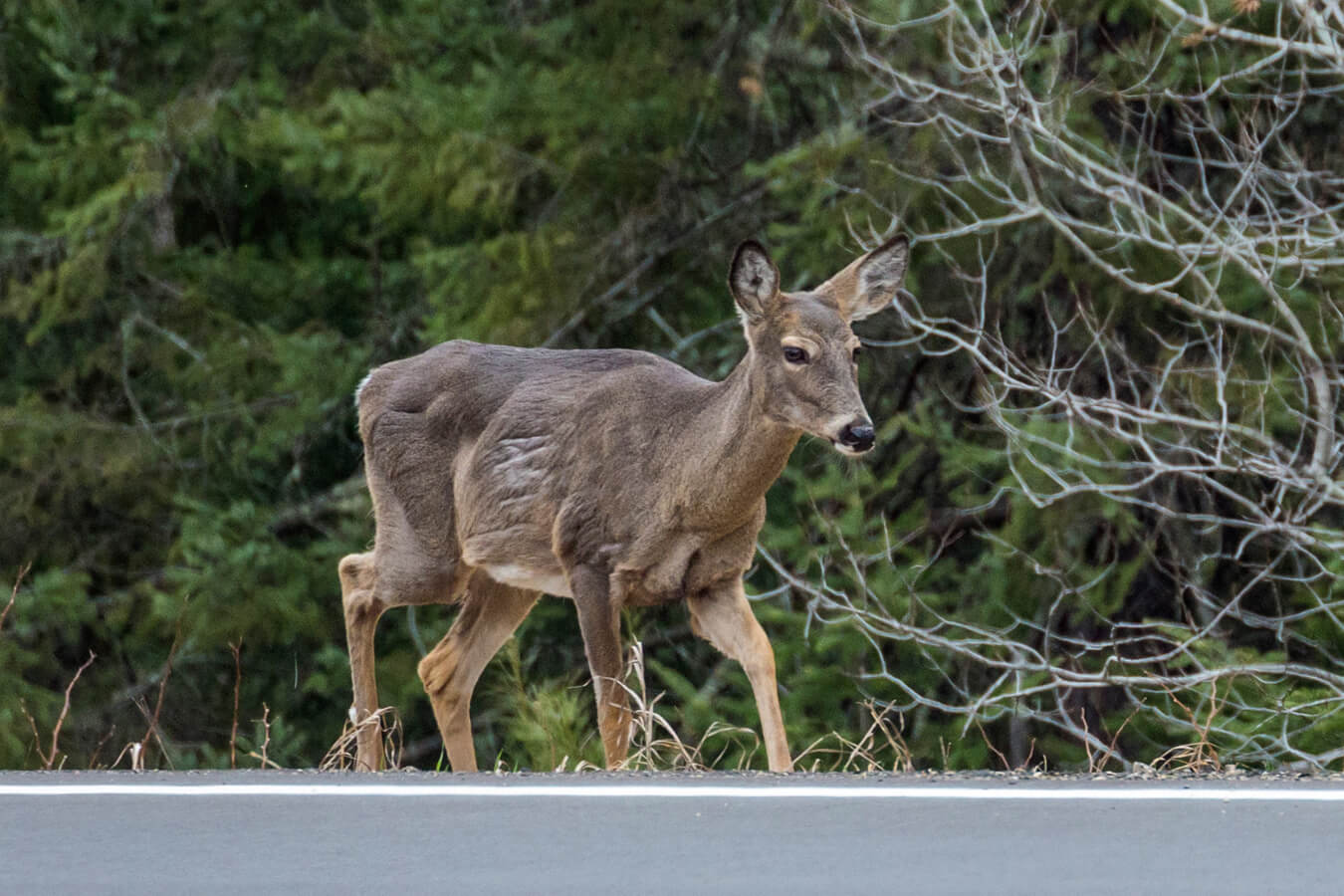
The summer coat is red-brown and the winter coat gray-brown. Bucks and does are colored alike, with these markings:
- White belly and rump: The belly and underside of the tail stay white year round.
- Throat patch: A white patch on the throat.
- Face: White rings around the eyes and a white ring around the muzzle.
- Ears: Whitish patches line the inside of the ears.
The species is named for its large, broad white tail. When a whitetail is alarmed, it raises the tail and runs. This is called “flagging,” because the deer waves its tail like a white flag as it flees. For a photographer, a raised tail usually means the moment is already over.
White-tailed Deer or Mule Deer?
In much of the West, white-tailed deer share parks with mule deer (Odocoileus hemionus). The two can be told apart by antler shape and by the size and appearance of their tails. At Devils Tower, where both species live year round, look at the face and the hind end:
- Face: A mule deer’s face is mostly light brown. A white-tailed deer has more white around the nose and ears.
- Ears: Mule deer have much larger ears set at a greater angle from the head. A whitetail’s ears are smaller, more upright, and rounded.
- Antlers: Mule deer antlers fork multiple times. White-tailed deer antlers grow from a single main beam.
- Gait: Mule deer bound, hopping with all four feet at once. White-tailed deer gallop.
- Tail: A mule deer’s tail has a black tip and stays lowered. A whitetail’s larger tail rises to show the white underside when the deer is on alert.
At Big Bend National Park, habitat separates the two. Here the Carmen whitetail keeps to elevations over 4,000 feet, where there is standing water and thick cover, and mule deer take the rugged canyons and more open slopes. For more on the western species, see our Mule Deer page.
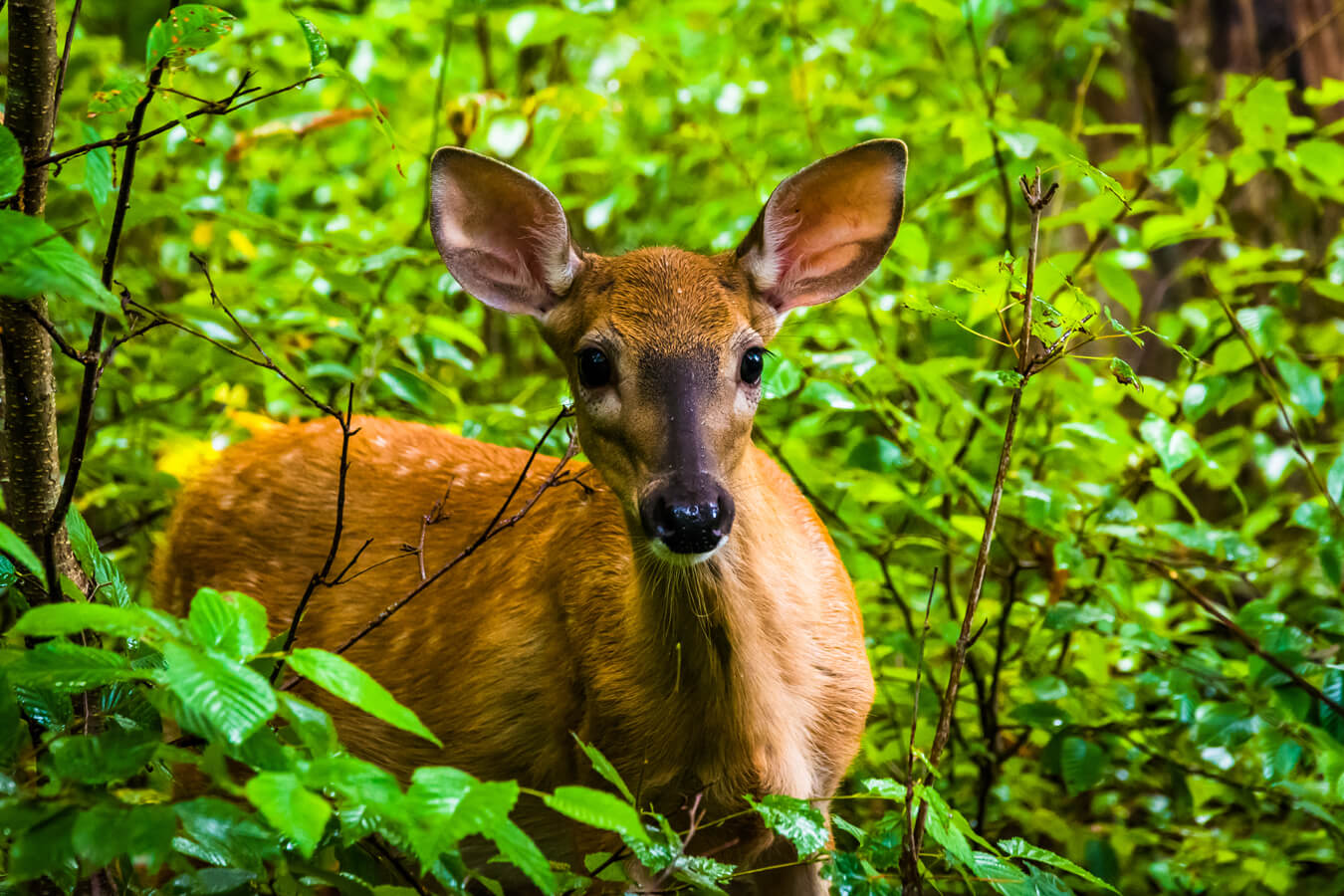
Habitat and Range
White-tailed deer are adaptable, and their numbers vary a great deal from park to park:
- Acadia: Deer are plentiful, while moose are very rarely seen.
- Great Smoky Mountains: One of three hoofed mammals in the park, commonly seen in open areas such as Cades Cove and Cataloochee Valley.
- Mammoth Cave: One of the most common mammals in the park.
- Indiana Dunes: The largest herbivore in the park, living throughout it.
- Yellowstone: Uncommon and not tracked by the park; look near waterways on the northern range.
- Devils Tower: Found throughout the park, often lying hidden in tall grass.
Yellowstone has never held many whitetails. The park suggests the northern range’s habitat and elevation may limit them, or that other hoofed animals better adapted to the park outcompete them. Jewel Cave tells the opposite story: once fresh grass sprouts in recently burned, open ground, whitetails do well there. Deer can cross water, too. Deer swim better than most people expect, and in Voyageurs National Park visitors sometimes watch one paddling out to an island, as wolves, bears, and moose also do.
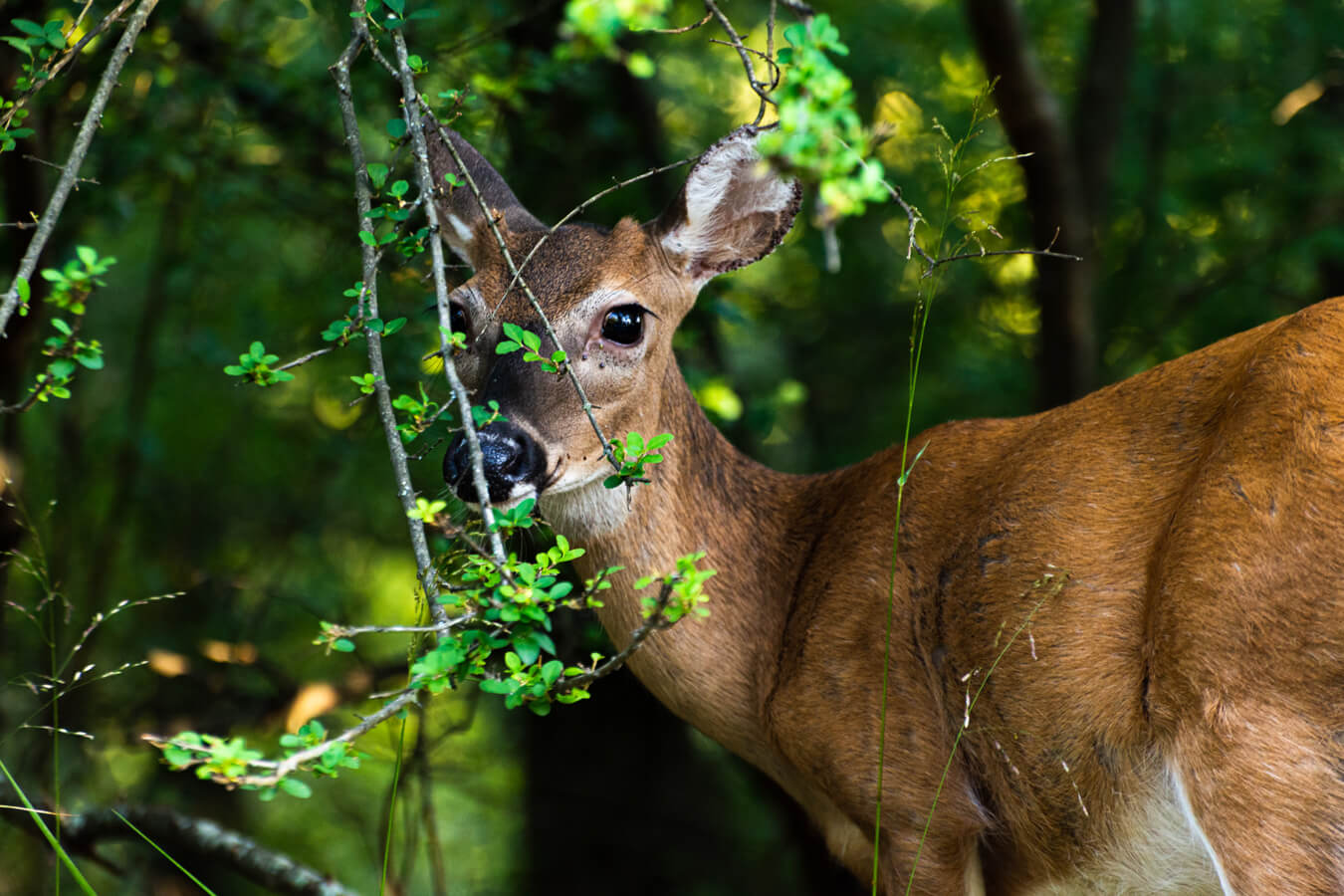
Behavior and Diet
White-tailed deer are semi-gregarious. Does often gather in small groups made up of a few females and their young. Outside the breeding season, bucks commonly travel together in bachelor groups. Dawn and dusk are the best times to see deer in Acadia. In Mammoth Cave National Park, deer are hit by vehicles every year, a reminder to watch for wildlife and obey posted speed limits.
Deer are herbivores. They feed mainly on grasses, shrubs, and forbs, with conifers in spring in Yellowstone. Whitetails are pickier about food than mule deer. They choose the most nutritious plants and plant parts, use farm fields such as corn, soybeans, and alfalfa, and eat acorns, mushrooms, fruits, and broad-leaved plants.
Deer that live around people can lose their wariness. At Fire Island National Seashore, some deer tend not to flee, so people try to touch or feed them. Feeding can change deer behavior and affect their health, and food-conditioned deer are more likely to approach people, get tangled in fencing, or be hit by vehicles.
Their predators are wolves, coyotes, cougars, and bears. Mountain lions rely heavily on robust white-tailed deer populations, and coyotes and bobcats are major predators of fawns.
Antlers and the Rut
Bucks grow and shed a new set of antlers every year. Bone, cartilage, and blood vessels make up an antler. Diet and genetics largely decide how big they grow and what shape they take. Until they finish growing, antlers wear a living skin known as velvet. Yellowstone bucks grow their antlers between May and August. Shedding dates vary: after the fall rut, typically late December to February, in Mammoth Cave; late fall or early winter on Fire Island; and early to late winter at Devils Tower.
The rut peaks in November in both Yellowstone and Devils Tower. Day length (photoperiod) sets off breeding, which is why the timing shifts from region to region. Bucks advertise themselves in several ways:
- Sparring: Bucks fight with their antlers. They lock antlers until one submits.
- Rubs: Bucks rub their antlers and the tops of their heads on trees.
- Scrapes: Bucks scrape the ground down to bare dirt.
Each of these leaves scent and signals rank, and the highest-ranking bucks get first pick of does. A doe is receptive for only 24 to 36 hours, and if she does not breed, she comes into heat again 28 days later.
Fawns
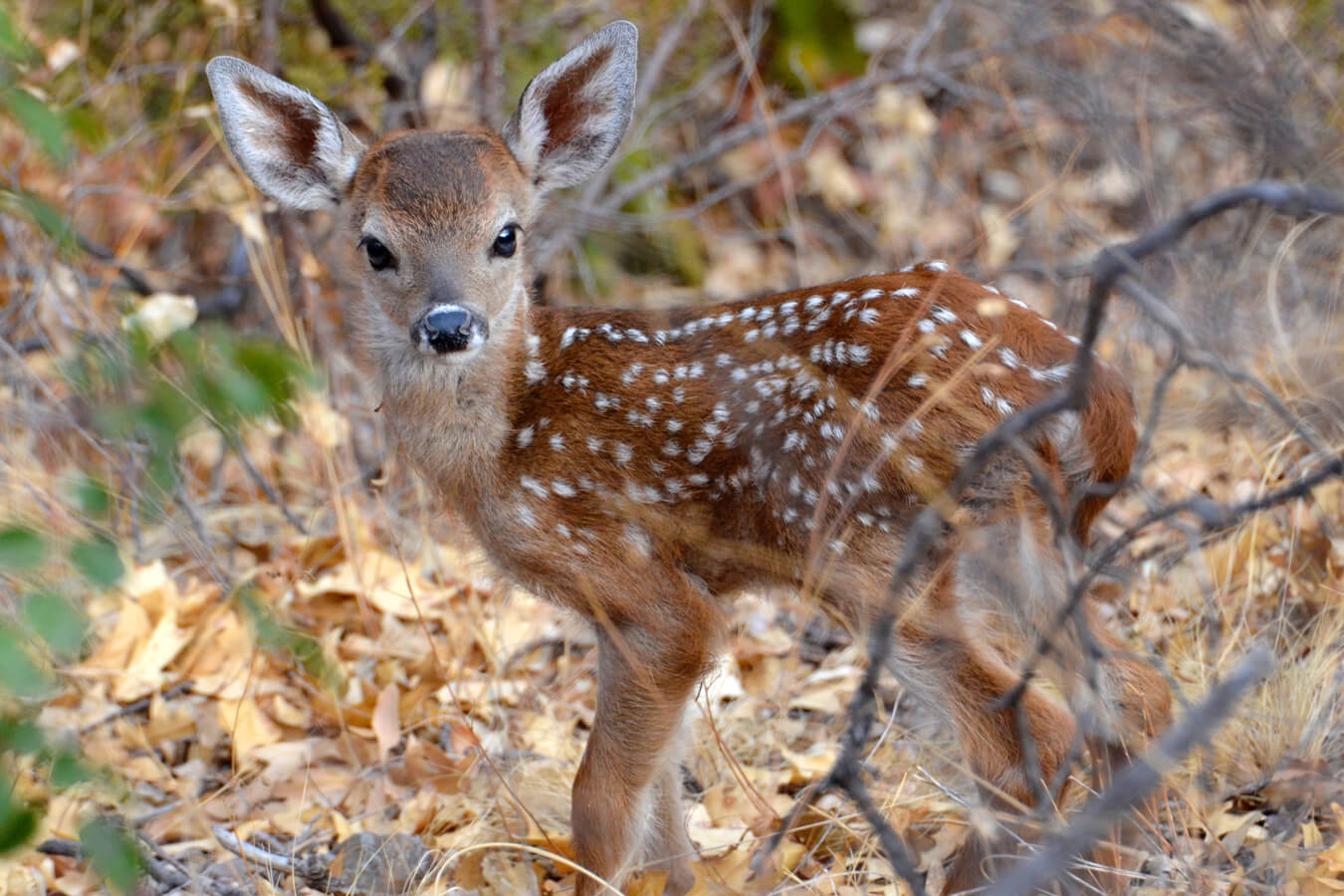
A doe is pregnant for about 200 days. Yellowstone and Devils Tower fawns usually arrive in late May or June. Farther south in the Appalachians, most births come in late June. A doe typically has one or two fawns, and triplets or quadruplets are occasionally born. Twins are common, and a doe carrying two fawns is usually in excellent condition.
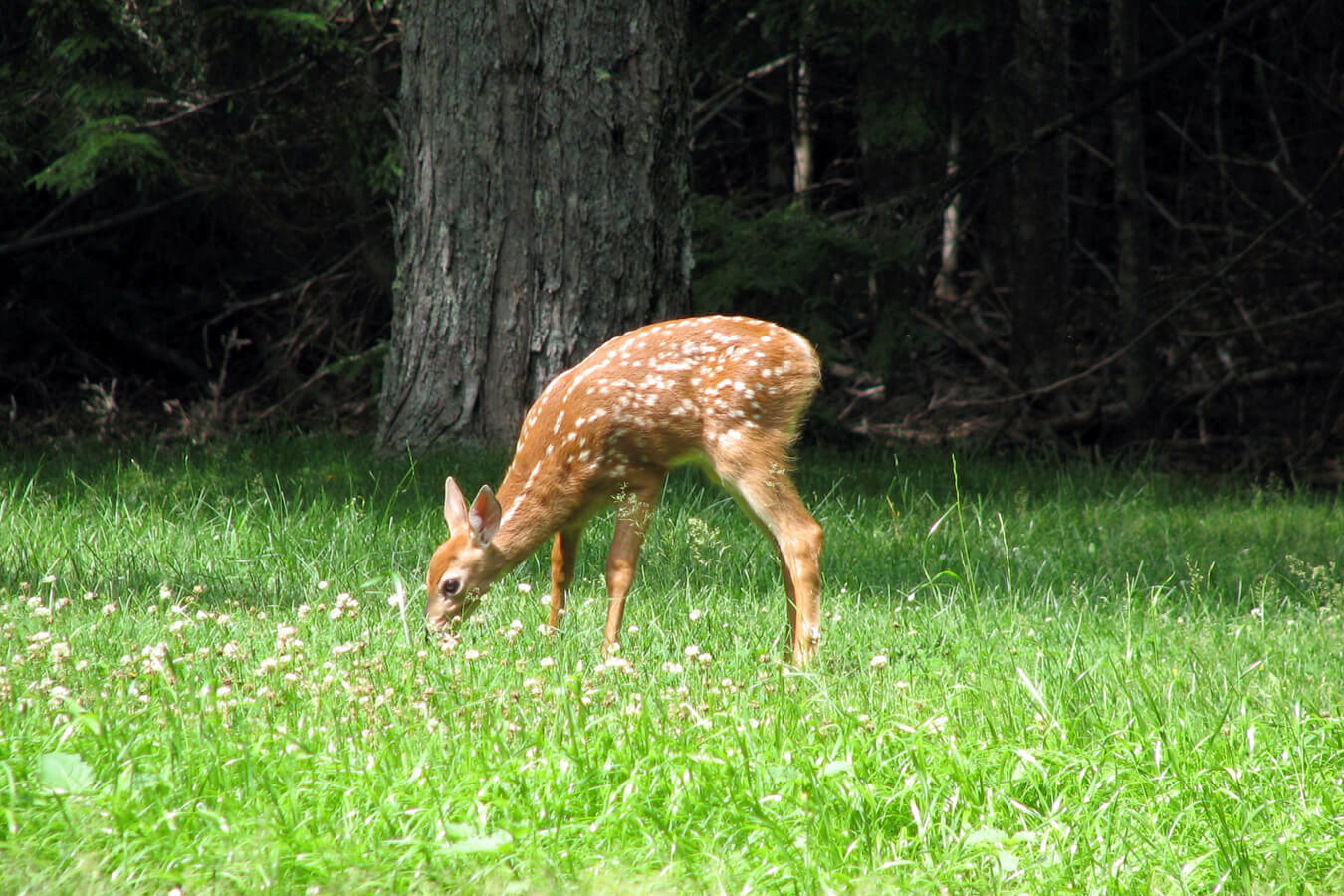
Newborn fawns weigh about 6 to 8 pounds and can stand within a couple of hours. Their spotted coats help them blend in. Fawns can’t outrun predators at first, so they survive by lying still in tall vegetation or forest where their mother leaves them. For the first few weeks the doe stays away for hours at a time so her scent doesn’t rub off, which keeps the fawn nearly scentless. By roughly one month of age, fawns can keep up with their mothers while they feed.
Finding a fawn alone is normal. Mammoth Cave and Jewel Cave both ask visitors not to approach or disturb a lone fawn, because its mother will be back soon.
Too Many Deer in Eastern Parks
Eastern deer herds were heavily exploited after Europeans arrived around 1600, then began to increase in the early 1900s because of a lack of predators and more food and habitat. Given plenty of food and no natural predators, a herd can double in size in just two or three years. On Fire Island, where no natural predators remain, most deer reach six to ten years of age and some live longer.
Researchers who surveyed forests in 39 eastern parks between Maine and Virginia concluded that heavy deer browsing was a leading reason young canopy trees were scarce or missing beneath the forest in most of those parks. Catoctin and Rock Creek Park both cite research showing that vegetation damage occurs when deer exceed 20 per square mile. Parks that reduced their herds are seeing results:
- Catoctin Mountain Park: About 123 deer per square mile in fall 2009. After management began in 2010, tree seedling density increased 21-fold.
- Rock Creek Park: Tree seedling density has more than doubled since deer reduction began in 2013.
- Valley Forge National Historical Park: An estimated 241 deer per square mile in 2009, with a target of 20 to 25. Early results show seedling numbers up 850%.
- Cuyahoga Valley National Park: More than 78 deer per square mile in 1999, down to 18 in fall 2023, the lowest recorded.
Cuyahoga Valley reports that the deer gain as well. With fewer animals, their body weight, a measure of health, has gone up. Indiana Dunes National Park has too many deer because few predators remain and others are gone entirely. The deer there eat almost every plant they can reach, rare species included.
Other plants recover along with the trees. Catoctin’s 2016 count found more purple fringed orchids, a state-threatened plant, than the 2008 count did, and over ten times as many downy rattlesnake plantain orchids. Fences that had guarded the purple fringed orchids since the late 1980s are no longer needed. Parks also count their deer. In February 2023, Mammoth Cave announced an aerial survey using infrared cameras on fixed-wing aircraft flying above 1,000 feet to give a baseline census of the deer inside the park.
Chronic Wasting Disease
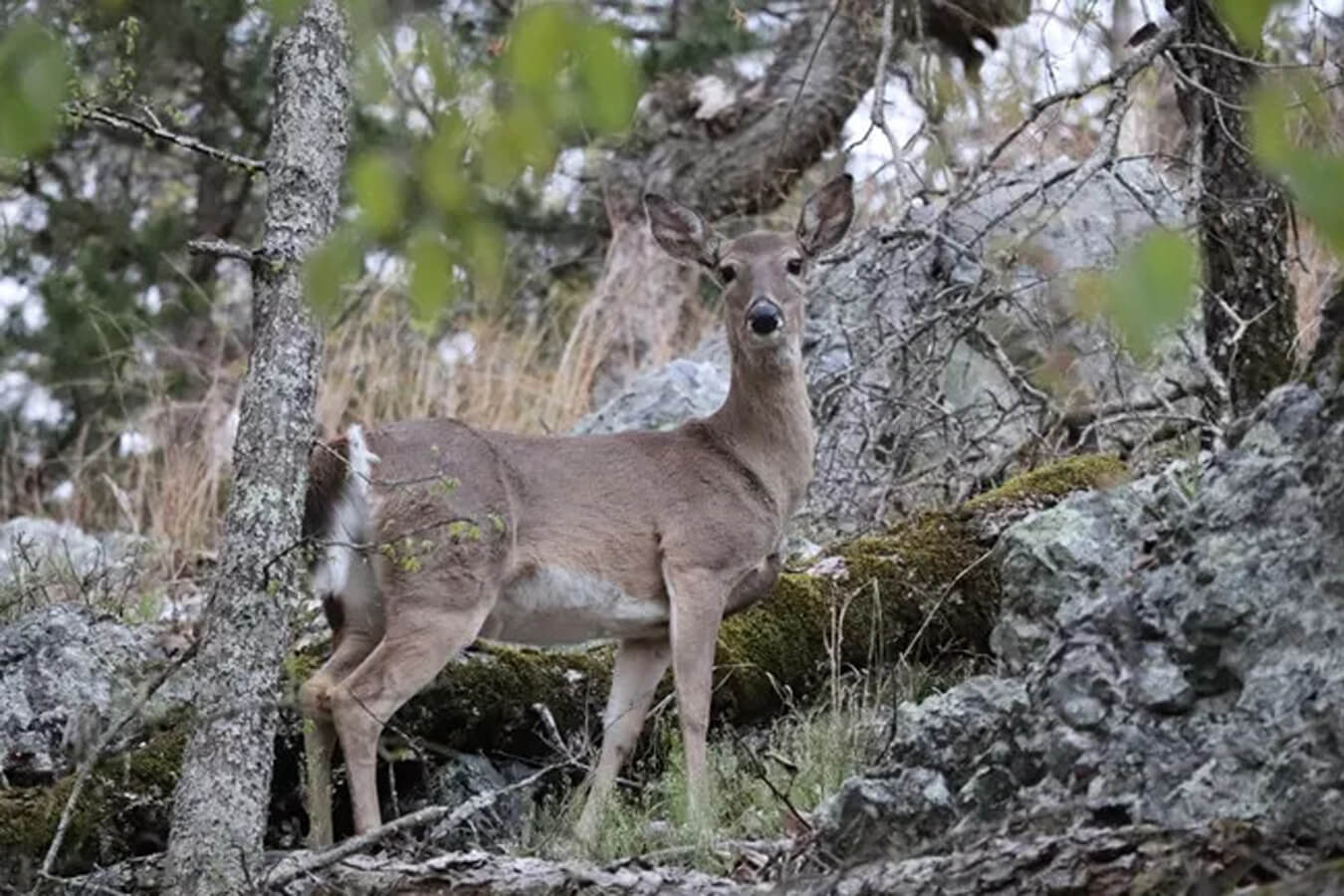
Deer, elk, and moose are all vulnerable to chronic wasting disease (CWD), an illness that passes between animals and damages the nervous system. It is caused by abnormally shaped proteins called prions, which degenerate the brain. Sick deer waste away, act strangely, and lose control of their bodily functions. The disease is generally fatal, and there is no known cure. Prions are likely shed in saliva, feces, and urine and can remain infectious in soil for many years. The CDC and the World Health Organization report no evidence that people can catch CWD. Staggering, drooping head and ears, drooling, and a loss of fear show up only late in the disease.
Shenandoah has a CWD Response Plan that allows the park to reduce deer densities in some front-country areas to levels similar to the backcountry. As of the park’s 2019 update, the nearest confirmed case was roughly 10 miles away, near Strasburg, Virginia. Any removals would probably happen at night between November and March, while Skyline Drive or facilities nearby are shut. If you see a sick or emaciated deer in Shenandoah, the park asks you to call 540-999-3500 x3397 with specific location information. Keeping predator populations intact helps keep deer numbers in check and protects deer from diseases like CWD.
National Park Presence
White-tailed deer live in many of the 63 designated U.S. National Parks. For photographers, white-tailed deer can be found in the following parks:
According to National Park Service NPSpecies records, white-tailed deer are listed as abundant in Acadia, Cuyahoga Valley, Indiana Dunes, Mammoth Cave, and Shenandoah, and as common in parks including Great Smoky Mountains, New River Gorge, Congaree, Everglades, Voyageurs, Badlands, and Glacier. Yellowstone and Grand Teton list them as uncommon. Crater Lake’s record is for the Columbian white-tailed deer, and Virgin Islands National Park lists its deer as non-native.
White-tailed Deer Photography Tips
Park pages point to several reliable spots:
- Great Smoky Mountains: The Cades Cove loop road and the Roaring Fork Motor Nature Trail.
- Acadia: The Sieur de Monts area and the carriage roads, at dawn or dusk.
- Mammoth Cave: Near the visitor center and along roadsides.
- New River Gorge: The fields and forests at Grandview.
- Devils Tower: Near the park road and along the Tower Trail.
Deer used to roadsides can make it tempting to walk right up to them. Don’t. Great Smoky Mountains sets a minimum of 25 yards from elk, and more if an animal reacts to you. Feeding, touching, or deliberately disturbing any wildlife there is against the law. A longer lens lets you fill the frame without pushing a deer into flight.
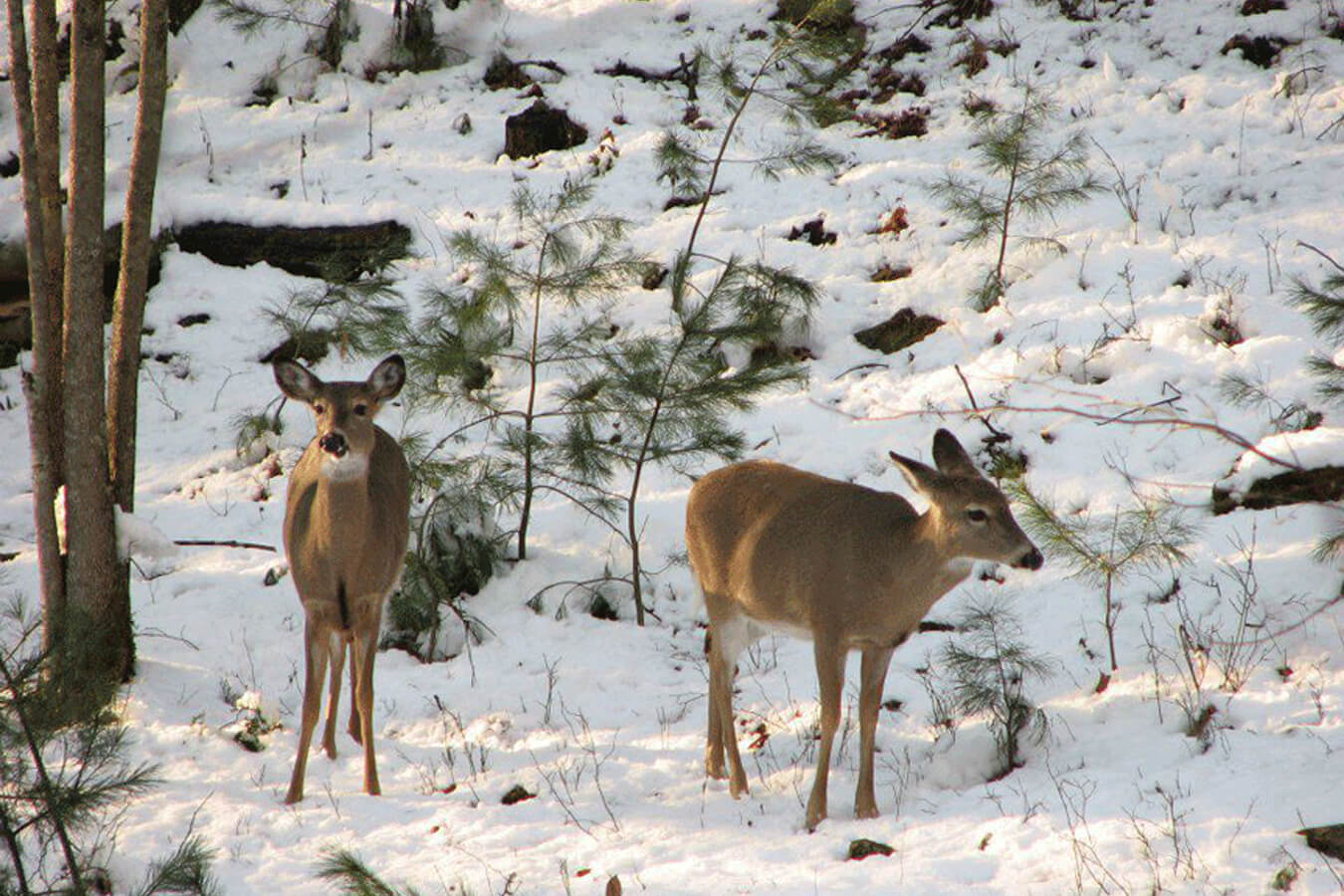
Timing matters. Deer are most visible around dawn and dusk, when the light is also softest. In snow, a gray-brown winter coat stands out cleanly against white. Late spring brings spotted fawns (photograph them from a distance and never move one), late summer shows bucks in velvet, and late fall brings the rut.
A telephoto lens is essential for photographing white-tailed deer responsibly. If you already own or want to own a professional-grade mirrored camera like the Canon EOS 5D Mark IV Full Frame Digital SLR, we recommend using a Canon EF 100-400mm f/4.5-5.6L IS II USM Lens zoom lens for wildlife photography. If you have or are interested in a newer mirrorless model like the Canon EOS R5 Full-Frame Mirrorless Camera, we recommend using a Canon RF100-400mm F5.6-8 IS USM for long-distance shots.
Not quite ready to invest in traditional professional-grade camera equipment but want to enhance the quality of your cell phone photographs? Consider using a Moment Tele 58mm Mobile Lens II for improved reach, and use a Moment camera case with a lens mount to attach it to your phone. Since cell phones generally cannot provide the same reach as a dedicated telephoto camera lens, never compensate by moving dangerously close to wildlife.
No photograph is worth disturbing an animal or putting yourself or others at risk.
A Note About White-tailed Deer Taxonomy
Readers researching white-tailed deer may encounter several scientific names. This page uses:
Odocoileus virginianus
However, some National Park Service records and older references use subspecies names, including:
Odocoileus virginianus virginianus, Odocoileus virginianus carminis, Odocoileus virginianus texanus, Odocoileus virginianus leucurus, and Odocoileus leucurus
NPSpecies lists carminis as a synonym in Big Bend, home of the Carmen whitetail. Within U.S. borders, this subspecies turns up only in the park and in a handful of nearby, isolated mountain ranges. At an average of 67 pounds, it is the smallest of Texas’s four whitetail subspecies, and it favors high ground over 4,000 feet with water close by and thick growth like oak woodland. Crater Lake’s record carries the common name Columbian white-tailed deer, with leucurus synonyms.
For consistency throughout National Park Photographer, this page uses Odocoileus virginianus while recognizing the other names visitors may encounter.
Final Thoughts
White-tailed deer are easy to overlook, yet they tell a big story about our National Parks: how the loss of predators changed eastern forests, and how parks are now working to restore a balance between deer and the plants they depend on.
Whether it’s a fawn at Acadia, a pair of deer in snow in the Smokies, or a deer along the Limberlost Trail, whitetails reward a patient photographer. Keep your distance and watch the edges of fields at first and last light.
Want more information about the amazing wildlife that call our National Parks home? Take a look at our National Park Wildlife page to explore the various parks and the animals in them. Planning on visiting a National Park in the near future? Be sure to follow park regulations, practice Leave No Trace principles, and prioritize both your safety and the well-being of wildlife while exploring.
Joyful Journeys!
Bonnie, Co-Owner, National Park Photographer
Want to learn more about white-tailed deer? Check out the additional resources below!
White-tailed Deer Books & Field Guides
- The Deer of North America
- Peterson Field Guide to Mammals of North America
- Mammal Tracks & Sign: A Guide to North American Species
- 10×42 Binoculars for Wildlife Viewing
- Monocular for Wildlife Viewing
- Camera Bean Bag for Wildlife Photography
Please note, by making purchases through our affiliate links, you are supporting our mission to celebrate and showcase our National Parks and the photographers who frequent them. As an Amazon Associate, National Park Photographer earns from qualifying purchases at no cost to you. We appreciate your support.
References & Additional Resources
- National Park Service — Yellowstone National Park: White-tailed Deer
- National Park Service — Devils Tower National Monument: Ungulates (Hoofed Animals)
- National Park Service — White-Tailed Deer at Devils Tower
- National Park Service — Jewel Cave National Monument: White-tailed Deer
- National Park Service — Fire Island National Seashore: White-tailed Deer
- National Park Service — Great Smoky Mountains National Park: Mammals
- National Park Service — Great Smoky Mountains National Park: Wildlife Viewing
- National Park Service — Acadia National Park: Mammals
- National Park Service — Shenandoah National Park: Mammals
- National Park Service — Shenandoah National Park: Chronic Wasting Disease (CWD)
- National Park Service — Mammoth Cave National Park: Mammals
- National Park Service — Mammoth Cave National Park: Aerial Study of White-Tailed Deer
- National Park Service — New River Gorge National Park & Preserve: Mammals
- National Park Service — New River Gorge National Park & Preserve: Watchable Wildlife
- National Park Service — Voyageurs National Park: Mammals
- National Park Service — Indiana Dunes National Park: White-tailed Deer
- National Park Service — Big Bend National Park: What Mammal Did I See
- National Park Service — Catoctin Mountain Park: White-tailed Deer Management
- National Park Service — Rock Creek Park: White-Tailed Deer Management
- National Park Service — Valley Forge National Historical Park: White-tailed Deer Management
- National Park Service — Cuyahoga Valley National Park: White-tailed Deer Management
- National Park Service — Response of the Forest to Reduced Impacts of White-tailed Deer
- National Park Service — Eastern Parks Reduce Herds to Benefit Forests, Deer, and People
- National Park Service — NPSpecies Species Search
Do you want to be featured on National Park Photographer?
Why wait! Contact us today at nationalparkphoto@gmail.com for a chance to be a Featured National Park Photographer!