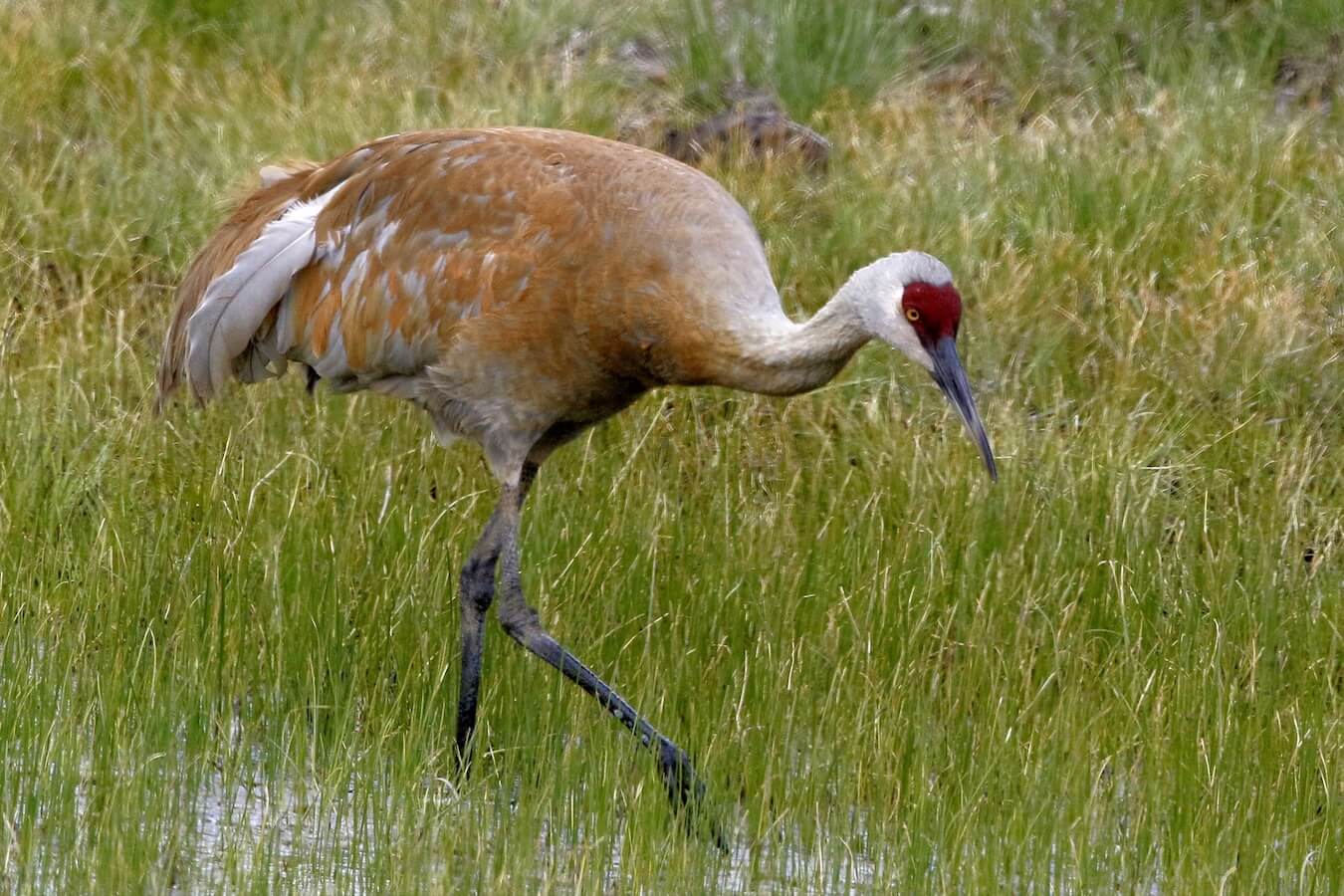
The rolling, rattling call of a sandhill crane is one of the oldest sounds on the continent, and it often reaches you well before the bird comes into view. Then a tall gray shape steps out of the grass, red crown bright against the meadow, and moves with a slow, deliberate stride that seems to belong to another age. Watch a pair long enough in spring and you may even see them dance.
The sandhill crane (Antigone canadensis) belongs to Gruidae, the crane family, which includes 15 species worldwide. It is the most numerous crane on Earth, breeding from Siberia and Alaska across Canada to the northern United States, with resident populations in Florida, Mississippi, and Cuba. NPSpecies records list sandhill cranes as present in 35 National Parks, including Denali, Everglades, Grand Teton, Indiana Dunes, and Yellowstone.
Learning about animals like sandhill cranes can significantly enhance wildlife photography skills by providing valuable insights into animal behavior, habitat, and physical characteristics. Understanding an animal’s habits can allow photographers to better anticipate and capture unique and authentic moments. Knowledge of an animal’s habitat may also help in selecting the best locations and times for wildlife viewing and photography, while familiarity with physical characteristics is essential for accurately identifying wildlife in the field. If wildlife photography or simply wildlife viewing are of interest to you, then you’ve come to the right place! Together, let’s learn more about what makes sandhill cranes so special.
Physical Characteristics
Sandhill cranes are among the tallest birds in North America. In Yellowstone, where they are the tallest birds in the park, adults stand about 4 feet high and have a wingspan of roughly 6.5 feet. From a distance, a crane standing in tall grass is sometimes mistaken for a person. Size varies by population. The lesser sandhill cranes that nest in the Arctic weigh around 6 to 8 pounds, while greater sandhill cranes can reach 10 to 14 pounds. Males and females look alike, although males are usually a little larger.
Look for these features:
- Crown: A patch of bare red skin on the forehead and crown, which the bird can expand when excited.
- Cheeks: White or pale gray cheeks below the red crown.
- Body: Mostly gray, with long legs and a long neck.
- Tail: A bushy “bustle” of long feathers that droops over the tail.
- Bill: Long, straight, and dark.
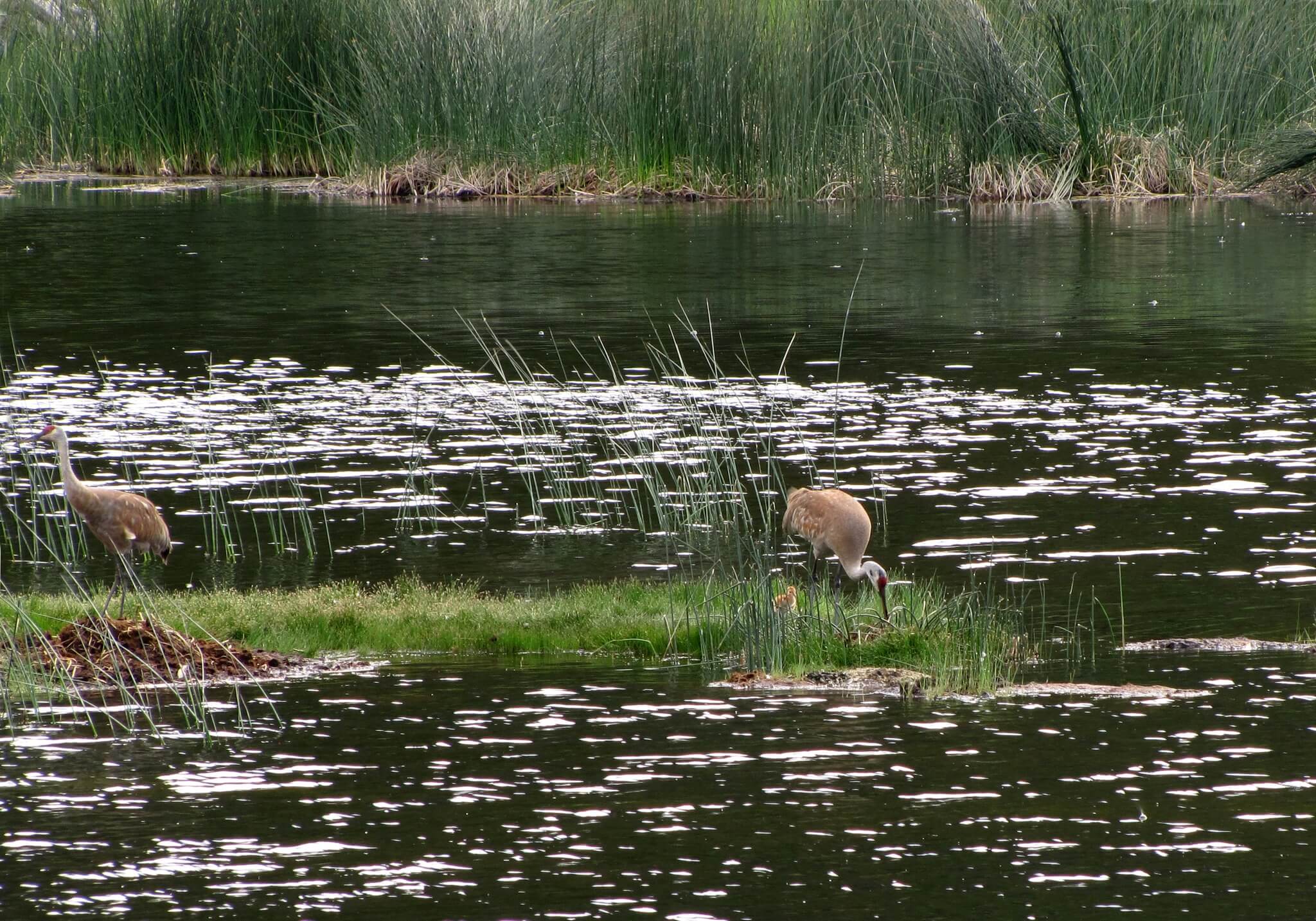
Many sandhill cranes in summer are not gray at all, but rusty brown. That color comes from the birds themselves. Cranes preen their feathers with mud, and in areas where the soil is rich in iron, the mud stains the feathers a reddish brown. The stain fades as new feathers grow in after the molt.
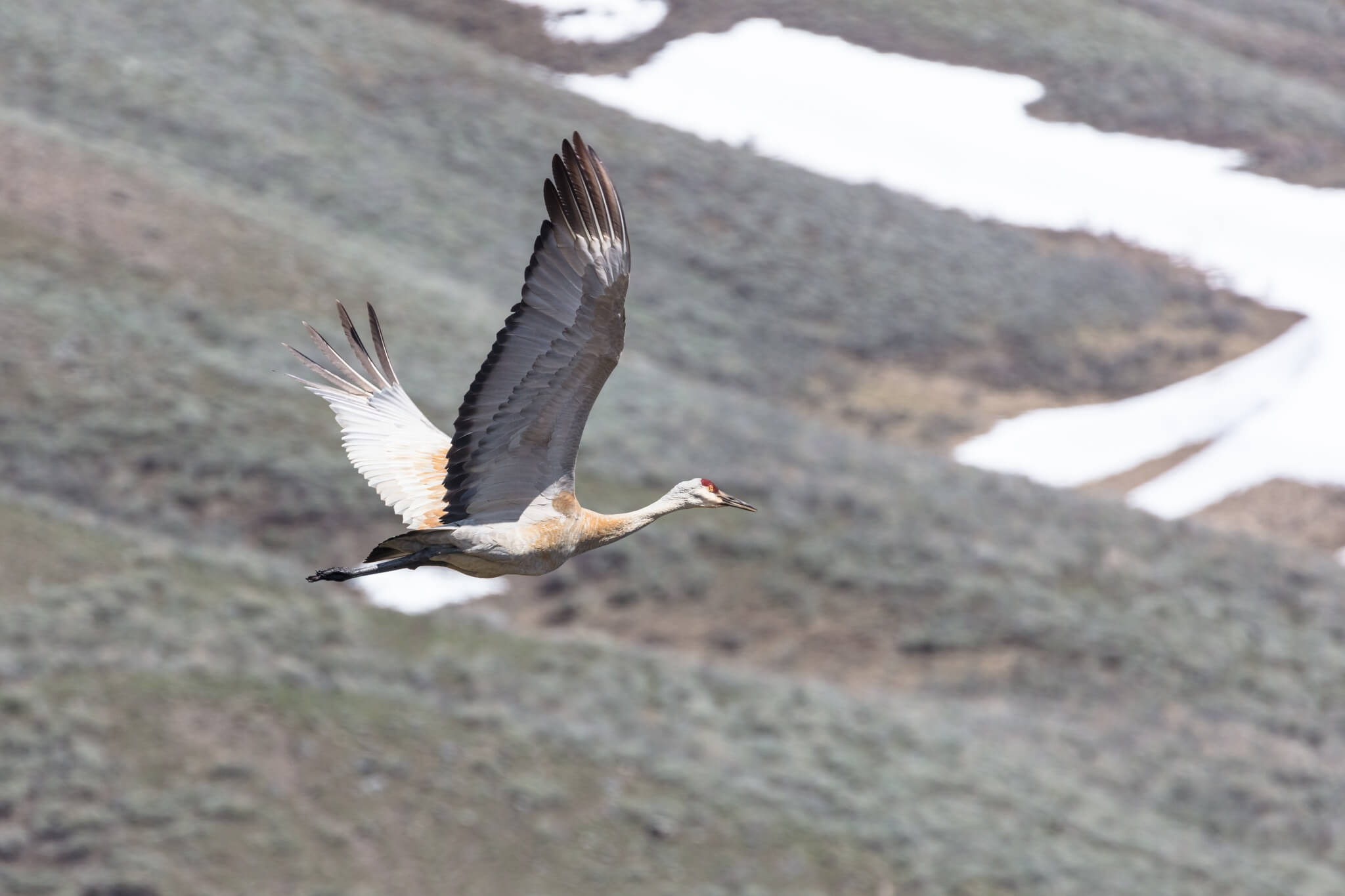
In flight, sandhill cranes fly with their necks stretched straight out and legs trailing behind, unlike herons, which fold their necks back. They often fly in long lines or V-shaped flocks, calling as they go, and they can soar on rising air for long distances without flapping.
Calls
The sandhill crane’s call is a loud, rolling, trumpeting rattle that can carry for more than two miles. Their windpipe is long and coiled inside the breastbone, which helps produce that deep, resonant sound.
Cranes use several kinds of calls:
- Unison call: A coordinated duet given by a mated pair, with the male and female calling in a set pattern. It strengthens the pair bond and warns other cranes away from the territory.
- Guard call: A single loud note given when a crane senses danger.
- Contact calls: Softer purring calls used to keep a family or flock together.
- Flight calls: The rattling calls you often hear from flocks high overhead during migration.
In a unison call, both birds throw their heads back and point their bills to the sky. The female usually gives two notes for every one of the male’s, and the pair’s calls sound like a single long song. Each pair’s duet is slightly different.
Young cranes, called colts, have a high, chirping whistle that slowly deepens into the adult rattle over their first year. Hearing a colt’s peeping call in a summer meadow is often the first clue that a family is nearby.
Dancing and Pair Bonds
Sandhill cranes are famous for dancing. A dancing crane bows, leaps into the air with wings spread, bounces, and sometimes tosses grass or sticks over its head. Often the mate joins in, and a dance can spread through a whole flock.
Cranes dance for several reasons:
- Courtship: Dancing is part of how cranes choose a mate and renew their bond each spring.
- Pair bonds: Sandhill cranes usually mate for life, and pairs often stay together year-round.
- Stress relief: Dancing may help release tension or aggression within a flock.
- Practice: Young cranes dance, too, possibly as a way to build coordination and social skills.
Spring is the best season to see dancing, especially at the great migration stops where thousands of cranes gather. In Colorado’s San Luis Valley, near Great Sand Dunes National Park and Preserve, more than 20,000 cranes stop each spring and fall, and pairs renew their bonds through bowing, dancing, and calling.
Cranes are slow to breed. Most do not raise young until they are two to seven years old, and a pair usually raises only one or two colts a year. Long-lasting pairs and long lives help balance that slow pace. Sandhill cranes can live 20 years or more in the wild.
Habitat and Range
Sandhill cranes need open wetlands. They nest in marshes, bogs, wet meadows, and the edges of shallow lakes, where they can see predators coming and wade in the water when needed. Outside the nesting season they spend much of their time in open grasslands and farm fields, often returning to shallow water at night to roost.
Migratory populations breed in Alaska, Canada, the Great Lakes region, and the northern Rocky Mountains, then winter in California, the Southwest, Texas, Mexico, and the Southeast. Three populations stay put all year:
- Florida: Florida sandhill cranes live in the state’s prairies and marshes year-round.
- Mississippi: A small, endangered population lives in the pine savannas of the Mississippi Gulf Coast.
- Cuba: A small resident population lives on the island.
Alaska holds a large share of the world’s sandhill cranes in summer. Lesser sandhill cranes nest across the tundra and boreal wetlands of the state, and big flocks pass over the interior each spring and fall. In Denali, Gates of the Arctic, and Wrangell-St. Elias, their rattling calls overhead are often the first sign that migration has begun.
In national parks, crane habitat ranges from the tundra of Denali and Gates of the Arctic to the sagebrush meadows of Grand Teton and Yellowstone and the sawgrass prairies of Everglades. In Yellowstone, cranes nest in wet meadows and marshy areas throughout the park, and their gray feathers blend into the surrounding grassland so well that their calls are often the only way to find them.
Diet
Sandhill cranes are omnivores that eat almost anything they can find in a meadow, marsh, or field. Their diet includes:
- Plants: Seeds, roots, tubers, and berries.
- Grains: Corn, wheat, barley, and other leftover grain in farm fields.
- Invertebrates: Insects, worms, snails, and crayfish.
- Small animals: Mice, frogs, snakes, and sometimes the eggs and young of other birds.
Cranes forage by walking slowly and probing the ground with their bills. They often dig into soft soil or mud to pull out roots and tubers, and they can strike quickly to catch insects, frogs, or small mammals.
During migration, waste grain left behind in harvested fields is a key food source. In the San Luis Valley, cranes build up energy by feeding on grain in farm fields and on invertebrates and amphibians in wetlands. They usually spend the day feeding in fields and return to shallow wetlands from sunset to sunrise, where standing in water helps protect them from predators while they sleep.
Nesting and Colts
Sandhill crane pairs build their nests on the ground or in shallow water, usually in a marsh or wet meadow. The nest is a mound of plant material, sometimes surrounded by water. The female usually lays two eggs, and both parents take turns incubating for about a month.
Young cranes are called colts. They are covered in cinnamon-colored down and can leave the nest within a day of hatching. From there, development moves quickly:
- First days: Colts follow their parents through the marsh and are fed insects and other small foods.
- First weeks: They begin finding food on their own while staying close to the adults.
- About two to two and a half months: They can fly.
- First year: Colts stay with their parents through fall migration and the winter, often until the next spring.
Although two eggs are usually laid, often only one colt survives. Siblings sometimes fight, and coyotes, foxes, raccoons, ravens, and eagles take eggs and young colts. Parents defend their young fiercely, and adults have been seen spreading their wings and charging at predators much larger than themselves.
Summer is the time to look for colts in parks like Yellowstone and Grand Teton. Families are often visible in wet meadows along roads, and colts grow so quickly that a fuzzy chick in June can look almost like an adult by late August.
Migration
Most sandhill cranes are long-distance migrants. Every spring and fall, hundreds of thousands make journeys of hundreds to thousands of miles between their breeding and wintering grounds. Many stop at a few traditional places along the way, where they rest and refuel.
The most famous of these stops is the Platte River in Nebraska, where hundreds of thousands of cranes gather each March before continuing north. The San Luis Valley in Colorado is another major stop for cranes from the Rocky Mountain population. Cranes there arrive in early February, leave by late March, and return from late September through November.
Migrating cranes are very good at using the weather. They often wait for favorable winds and then ride rising columns of warm air called thermals, soaring in circles to gain height before gliding long distances. On a good day, a flock can cover several hundred miles.
Some of these stops have become events in their own right. The Monte Vista Crane Festival has welcomed visitors to the San Luis Valley each March for decades, with guided tours to the fields and wetlands where cranes feed and roost. Along the Platte, viewing blinds let people watch the birds come in at dusk without disturbing them. Visiting one of these gatherings is the easiest way to see hundreds or even thousands of cranes at once.
Watching a migration is a sight many people never forget. Long, wavering lines of cranes stream across the sky, calling the whole time. Some flocks fly so high they are barely visible, and their calls seem to come from nowhere.
Cranes and Conservation
Sandhill cranes have a long history in North America. Fossils show that cranes have lived in North America for millions of years, and the sandhill crane is often described as one of the oldest bird species still living on the continent.
That long history almost came to an end in parts of the country. By the early 1900s, hunting and the draining of wetlands had pushed sandhill cranes out of much of their range. Protection under the Migratory Bird Treaty Act of 1918 and the restoration of wetlands helped them recover, and today most migratory populations are stable or growing.
The resident populations are another matter. The Mississippi sandhill crane is listed as endangered, with only around 100 to 150 birds living in a national wildlife refuge set aside for them. The Cuban population is also very small. Florida’s resident cranes are listed as threatened by the state, as their prairie and marsh habitat continues to be lost to development.
Wetland protection is the single biggest factor in the sandhill crane’s future. The same marshes, wet meadows, and shallow rivers that cranes need also support countless other species, which is one more reason to protect them.
National Park Presence
Sandhill cranes live in many of the 63 designated U.S. National Parks. For photographers, sandhill cranes can be found in the following parks:
According to National Park Service NPSpecies records, sandhill cranes are listed as common in Badlands, Glacier Bay, Grand Teton, Indiana Dunes, Kenai Fjords, Wrangell-St. Elias, and Yellowstone and as uncommon in parks such as Big Bend, Denali, Isle Royale, Katmai, Voyageurs, and Wind Cave. Many other parks list them as occasional or rare, often because cranes only pass through during migration. Dry Tortugas National Park lists the sandhill crane as occasional and non-native, an unusual record for a bird native to Florida, so treat it with caution. Great Sand Dunes National Park and Preserve lists cranes only as probably present, even though thousands pass through the surrounding San Luis Valley. A few hundred do feed and roost in wetlands inside the park boundary, but that land is owned by The Nature Conservancy and is not open to the public.
Sandhill Crane Photography Tips
Park pages and NPS photos point to several good places to look:
- Yellowstone: Wet meadows in Lamar Valley, Hayden Valley, and around Floating Island Lake, where pairs nest and raise colts each summer.
- Grand Teton: Marshy meadows and sagebrush flats in the valley, especially in spring and early summer.
- Indiana Dunes: Open skies along the Lake Michigan shore during spring and fall migration.
- Everglades: Open prairies, where resident Florida sandhill cranes are rare but possible year-round.
- Great Sand Dunes: The San Luis Valley outside the park, including Monte Vista National Wildlife Refuge, in late February and March and again in the fall.
Keep your distance. Cranes are wary and will walk or fly away if you approach on foot, and nesting pairs can abandon eggs if disturbed. Watch from roads, pullouts, and viewing areas, and use a long lens to fill the frame. Yellowstone National Park, for example, requires visitors to stay at least 25 yards from most wildlife, and many other parks have similar rules.
Timing matters. Early morning and evening light shows off the red crown and the texture of the feathers, and cranes are often most active then. At migration stops, the hour around sunrise and sunset, when flocks leave or return to their roosts, offers the best chance for big flight shots. Use a fast shutter speed to freeze wings, and switch to continuous autofocus for birds in flight. For dancing, stay ready and shoot in bursts, since a leap can last only a second or two.
A telephoto lens is essential for photographing sandhill cranes responsibly. If you already own or want to own a professional-grade mirrored camera like the Canon EOS 5D Mark IV Full Frame Digital SLR, we recommend using a Canon EF 100-400mm f/4.5-5.6L IS II USM Lens zoom lens for wildlife photography. If you have or are interested in a newer mirrorless model like the Canon EOS R5 Full-Frame Mirrorless Camera, we recommend using a Canon RF100-400mm F5.6-8 IS USM for long-distance shots.
Not quite ready to invest in traditional professional-grade camera equipment but want to enhance the quality of your cell phone photographs? Consider using a Moment Tele 58mm Mobile Lens II for improved reach, and use a Moment camera case with a lens mount to attach it to your phone. Since cell phones generally cannot provide the same reach as a dedicated telephoto camera lens, never compensate by moving dangerously close to wildlife.
No photograph is worth disturbing an animal or putting yourself or others at risk.
A Note About Sandhill Crane Taxonomy
Readers researching sandhill cranes may encounter several scientific names. This page uses:
Antigone canadensis
However, most National Park Service records and older references use the earlier name:
Grus canadensis
The sandhill crane was long placed in the genus Grus with many other cranes. Genetic studies showed that it is more closely related to a small group of cranes including the sarus and brolga, and in 2016 the American Ornithological Society moved it to Antigone. Most parks still list it as Grus canadensis, while Black Canyon of the Gunnison and Canyonlands National Parks and the Yellowstone nature pages use Antigone canadensis. Several subspecies are also recognized, including the lesser, greater, Florida, Mississippi, and Cuban sandhill cranes.
For consistency throughout National Park Photographer, this page uses Antigone canadensis while recognizing the other names visitors may encounter.
Final Thoughts
Sandhill cranes connect places that seem worlds apart. A pair nesting in a Yellowstone meadow may winter in New Mexico and rest in Colorado’s San Luis Valley along the way, tying together wetlands across half a continent.
Whether it’s a rusty-stained crane walking a wet meadow in Yellowstone, a pair guarding a colt at Floating Island Lake, or a flock passing high over Lamar Valley, a crane sighting is worth the wait. Listen for the rattle, keep your distance, and be patient.
Want more information about the amazing wildlife that call our National Parks home? Take a look at our National Park Wildlife page to explore the various parks and the animals in them. Planning on visiting a National Park in the near future? Be sure to follow park regulations, practice Leave No Trace principles, and prioritize both your safety and the well-being of wildlife while exploring.
Joyful Journeys!
Bonnie, Co-Owner, National Park Photographer
Want to learn more about sandhill cranes? Check out the additional resources below!
Sandhill Crane Books & Field Guides
- Sandhill and Whooping Cranes: Ancient Voices over America’s Wetlands
- Hello, I’m Here!
- The Sibley Guide to Birds, 2nd Edition
- 10×42 Binoculars for Wildlife Viewing
- Monocular for Wildlife Viewing
- Camera Bean Bag for Wildlife Photography
Please note, by making purchases through our affiliate links, you are supporting our mission to celebrate and showcase our National Parks and the photographers who frequent them. As an Amazon Associate, National Park Photographer earns from qualifying purchases at no cost to you. We appreciate your support.
References & Additional Resources
- National Park Service — Yellowstone National Park: Sandhill Crane
- National Park Service — Great Sand Dunes National Park and Preserve: Sandhill Crane Migration
- National Park Service — Great Sand Dunes National Park and Preserve: Birds
- National Park Service — Grand Teton National Park: Birds
- National Park Service — Yellowstone National Park: Safety
- Montana Field Guide: Sandhill Crane
- National Park Service — NPSpecies Species Search
Do you want to be featured on National Park Photographer?
Why wait! Contact us today at nationalparkphoto@gmail.com for a chance to be a Featured National Park Photographer!