The bobcat is one of the most widespread wild cats in North America, yet most visitors never see one. Grand Canyon calls bobcats “common, but rarely seen,” and that description fits almost every park they live in. They hunt mostly at night, rest in rock crevices and thick brush during the day, and blend so well into their surroundings that they can be watching you long before you notice them.
Bobcats (Lynx rufus) belong to Felidae, the cat family. Their range spans the United States from the Atlantic to the Pacific and extends north into southern Canada and south into Mexico. NPSpecies records list them in more than 40 National Parks, from Everglades and Great Smoky Mountains to Yosemite, Mesa Verde, and Badlands.
Learning about animals like bobcats can significantly enhance wildlife photography skills by providing valuable insights into animal behavior, habitat, and physical characteristics. Understanding an animal’s habits can allow photographers to better anticipate and capture unique and authentic moments. Knowledge of an animal’s habitat may also help in selecting the best locations and times for wildlife viewing and photography, while familiarity with physical characteristics is essential for accurately identifying wildlife in the field. If wildlife photography or simply wildlife viewing are of interest to you, then you’ve come to the right place! Together, let’s learn more about what makes bobcats so special.
Physical Characteristics
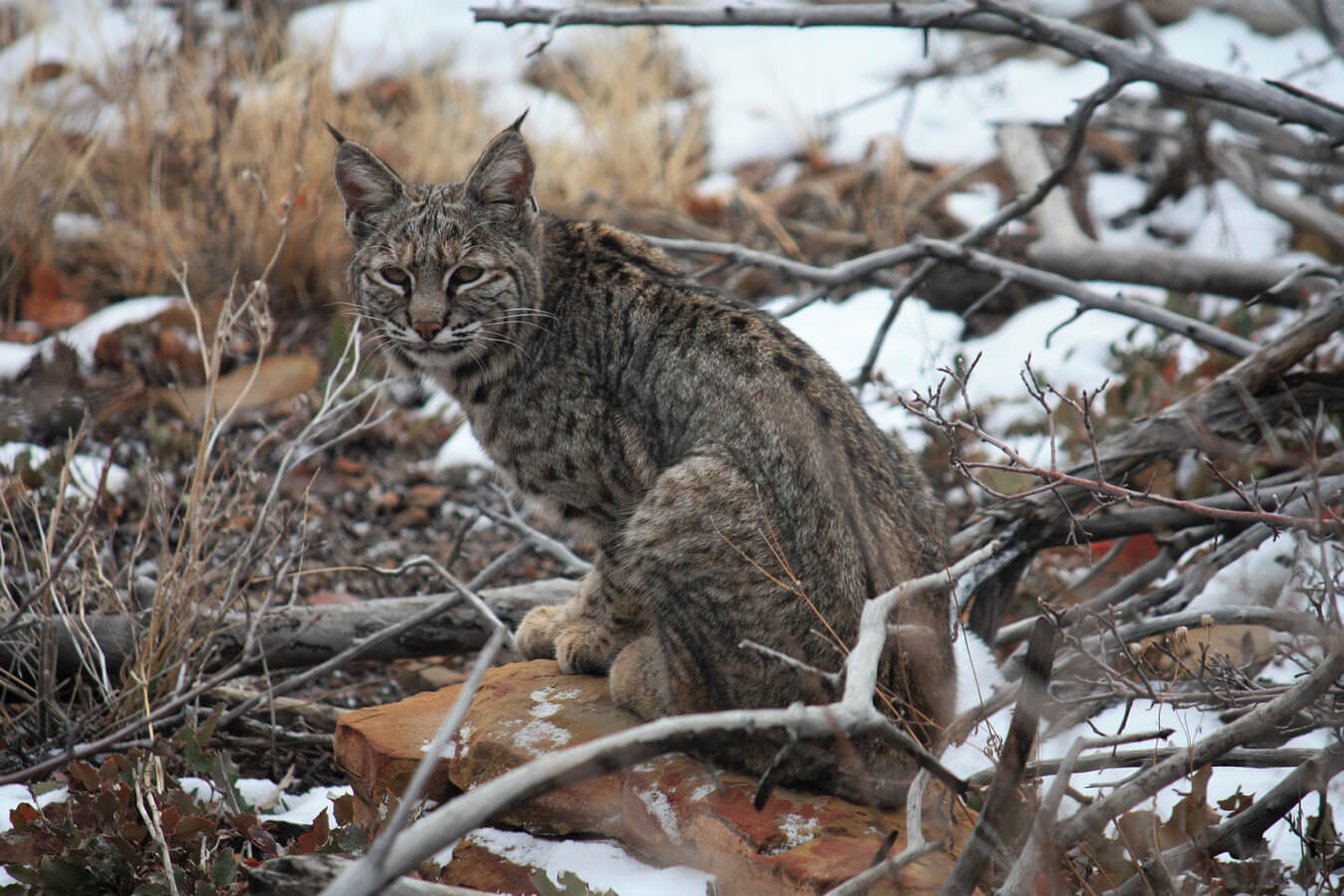
Bobcats are compact, muscular cats. Adults weigh roughly 15 to 30 pounds, though figures shift a little from park to park. In Yellowstone they weigh 15 to 30 pounds and run 31 to 34 inches long; at Jewel Cave National Monument, 15 to 35 pounds and 19 to 23 inches at the shoulder; and in Santa Monica Mountains National Recreation Area, local bobcats weigh about 20 pounds and stand almost 18 inches high. That makes a bobcat two to three times the size of an average house cat.
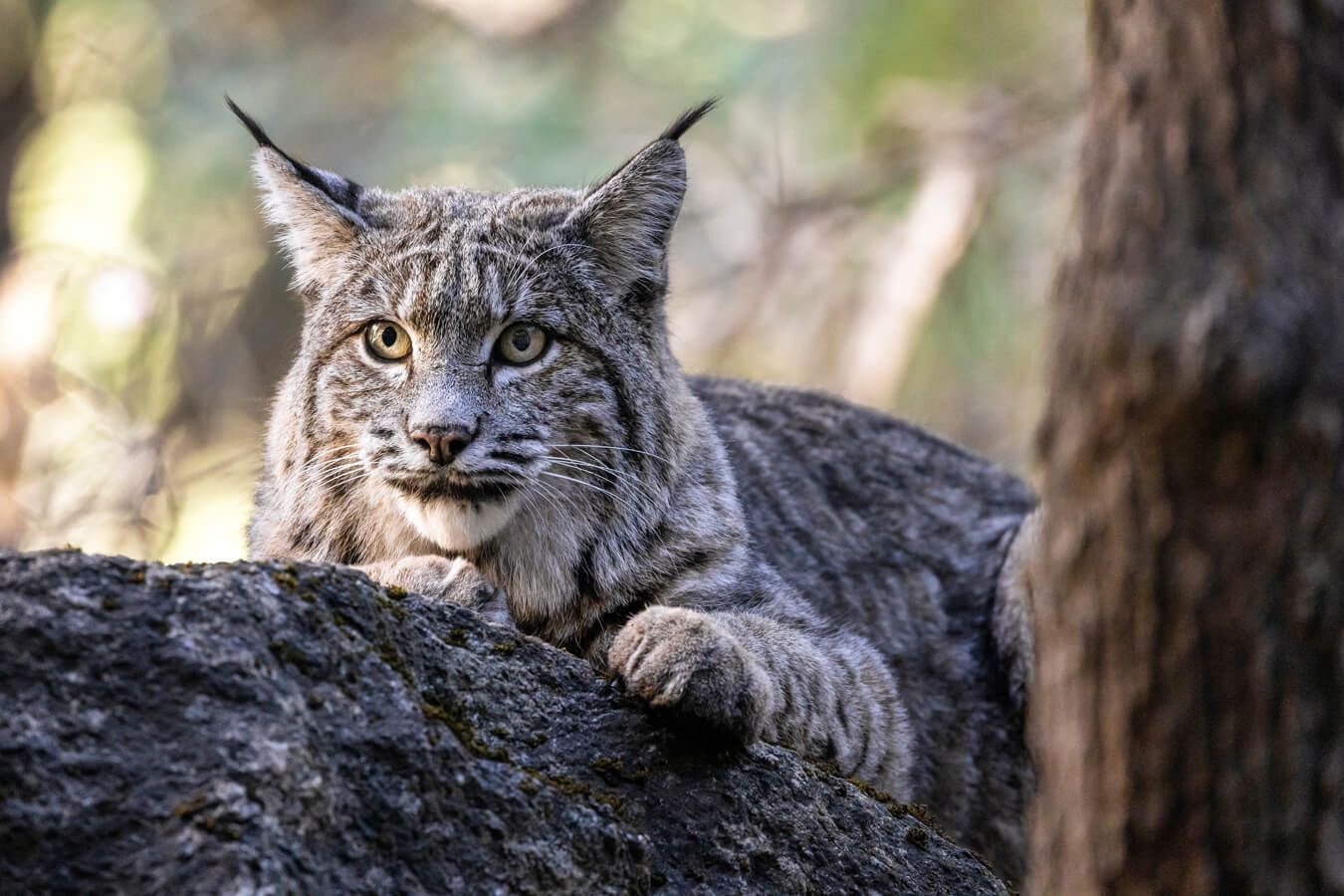
The coat is the most variable part of a bobcat’s appearance. Most have a reddish-brown back, a pale underside, and dark spots or streaks scattered over the coat, though the amount of spotting varies a lot, from heavy to almost none. Some are reddish brown with faint markings, while others are pale buff with bold dark spots. Bobcats molt once a year, and the redder look of summer comes from the same yellowish winter coat, worn and faded over the months.
Look for these features to identify a bobcat:
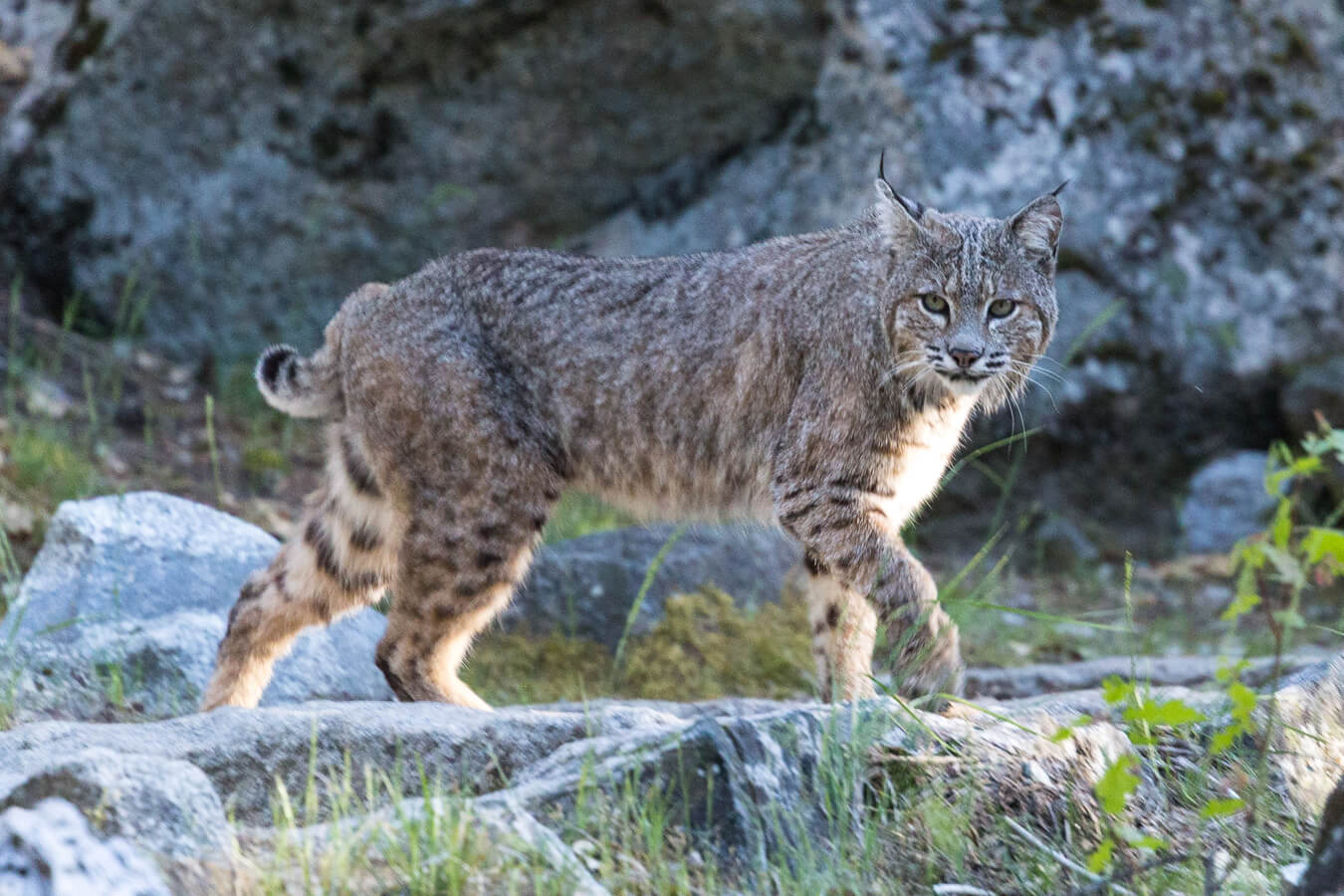
- Short tail: The “bobbed” tail that gives the bobcat its name measures about 9 inches in the Santa Monica Mountains. No other native Arizona cat has a short tail.
- Ear tufts: Black, pointed tufts of hair on the ear tips, shorter than a lynx’s.
- Facial ruff: Tufts of fur on the cheeks, sometimes called “mutton chops.”
- Tail markings: Several black bars that don’t fully circle the tail, with no solid black tip.
- Spotted legs: Black blotches mark the legs, tail, and face, with white on the underside.
A common misconception is that bobcats have no tail. They do; it’s just short. People in southern California also frequently confuse bobcats with mountain lions, even though bobcats are much smaller and lack the lion’s long tail.
Habitat and Range
Bobcats are highly adaptable. They live not only in forests and wooded areas, but also in swamps, semi-deserts, mountains, and canyons. Everglades National Park sums it up well: the bobcat “successfully occupies a diversity of habitats” across the United States.
Each park offers a slightly different picture of where bobcats spend their time:
- Yellowstone: Rarely seen; most reports come from rocky areas and near rivers, with conifer forests as typical habitat.
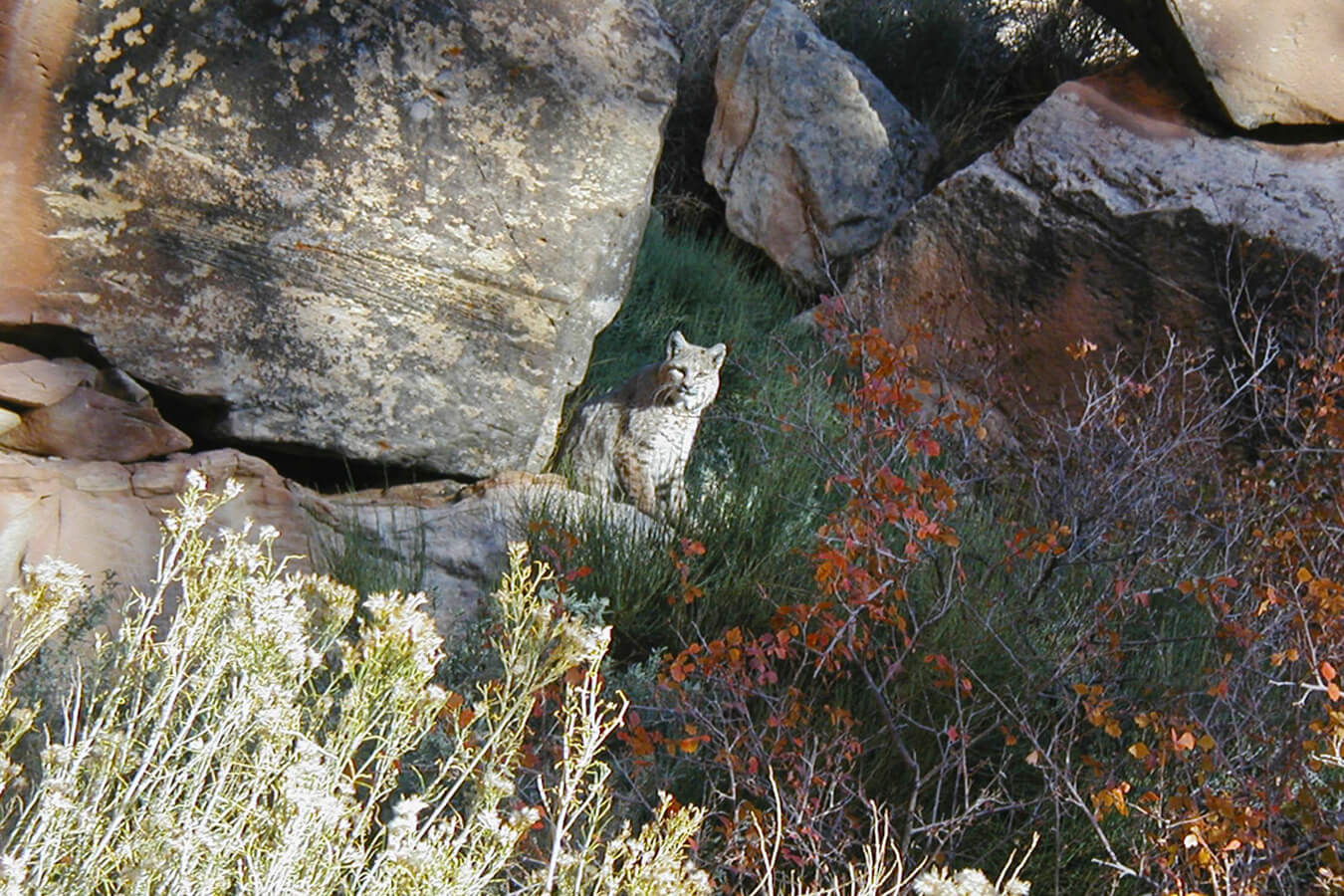
- Grand Canyon: Bobcats spend most of the day denning in rock crevices or tree hollows.
- Big Bend: The most common cat in the park and the one visitors see most, found park-wide but especially in brush close to water.
- Everglades: Common, and willing to slog through mangrove forest.
- Saguaro: Bobcats do well near the park’s urban Tucson borders, where rabbits and quail are abundant.
Bobcats live across nearly all of the lower 48, with a gap in part of the Midwest that trapping for their once-valuable fur created, not a shortage of habitat. Their ancestors crossed into North America from Asia over the Bering land bridge, and scientists think the modern bobcat took shape roughly 20,000 years ago.
Behavior
Bobcats are solitary. Outside of raising kittens, a bobcat spends most of its life alone. They are active between sunset and sunrise, primarily nocturnal and crepuscular, meaning they move around sunset, at night, and around dawn.
Bobcats are also territorial. Home range size depends heavily on food. Territory size varies widely, from three or four square miles to more than a hundred, with males usually holding larger territories that may overlap with several females. In the Santa Monica Mountains, decades of study show that a male needs roughly three square miles and a female about half that. Males mark their home ranges with urine, feces, and anal gland secretions.
Within a home range, a bobcat usually keeps one primary den plus a few backup shelters in brush piles, hollow logs, or under rock ledges. Daily travel can be impressive. A hunting adult may travel anywhere from 5 to 50 miles in a day.
Bobcats are not at the top of the food chain. Mountain lions and coyotes prey on adult bobcats, while owls, foxes, and coyotes prey on kittens.
Hunting and Diet
Bobcats are ambush hunters. They often sit hidden along a game trail and wait for prey to come to them, sometimes lying in wait all day for a bird, small mammal, or reptile to wander by. Big, soft paws help them sneak close, and a hunt often ends with a ten-foot leap.
Rabbits and hares are the preferred food in most places, but bobcats are flexible:
- Yellowstone: Small mammals such as rabbits, hares, voles, mice, and red squirrels; birds such as grouse, sparrows, and wrens; and now and then a deer or adult pronghorn.
- Jewel Cave: Mostly voles, mice, and ground-nesting birds in high desert, versus frogs and songbirds in southern swamps.
- Everglades: Small mammals, birds, and fish.
- Saguaro: Small mammals, birds, and carrion.
Bobcats can take much larger prey. Bobcats are capable of killing deer, bringing one down with quick, repeated bites to the throat. After eating its fill of a big kill, a bobcat may hide the remains and come back later. They eat almost nothing but meat, unlike bears and coyotes, which mix in plants such as prickly pear fruit.
One dawn hunt at Eco Pond in the Everglades went like this: a bobcat waited at the shoreline with its eyes on a young coot, charged into the water, climbed back out, shook off, and disappeared into the trees with its meal.
Kittens and Life Cycle
Females can usually breed by their first birthday, while males typically wait until two. In harsher parts of the range, breeding peaks in February and March, and in some areas bobcats can breed at any time of year. Gestation lasts about 60 to 70 days.
Kittens usually arrive in spring. Litters usually arrive in April or May, as prey becomes plentiful. A litter usually holds two to four kittens, though anywhere from one to five is possible. Kittens are born blind and are weaned at about two months.
Dens can be surprisingly hard to find. In the Santa Monica Mountains, biologists say dens are often in hollow areas in thick chaparral or coastal sage scrub, with woodrat nests the second most common location. In 2021, researchers tracked a collared female to a cavity in a large oak tree, an unusual choice they believe was linked to habitat loss from the 2018 Woolsey Fire. Her three kittens weighed 500 to 600 grams at about 30 days old.
For their first four to five weeks, kittens stay in the den where they were born; after that the family shifts among other dens. Researchers suspect this is an anti-predator behavior. At about 12 weeks, the kittens begin following their mother as she hunts, and she cares for them until they are about nine to 11 months old. Young bobcats start hunting on their own at around seven to nine months. A male may pitch in now and then, but raising the kittens falls mainly to the female.
Bobcats on the Urban Edge
One of the longest-running bobcat studies anywhere happens in a national park unit. Since 1996, National Park Service biologists in Santa Monica Mountains National Recreation Area have been trapping, radio-collaring, and following bobcats to learn how the cats hang on in the city-dominated landscape around Los Angeles. By 2013, they had captured their 300th bobcat.
The research has uncovered serious threats:
- Roads: Bobcats are at risk of being hit by vehicles as they move between patches of habitat.
- Genetic isolation: Two freeways, the 405 and the 101, have divided the area’s bobcats into three separate genetic populations. Of the three, the eastern population in Griffith Park and the Hollywood Hills was the least genetically diverse.
- Mange and rat poison: Beginning in spring 2002, a notoedric mange epidemic sharply reduced urban bobcats. Every affected animal tested had been exposed to anticoagulant rat poisons, which over time can cause immune system dysfunction and make bobcats more susceptible to diseases like mange.
Between 2003 and 2006, more than half of the radio-collared bobcats in the Simi Hills study area died from mange, which overtook vehicle collisions as the leading cause of death. By 2013, bobcat numbers appeared to be recovering, including in areas where local populations had nearly vanished.
Visitors can help. The Santa Monica Mountains team runs a Backyard Bobcats project on iNaturalist, where people can share photos and videos of bobcats. Because each bobcat’s spot pattern is unique, researchers can sometimes identify individuals from photos.
Tracks and Signs
Because bobcats are so secretive, tracks and scat are often the best evidence you’ll find. At Jewel Cave, bobcats are rarely seen but leave tracks and scat along the Canyons Trail. In the Everglades, check hiking trails for scat packed with fur and bits of bone.
Cat tracks look round, and the palm pad takes up half or more of each print. Cats have five toes, but only four register in their tracks, and their retractable claws often don’t show at all. These features help separate cat tracks from dog tracks. Front tracks measure about 1.5 to 2.25 inches long at Mount Rainier National Park, and about 2 inches in Yellowstone.
Parks also use technology to find bobcats. Great Basin began a remote camera study in 2002 to document secretive carnivores such as bobcats, mountain lions, and ringtails. The cameras were triggered by infrared motion sensors, and in summer crews relocated them to high passes and isolated springs.
National Park Presence
Bobcats live in many of the 63 designated U.S. National Parks. For photographers, bobcats can be found in the following parks:
According to National Park Service NPSpecies records, bobcats are listed as common in parks including Everglades, Great Smoky Mountains, Grand Canyon, Joshua Tree, Mesa Verde, Olympic, Redwood, Rocky Mountain, and Theodore Roosevelt. In many other parks, abundance is listed as uncommon, rare, or unknown, which reflects how hard these cats are to survey. Grand Teton, Great Sand Dunes, and Voyageurs list bobcats as probably present.
Bobcat Photography Tips
Photographing a bobcat usually takes patience and luck. Since they are most active around sunset, at night, and around dawn, early morning and late evening hours are the best time to spot one. Everglades is an exception to the rule: its bobcats are often seen in daylight, so keep an eye on the Main Park Road and the Snake Bight and Bear Lake trails, which bobcats use because the going is easy.
At Big Bend National Park, some years bring many bobcat reports around the campground and picnic areas at Rio Grande Village. In Yellowstone, look in rocky areas and near rivers. Wherever you are, scan rock ledges, brush edges, and trails, since a resting bobcat can be almost invisible against rock.
Give bobcats plenty of space. Yellowstone asks visitors to stay at least 25 yards from most wildlife and at least 100 yards from bears, wolves, and cougars, and to back away if an animal moves closer. If a bobcat changes its behavior because of you, you’re too close.
A telephoto lens is essential for photographing bobcats responsibly. If you already own or want to own a professional-grade mirrored camera like the Canon EOS 5D Mark IV Full Frame Digital SLR, we recommend using a Canon EF 100-400mm f/4.5-5.6L IS II USM Lens zoom lens for wildlife photography. If you have or are interested in a newer mirrorless model like the Canon EOS R5 Full-Frame Mirrorless Camera, we recommend using a Canon RF100-400mm F5.6-8 IS USM for long-distance shots.
Not quite ready to invest in traditional professional-grade camera equipment but want to enhance the quality of your cell phone photographs? Consider using a Moment Tele 58mm Mobile Lens II for improved reach, and use a Moment camera case with a lens mount to attach it to your phone. Since cell phones generally cannot provide the same reach as a dedicated telephoto camera lens, never compensate by moving dangerously close to wildlife.
No photograph is worth disturbing an animal or putting yourself or others at risk.
Bobcat or Canada Lynx?
Bobcats share their genus with the Canada lynx (Lynx canadensis), and the two can look nearly identical at a glance. Their ranges overlap in some northern parks. NPSpecies lists both cats in Glacier, Yellowstone, Rocky Mountain, Grand Teton, and Voyageurs (bobcats are listed as probably present in the last two). Alaska parks such as Denali have lynx records but no bobcat records.
Yellowstone offers these field marks for telling them apart:
- Tail: The lynx’s black tail rings are complete and the tip is solid black. A bobcat’s rings don’t fully circle the tail, and there’s no black tip.
- Ears: The lynx has longer ear tufts.
- Feet and tracks: A lynx’s broad, furry paws, with hair growing between and around the pads, keep it on top of the snow when it runs. Lynx tracks measure 4 to 5 inches, compared with about 2 inches for a bobcat.
- Legs: The lynx’s hind legs are longer than its front legs.
Diet also differs. Lynx in Yellowstone eat primarily snowshoe hares, especially in winter, and their large, furry feet work like natural snowshoes for chasing them. In 2000, the U.S. Fish and Wildlife Service protected the Canada lynx as a threatened species in the contiguous United States. Yellowstone has only 112 known lynx observations. Lynx there are limited to conifer forests above about 7,700 feet, and confirmed records include several animals near Yellowstone Lake and the Central Plateau from 2001 to 2004, a lynx photographed along the Gibbon River in 2007, and tracks verified near the Northeast Entrance in 2014.
A Note About Bobcat Taxonomy
Readers researching bobcats may encounter several scientific names. This page uses:
Lynx rufus
Depending on the source, the bobcat may appear under a different name. Some National Park Service records and older references use:
Felis rufus, Lynx rufus rufus, Lynx rufus baileyi, Lynx rufus texensis, Lynx rufus pallescens, Lynx rufus californicus, and Lynx fasciatus
The species name rufus refers to the reddish tone of the summer coat. The older genus name Felis still appears as a synonym in many NPSpecies records, and several parks list subspecies names, such as californicus in Yosemite and texensis in Big Bend and Guadalupe Mountains. Other common names for the bobcat include wildcat, red lynx, barred bobcat, and cat o’ the mountain.
For consistency throughout National Park Photographer, this page uses Lynx rufus while recognizing the other names visitors may encounter.
Final Thoughts
Bobcats are proof that some of the most interesting wildlife in our National Parks are the animals you rarely see. They live in deserts, swamps, mountains, and forests, often within sight of trails and campgrounds, yet most of their lives go unnoticed.
Long-term research in places like Santa Monica Mountains has shown how roads, development, and poisons can affect these adaptable cats, and how much we can learn from patient study.
If you are lucky enough to spot a bobcat on a rock ledge or along a trail at dawn, keep your distance and enjoy the moment. It may be watching you, too.
Want more information about the amazing wildlife that call our National Parks home? Take a look at our National Park Wildlife page to explore the various parks and the animals in them. Planning on visiting a National Park in the near future? Be sure to follow park regulations, practice Leave No Trace principles, and prioritize both your safety and the well-being of wildlife while exploring.
Joyful Journeys!
Bonnie, Co-Owner, National Park Photographer
Want to learn more about bobcats? Check out the additional resources below!
Bobcat Books & Field Guides
- Bobcat: Master of Survival
- Peterson Field Guide to Mammals of North America
- Glacier and Waterton Lakes National Parks Map (National Geographic Trails Illustrated)
- Mammal Tracks & Sign: A Guide to North American Species
- 10×42 Binoculars for Wildlife Viewing
- Monocular for Wildlife Viewing
- Camera Bean Bag for Wildlife Photography
Please note, by making purchases through our affiliate links, you are supporting our mission to celebrate and showcase our National Parks and the photographers who frequent them. As an Amazon Associate, National Park Photographer earns from qualifying purchases at no cost to you. We appreciate your support.
References & Additional Resources
- National Park Service — Yellowstone National Park: Bobcat
- National Park Service — Yellowstone National Park: Canada Lynx
- National Park Service — Yellowstone National Park: Safety
- National Park Service — Grand Canyon National Park: Bobcat
- National Park Service — Saguaro National Park: Bobcats and Mountain Lions
- National Park Service — Everglades National Park: Species Profile: Bobcat
- National Park Service — Big Bend National Park: What Mammal Did I See
- National Park Service — Great Basin National Park: Remote Wildlife Cameras
- National Park Service — Glacier National Park: Track Makers
- National Park Service — Mount Rainier National Park: Carnivore Tracking (PDF)
- National Park Service — Jewel Cave National Monument: Bobcat
- National Park Service — Bighorn Canyon National Recreation Area: Bobcats
- National Park Service — Tonto National Monument: Predators
- National Park Service — Santa Monica Mountains: Bobcats: Living on the Urban Edge
- National Park Service — Santa Monica Mountains: Bobcat Kittens Found in Oak Tree Cavity
- National Park Service — Santa Monica Mountains: National Park Service Captures 300th Bobcat
- National Park Service — NPSpecies Species Search
Do you want to be featured on National Park Photographer?
Why wait! Contact us today at nationalparkphoto@gmail.com for a chance to be a Featured National Park Photographer!