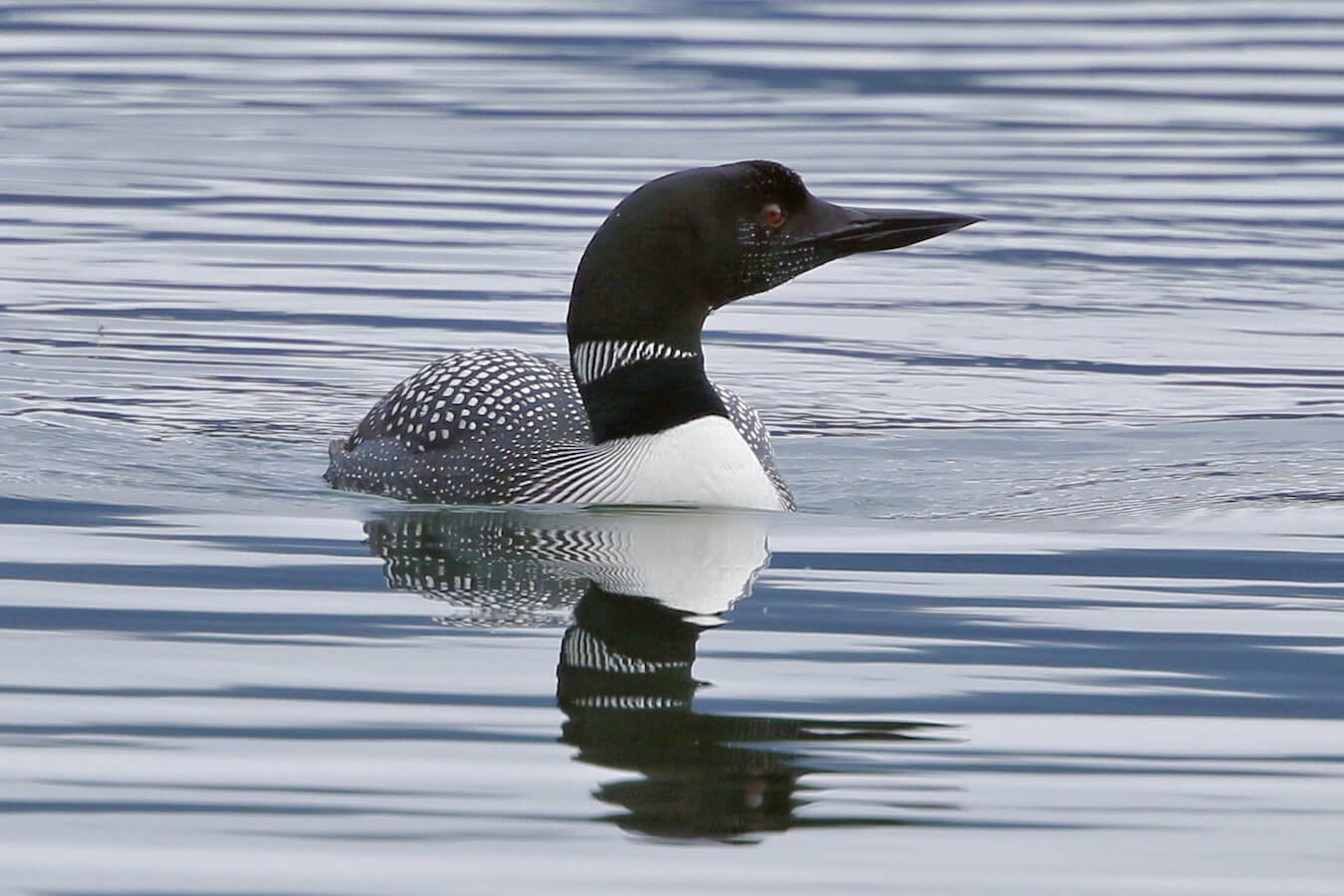
Most people hear a common loon long before they see one. The long, rising wail that carries across a still northern lake at dusk is one of the wildest sounds in North America, and it has a way of making a campsite feel very far from anywhere. Find the bird making it, sitting low in the water with its checkered back and dark green head, and you have one of the most rewarding subjects a lake can offer.
The common loon (Gavia immer) belongs to Gaviidae, a small family of five loon species found in the Northern Hemisphere. Common loons nest on lakes across Canada, Alaska, and the northern edge of the lower 48 states, and they spend the winter on coastal waters and some large inland lakes. NPSpecies records list common loons as present in 36 National Parks, including Acadia, Glacier Bay, Isle Royale, Voyageurs, and Yellowstone.
Learning about animals like common loons can significantly enhance wildlife photography skills by providing valuable insights into animal behavior, habitat, and physical characteristics. Understanding an animal’s habits can allow photographers to better anticipate and capture unique and authentic moments. Knowledge of an animal’s habitat may also help in selecting the best locations and times for wildlife viewing and photography, while familiarity with physical characteristics is essential for accurately identifying wildlife in the field. If wildlife photography or simply wildlife viewing are of interest to you, then you’ve come to the right place! Together, let’s learn more about what makes common loons so special.
Physical Characteristics
Common loons are larger than most ducks but smaller than a goose. Adults are about 30 inches long, weigh roughly 8 to 12 pounds, and have a wingspan of up to about 60 inches. Males and females look alike, although males are usually somewhat larger. In the field, it is very hard to tell them apart by sight.
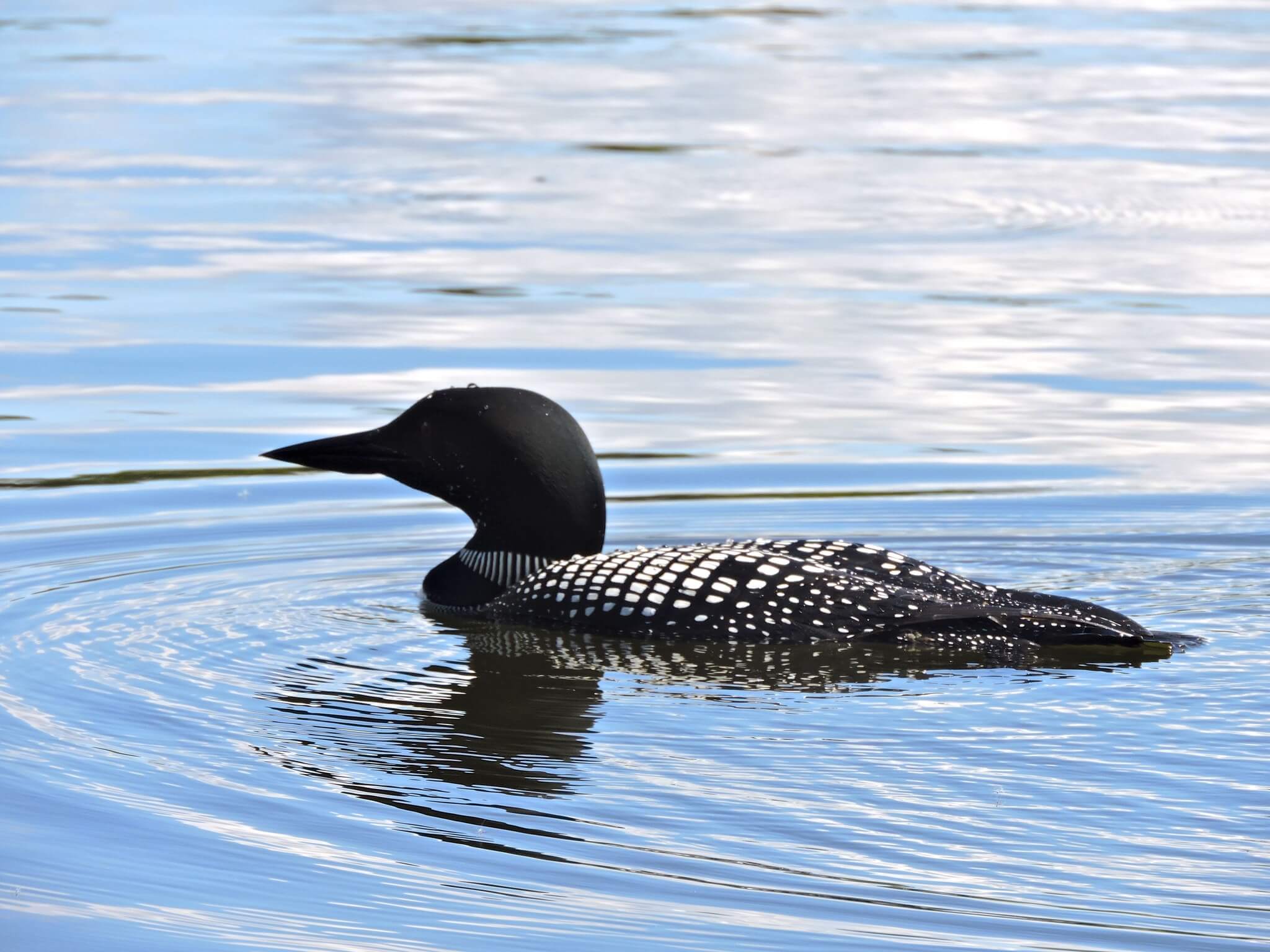
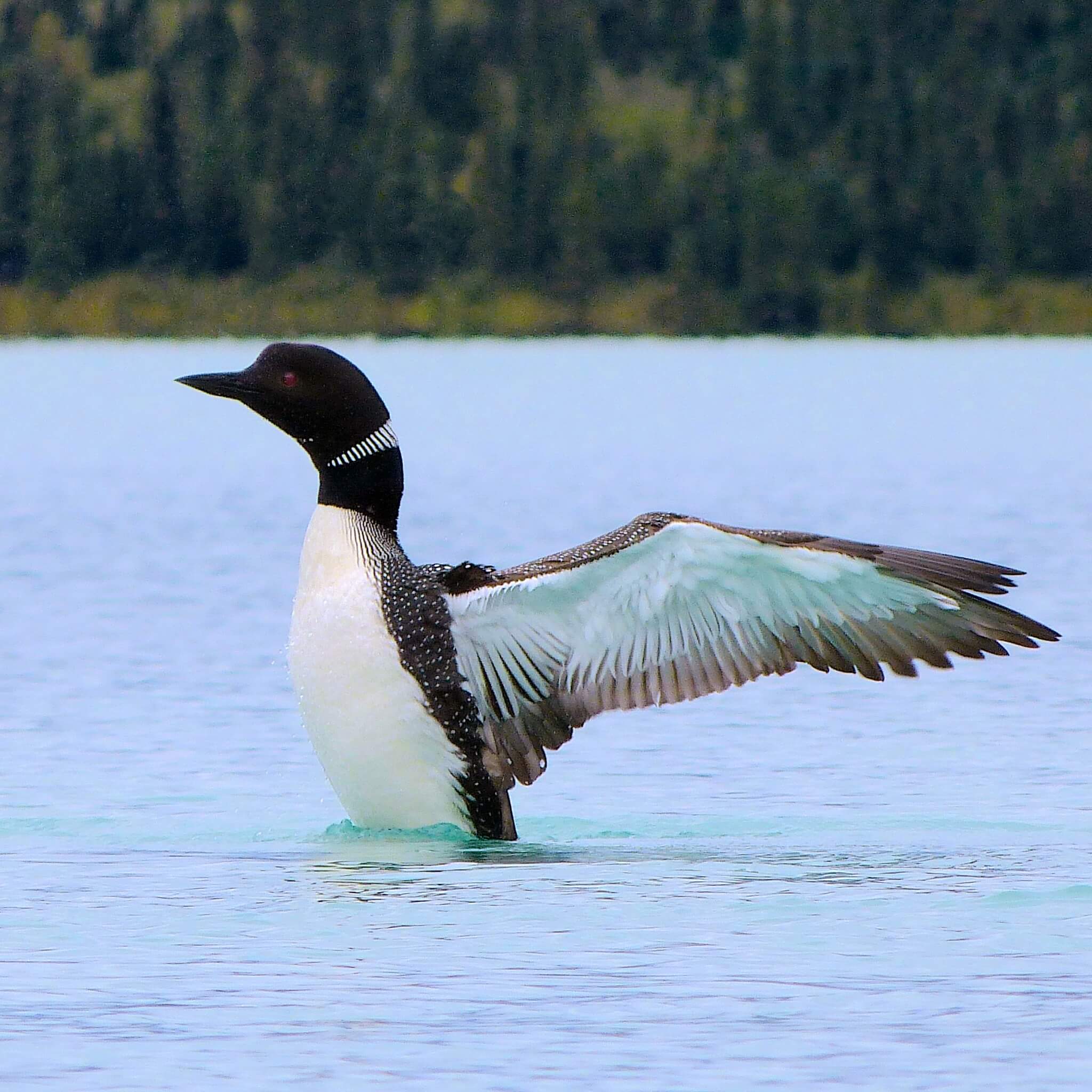
From about March through October, adults wear their breeding plumage:
- Head and neck: Black with a green or purple sheen in good light.
- Necklace: A band of short white stripes across the throat and another around the side of the neck.
- Back: A bold black and white checkerboard pattern on the back and white spots on the wings.
- Eyes: Deep red.
- Bill: Heavy, black, and dagger-shaped.
In winter, loons look very different. They molt into plain gray-brown above and white below, and the eyes turn duller. Many people who see a loon on the ocean in January would not recognize it as the same bird they heard on a lake in July.
In flight, a loon has a distinct shape that helps identify it even from far away. The head and neck stretch forward and droop slightly, the large feet trail out past the short tail, and the wings beat fast and steadily without gliding. Loons are among the fastest flying birds of their size, with migrating birds often clocked at well over 60 miles per hour.
The red eyes are more than decoration. They are thought to help loons see underwater, where red light fades quickly and the world turns blue-green. For photographers, a sharp red eye is often what makes a loon portrait come alive.
Built for Diving
Loons are made for life underwater. Unlike most birds, they have solid, heavy bones instead of hollow ones, which makes them less buoyant and helps them dive. They can also squeeze air from their feathers and body to sink lower in the water, sometimes swimming with only the head showing.
Several other features help them hunt:
- Legs: Set far back on the body, like propellers at the stern of a boat.
- Feet: Large and webbed, providing most of the power underwater.
- Depth: Able to dive to more than 100 feet while chasing fish.
- Vision: Eyes adapted to spot fish in clear water.
That design has a cost. With their legs so far back, loons are awkward on land and can barely walk. They come ashore mainly to nest, and they push themselves along on their bellies more than they walk. One explanation for the English name “loon” traces it to an old Scandinavian word meaning clumsy or awkward.
Getting airborne is also hard work. Loons need a long stretch of open water to take off, running across the surface and flapping hard before they lift. Once in the air, though, they are strong, fast flyers. That is why loons nest on lakes large enough to give them a runway, and why a loon that lands on a small pond or a wet parking lot can become trapped.
Habitat and Range
In summer, common loons need clear, fish-filled lakes with quiet shorelines for nesting. They prefer lakes large enough for a long takeoff run, often with islands, sheltered bays, and marshy edges. Rivers and the protected bays of large lakes, including the shoreline of Lake Superior at Isle Royale, also work.
Their breeding range stretches from Alaska across Canada to the northern Great Lakes and New England. In the lower 48 states, breeding loons are found mainly in Minnesota, Wisconsin, Michigan, northern New England and New York, and in small numbers in Montana, Idaho, Washington, and Wyoming.
Each breeding pair defends a territory, which can be an entire small lake or one bay of a larger one. Isle Royale is a good example of how many loons a good landscape can hold. In 2019, surveyors there found at least 126 breeding territories with 201 adults and 50 young. Voyageurs averages about 192 adults and 26 chicks in its surveys. Unpaired adults, called floaters, may wander between lakes looking for a chance to take over a territory.
Loons depend on clean water. Acid rain, shoreline development, heavy boat traffic, and lead fishing tackle have all caused declines in parts of their range, and the southern edge of their breeding range has moved north over the last century.
Diet
Common loons eat mostly fish. They hunt by sight, so they need clear water to find their prey, and they usually swallow fish underwater. Their diet includes:
- Fish: Perch, minnows, trout, suckers, and other small to medium fish.
- Crustaceans: Crayfish, especially in lakes where fish are scarce.
- Other prey: Aquatic insects, snails, leeches, and frogs.
- Chick food: Small fish and invertebrates the parents bring to the surface.
Before a dive, a loon often peers into the water with its head and eyes below the surface, a behavior called peering. Then it slips under with barely a ripple. Most dives last under a minute, and the bird can come up surprisingly far from where it went down.
Because loons sit at the top of the food chain in many lakes, they are also a good measure of a lake’s health. Mercury and other pollutants build up in fish, and loons that eat those fish can carry high levels. Researchers in several parks study loons in part to learn what is happening in the water around them.
Calls
Loons have four main calls, and each one means something different:
- Wail: The long, haunting call most people know. It is used to keep in contact with a mate or chick.
- Tremolo: A wavering, laughing call given when a loon is alarmed or disturbed, often in flight.
- Yodel: A long, rising call given only by males to defend their territory.
- Hoot: A short, soft call used between family members at close range.
The yodel is the one to listen for if you want to know where a male is. Each male’s yodel is slightly different, and researchers have found that a male may change his yodel after moving to a new territory.
The tremolo is worth noticing for a different reason. A loon giving a tremolo near you is telling you that you are too close. If you hear one while paddling or watching from shore, back off and give the bird more space.
Loons call most often at night and early in the morning, especially in late spring and early summer when pairs are setting up territories. A quiet evening at a lake in Voyageurs or Isle Royale can bring a chorus of wails and yodels from several pairs at once.
Nesting
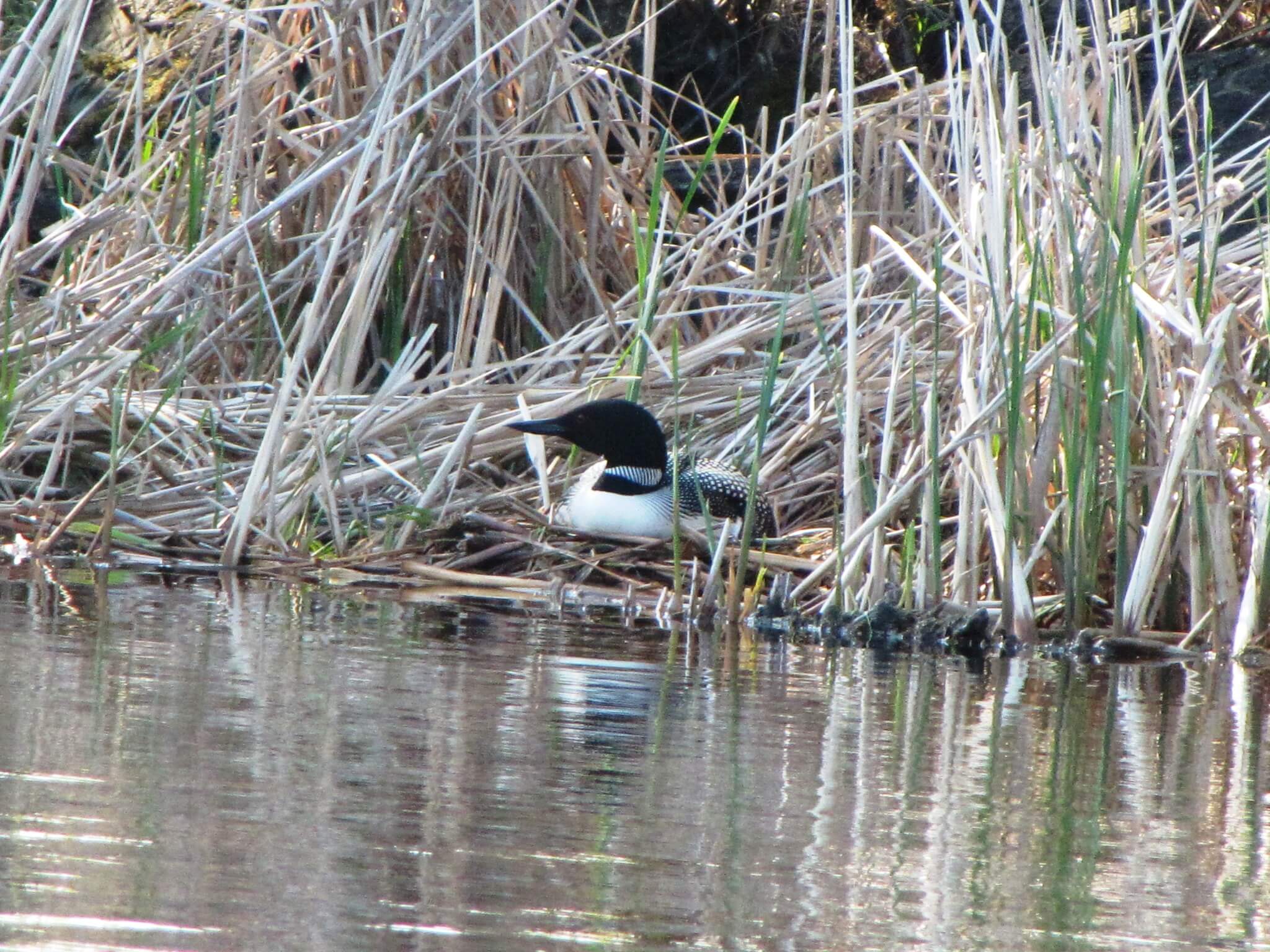
Common loon pairs tend to return to the same territory year after year, and many reuse the same nest site. Breeding usually begins after the ice goes out in spring. Nests are simple heaps of grasses, mud, and plant material, built on the shore of a sheltered bay, a small island, or a floating mat of vegetation.
Because loons walk so poorly, nests are usually built within about 3 feet of the water’s edge. That lets the bird slide straight into the water if a predator comes close. It also makes the nest vulnerable:
- Waves and boat wakes: Can wash over a nest and soak or scatter the eggs.
- Water levels: Rising water can flood a nest, and falling water can leave it stranded far from shore.
- Predators: Raccoons, gulls, ravens, eagles, and other animals take eggs when adults are away.
- People: Boaters and anglers who come too close can flush a loon off its eggs, leaving them exposed.
Females usually lay two olive-brown, lightly spotted eggs in late May or June. Both parents take turns incubating for about 27 to 30 days. In Yellowstone and some other parks, shorelines with nesting loons may be closed to people during the nesting season.
Chicks
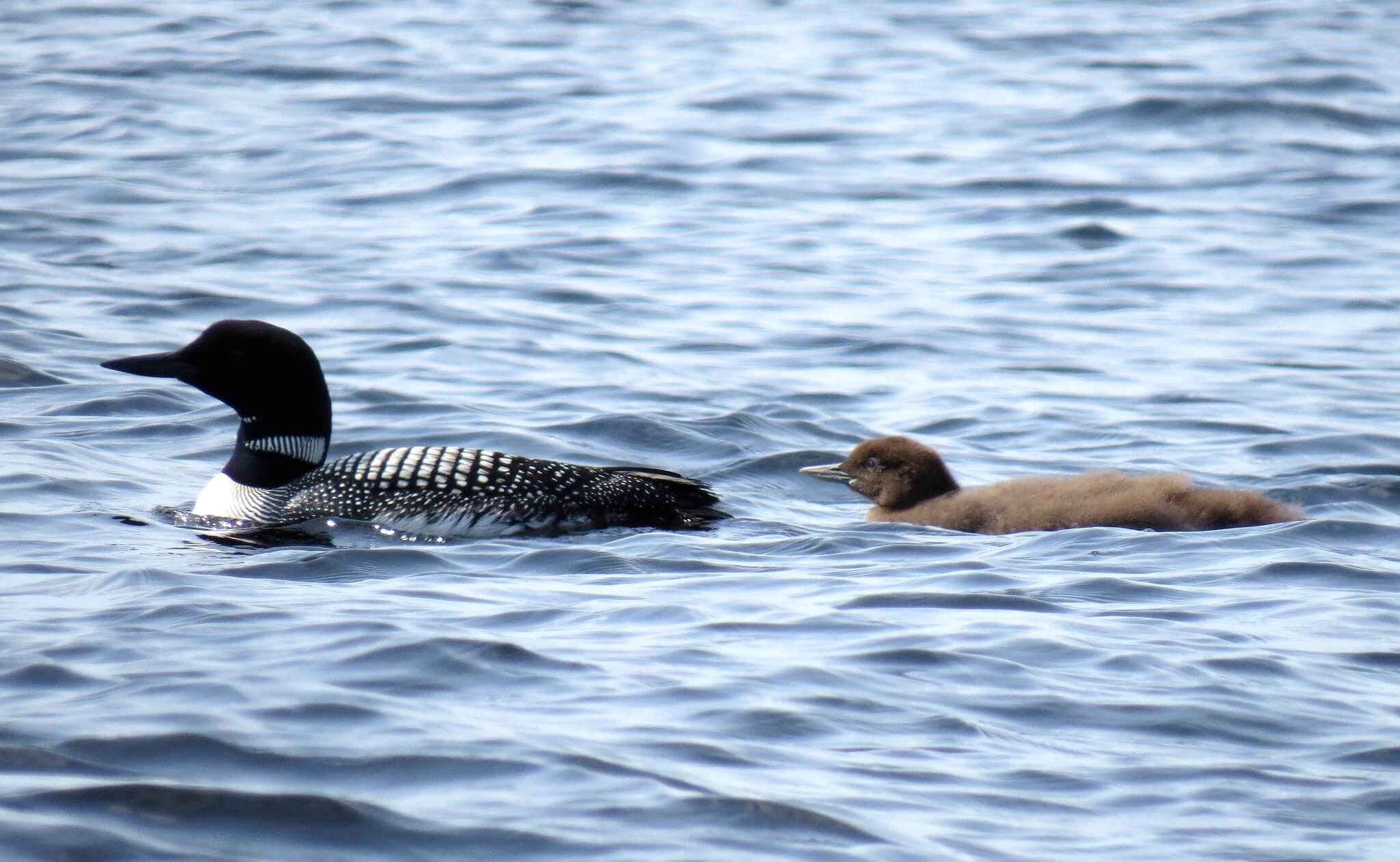
Loon chicks are covered in dark brown or black down when they hatch, and they can swim within hours. Even so, they spend much of their first few weeks riding on a parent’s back, where they stay warm and safe from snapping turtles, large fish, and eagles.
Both parents feed and care for the chicks. At first they bring tiny fish and invertebrates to the surface. As the chicks grow, they start diving and catching some food on their own, and the parents gradually do less of the work. Young loons can fly at about 11 to 12 weeks old.
Young loons do not head back to their home lakes right away. After they leave in the fall, they spend their first two or three years on the ocean or large lakes far to the south. They may not breed until they are five or six years old, and common loons can live up to about 30 years.
Not every chick survives. Eagles, gulls, large fish, and snapping turtles take young loons, and chicks sometimes die in fights when an intruding loon tries to take over a territory. Pairs that lose a nest early in the season may try again, but a second nest is usually less successful. In many northern lakes, a pair that raises even one chick to flying age has had a good year.
For photographers, a loon chick riding on its parent’s back is one of the most sought-after images on any northern lake. Getting it ethically means using a long lens, staying well back, and never steering a boat between a parent and its young.
Migration and Winter
When northern lakes start to freeze, loons head south. Most common loons spend the winter on the ocean, along the Atlantic coast from the Maritimes to Florida and the Gulf of Mexico, or along the Pacific coast from Alaska to Mexico. Some winter on large inland lakes and reservoirs that stay ice-free.
That migration explains why common loons show up in so many national parks. A breeding pair in Voyageurs or Isle Royale may winter off the coast of the Carolinas or the Gulf. Loons passing through in spring and fall stop on lakes in places like Grand Canyon, Death Valley, and Zion. Others winter on the waters of Acadia, Channel Islands, Olympic, and Everglades.
On winter waters, loons are quiet and spread out. Instead of their checkered breeding plumage, they wear plain gray and white, and they mostly feed alone or in loose groups. Adults molt their flight feathers all at once in late winter, which leaves them unable to fly for several weeks until new feathers grow in.
Yellowstone’s loons are a special case. They are the only breeding loons in Wyoming and are separated from the nearest other breeding population by more than 200 miles. In 2023, the park counted 38 loons, including 12 territorial pairs that raised 10 young. Wyoming lists the common loon as a Species of Special Concern.
National Park Presence
Common loons live in many of the 63 designated U.S. National Parks. For photographers, common loons can be found in the following parks:
According to National Park Service NPSpecies records, common loons are listed as abundant in Glacier Bay National Park and Preserve and Indiana Dunes National Park and as common in Acadia, Channel Islands, Isle Royale, Olympic, Redwood, Voyageurs, and Wrangell-St. Elias. Many other parks list them as uncommon, occasional, or rare, often because the birds pass through only during migration. Sequoia and Kings Canyon National Parks list the common loon as occasional and non-native, an unusual record for a bird that is native across North America, so treat it with caution.
Common Loon Photography Tips
Park pages and NPS photos point to several good places to look:
- Voyageurs: Sheltered bays and inland lakes from late spring through summer, with chicks most visible in July.
- Isle Royale: Both Lake Superior shorelines and the island’s interior lakes, where loons nest each summer.
- Yellowstone: Large lakes in the southern part of the park, viewed from shore or from legal boat access with closures respected.
- Glacier Bay: Protected waters of the bay, especially during spring and fall migration.
- Acadia: Coastal waters in winter, when loons in gray plumage feed offshore.
Keep your distance. Loons are sensitive to disturbance, especially at the nest. A loon that flattens its head and neck low over the water, rushes across the surface, or gives a tremolo call is stressed and needs space. Paddlers should stay well away from nests and families, and anglers should use lead-free tackle, since loons that swallow lead sinkers or jigs can die of poisoning. Yellowstone National Park, for example, requires visitors to stay at least 25 yards from most wildlife, and some parks close nesting areas entirely.
Timing matters. Early morning often brings calm water and soft light, ideal for reflections and for catching the loon’s red eye. Shoot from low to the water if you can, from shore or a stable boat, so the bird is at eye level. Bright sun on the black and white plumage can easily blow out the highlights, so watch your exposure and lean toward underexposing slightly. A loon stretching its wings or rising up to flap is a brief moment, so keep a fast shutter speed ready.
A telephoto lens is essential for photographing common loons responsibly. If you already own or want to own a professional-grade mirrored camera like the Canon EOS 5D Mark IV Full Frame Digital SLR, we recommend using a Canon EF 100-400mm f/4.5-5.6L IS II USM Lens zoom lens for wildlife photography. If you have or are interested in a newer mirrorless model like the Canon EOS R5 Full-Frame Mirrorless Camera, we recommend using a Canon RF100-400mm F5.6-8 IS USM for long-distance shots.
Not quite ready to invest in traditional professional-grade camera equipment but want to enhance the quality of your cell phone photographs? Consider using a Moment Tele 58mm Mobile Lens II for improved reach, and use a Moment camera case with a lens mount to attach it to your phone. Since cell phones generally cannot provide the same reach as a dedicated telephoto camera lens, never compensate by moving dangerously close to wildlife.
No photograph is worth disturbing an animal or putting yourself or others at risk.
A Note About Loon Taxonomy
Readers researching common loons may encounter several names. This page uses:
Gavia immer
However, some National Park Service records and older references use a subspecies name, including:
Gavia immer elasson
Big Bend National Park lists elasson as a synonym. Common names vary too. In Europe, the same bird is called the great northern diver, and several parks, including Grand Canyon, Grand Teton, Indiana Dunes, Lassen Volcanic, Sequoia and Kings Canyon, and Yellowstone, list “Great Northern Diver” or “Great Northern Loon” as alternate names. Acadia also lists “Greater Common Loon.”
For consistency throughout National Park Photographer, this page uses Gavia immer and the common name common loon while recognizing the other names visitors may encounter.
Final Thoughts
Common loons are tied to clean, quiet northern lakes in a way few birds are. They need clear water to hunt, undisturbed shorelines to nest, and space to raise their chicks, and their calls carry the feeling of those places better than any photograph can.
Whether it’s a loon in full breeding plumage on a calm Yellowstone lake, a parent carrying its chick through a sheltered bay in Voyageurs, or a bird stretching its wings on the water at Lake Clark, a loon sighting is a moment to savor. Listen for the wail, keep your distance, and be patient.
Want more information about the amazing wildlife that call our National Parks home? Take a look at our National Park Wildlife page to explore the various parks and the animals in them. Planning on visiting a National Park in the near future? Be sure to follow park regulations, practice Leave No Trace principles, and prioritize both your safety and the well-being of wildlife while exploring.
Joyful Journeys!
Bonnie, Co-Owner, National Park Photographer
Want to learn more about common loons? Check out the additional resources below!
Common Loon Books & Field Guides
- Loon Lessons: Uncommon Encounters with the Great Northern Diver
- Loons: The Iconic Waterbirds
- Goodnight Loon
- The Sibley Guide to Birds, 2nd Edition
- 10×42 Binoculars for Wildlife Viewing
- Monocular for Wildlife Viewing
- Camera Bean Bag for Wildlife Photography
Please note, by making purchases through our affiliate links, you are supporting our mission to celebrate and showcase our National Parks and the photographers who frequent them. As an Amazon Associate, National Park Photographer earns from qualifying purchases at no cost to you. We appreciate your support.
References & Additional Resources
- National Park Service — Yellowstone National Park: Common Loons
- National Park Service — Voyageurs National Park: Common Loon
- National Park Service — Isle Royale National Park: Common Loon
- National Park Service — Acadia National Park: Birds
- National Park Service — Yellowstone National Park: Safety
- Montana Field Guide: Common Loon
- National Park Service — NPSpecies Species Search
Do you want to be featured on National Park Photographer?
Why wait! Contact us today at nationalparkphoto@gmail.com for a chance to be a Featured National Park Photographer!