Desert bighorn sheep (Ovis canadensis nelsoni) are the bighorn of the American Southwest. They live in some of the hottest, driest, and steepest country in our National Parks, from the slickrock of Zion to the granite of Joshua Tree and the salt-crusted ranges around Death Valley. Compared with their Rocky Mountain relatives, they are smaller, longer-legged, and lighter-coated, and they can go days without drinking.
Desert bighorn are also one of the National Park Service’s most important restoration stories. Livestock diseases, hunting, and lost habitat wiped them out across much of their range. Canyonlands National Park kept one of the few remaining native herds, and sheep from Canyonlands were later used to restore herds in Arches and Capitol Reef. Today, some of the best places to see desert bighorn include Zion, Canyonlands, Grand Canyon, Joshua Tree, and Death Valley.
Learning about animals like desert bighorn sheep can significantly enhance wildlife photography skills by providing valuable insights into animal behavior, habitat, and physical characteristics. Understanding an animal’s habits can allow photographers to better anticipate and capture unique and authentic moments. Knowledge of an animal’s habitat may also help in selecting the best locations and times for wildlife viewing and photography, while familiarity with physical characteristics is essential for accurately identifying wildlife in the field. If wildlife photography or simply wildlife viewing are of interest to you, then you’ve come to the right place! Together, let’s learn more about what makes desert bighorn sheep so special.
Physical Characteristics
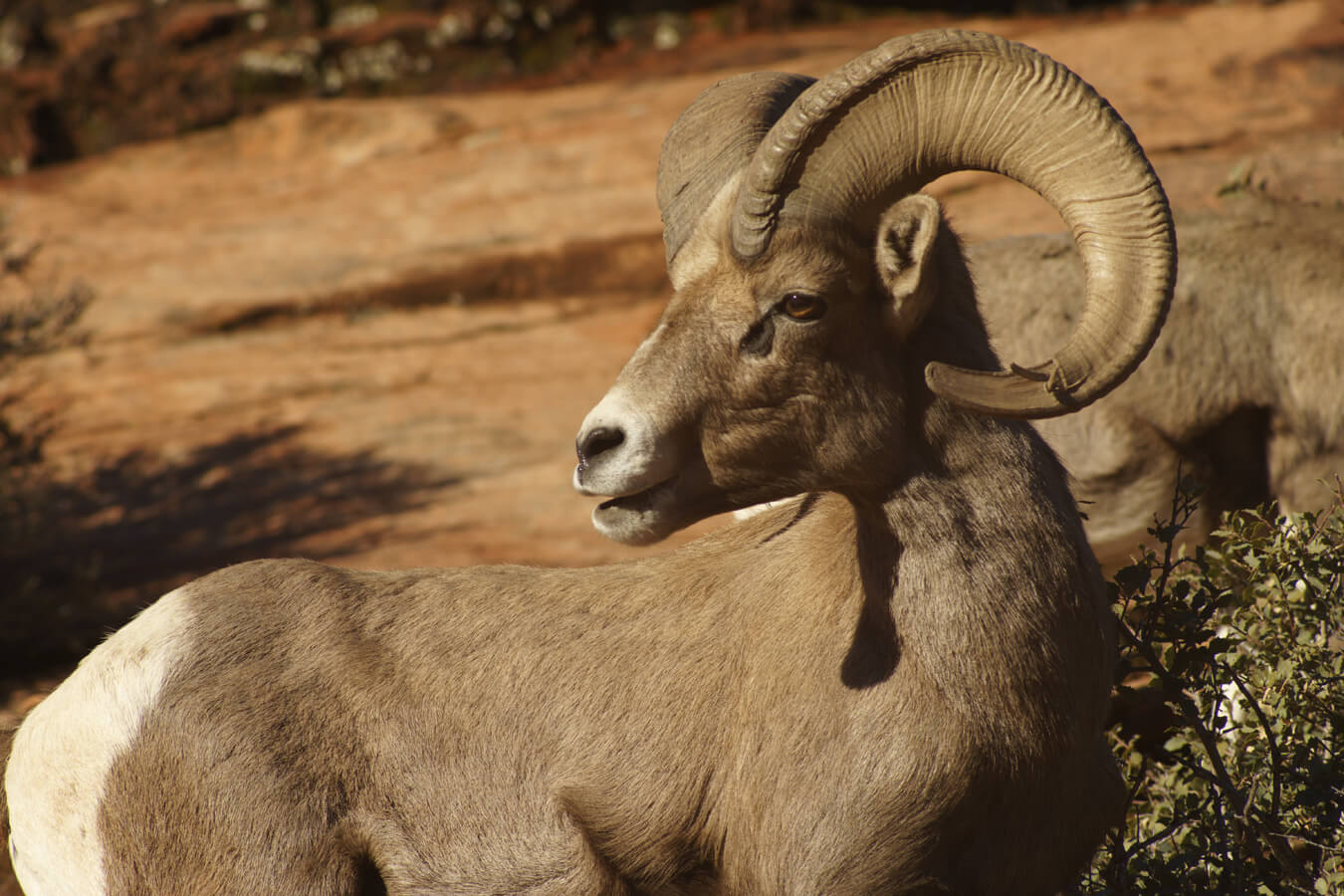
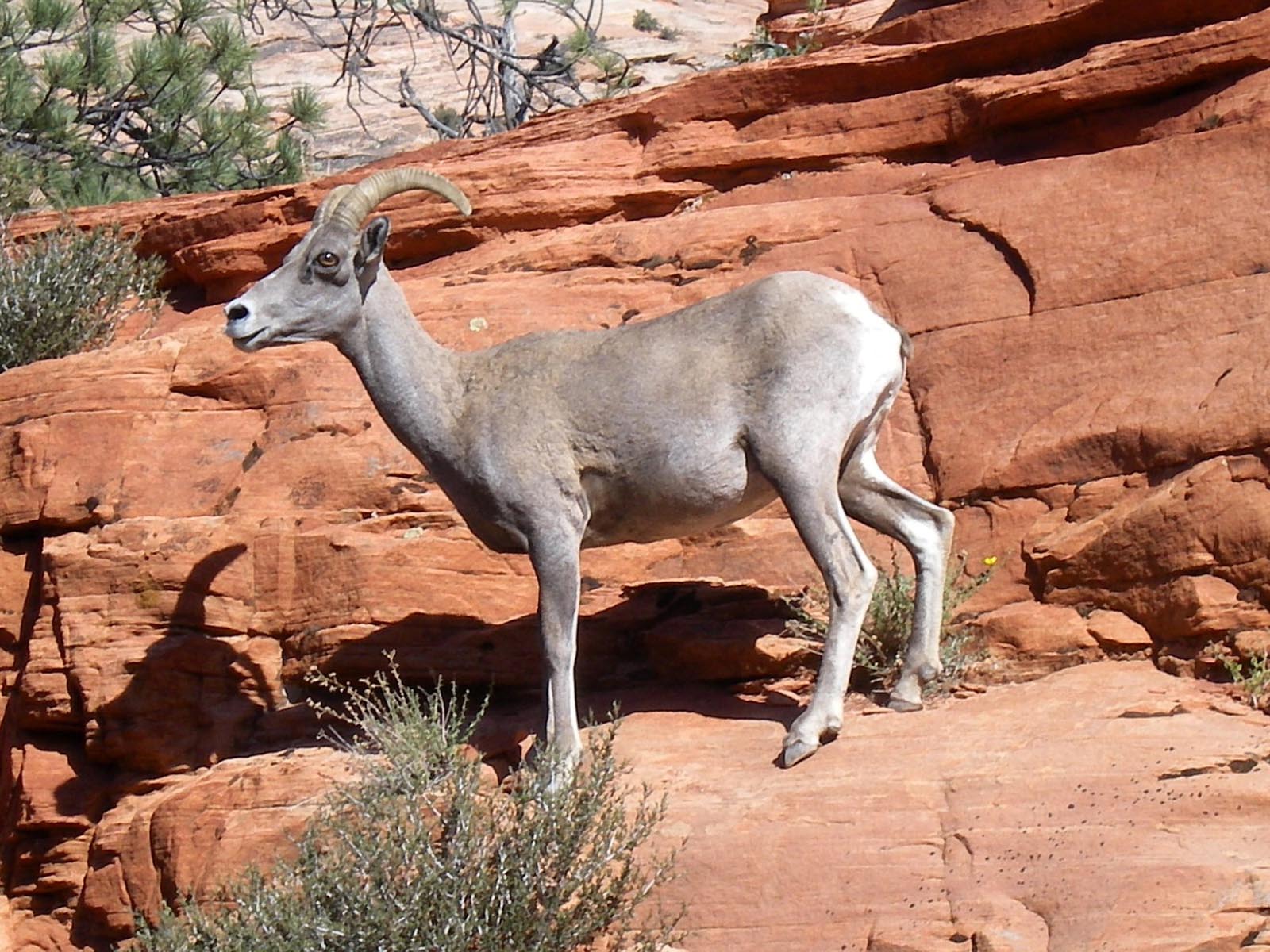
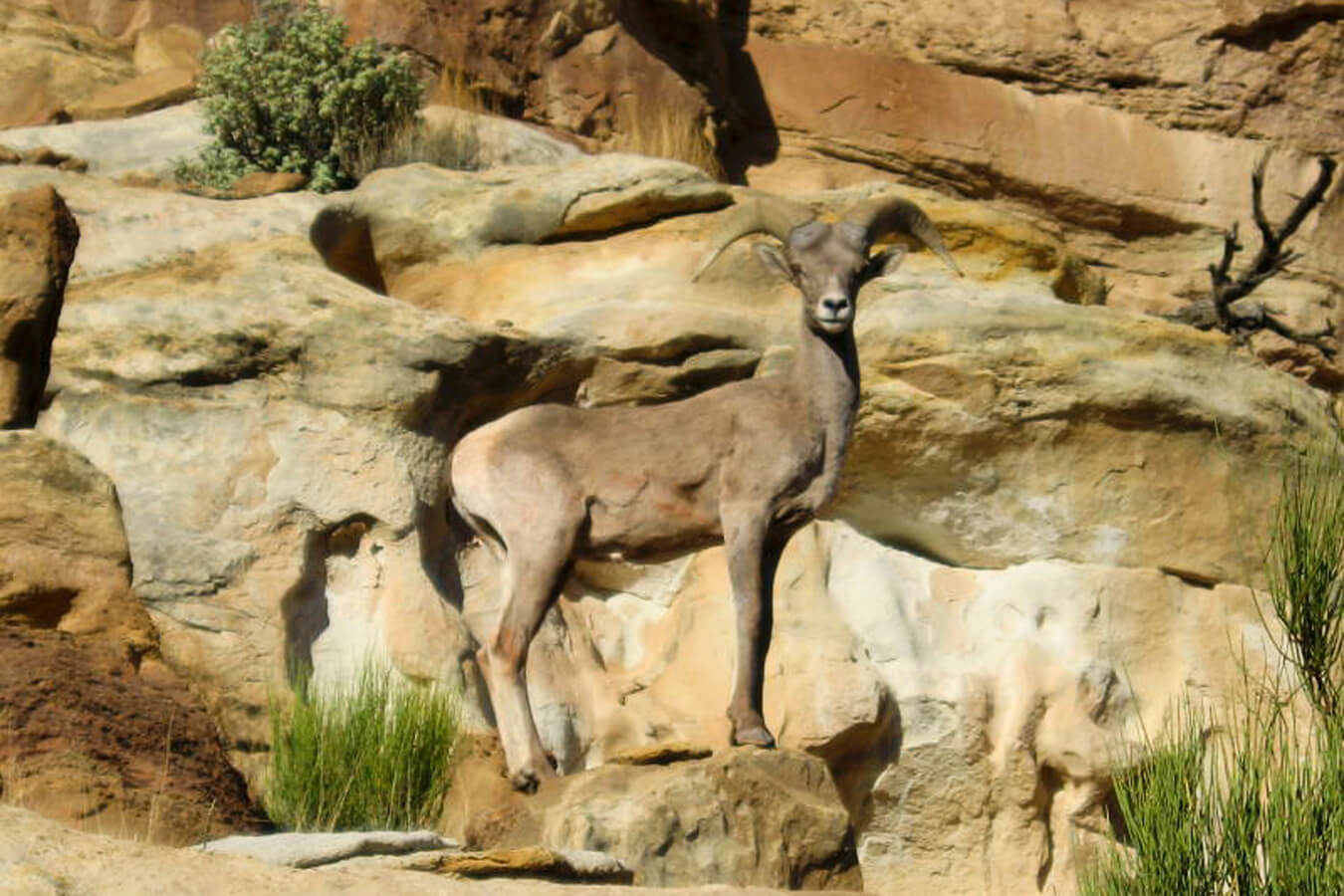
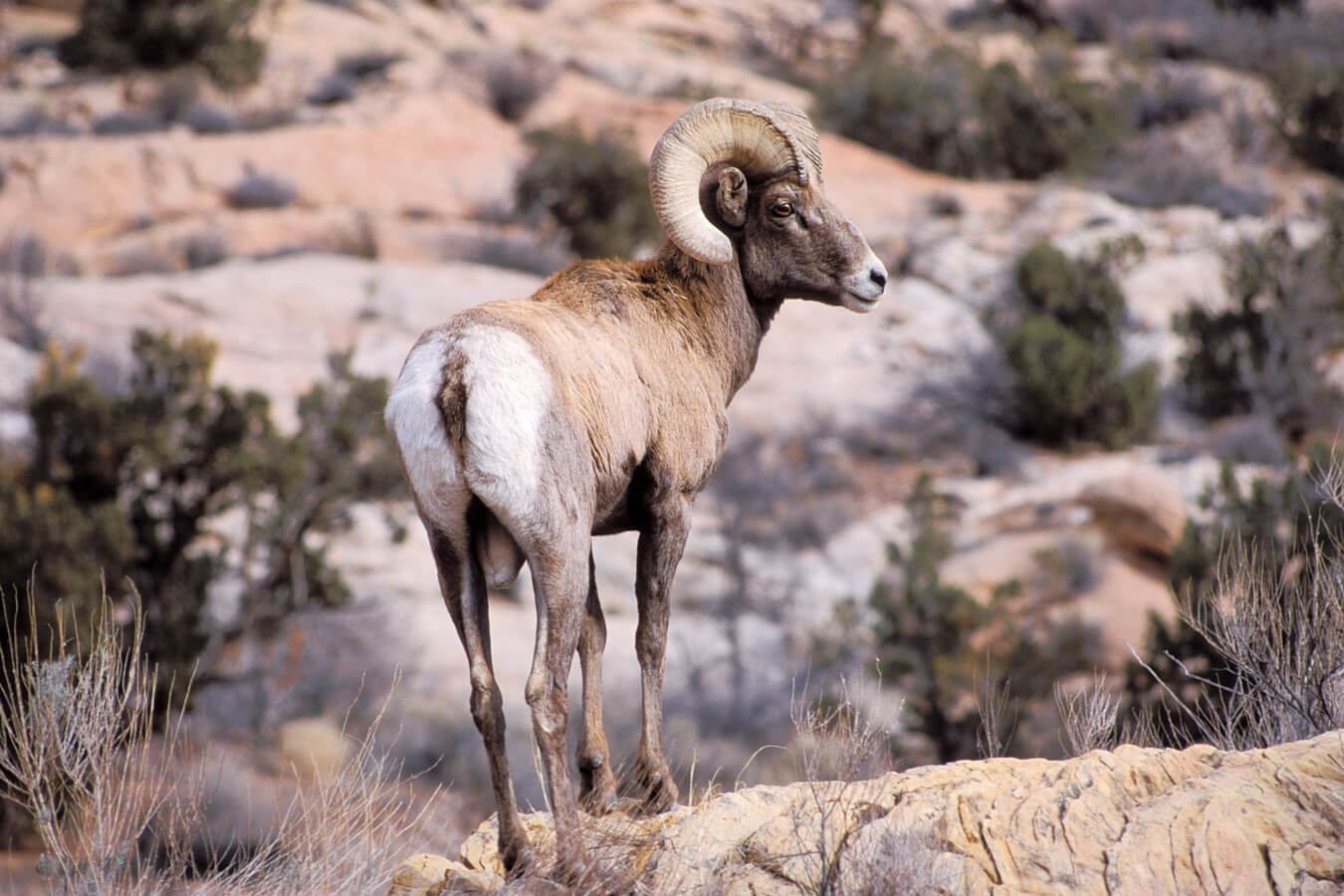
Desert bighorn are built for heat. Compared with Rocky Mountain bighorn sheep, they have smaller bodies, longer legs, and shorter or lighter coats. Their coats run gray-brown, set off by a white rump patch, white along the backs of the legs, and a white muzzle. That coloring helps them disappear against rock.
They are still large animals. Estimates differ a little by park. At Joshua Tree National Park, rams often top 200 pounds, while at Grand Canyon National Park they can reach 250, which makes bighorn the largest native animal in that park. Ewes are noticeably smaller.
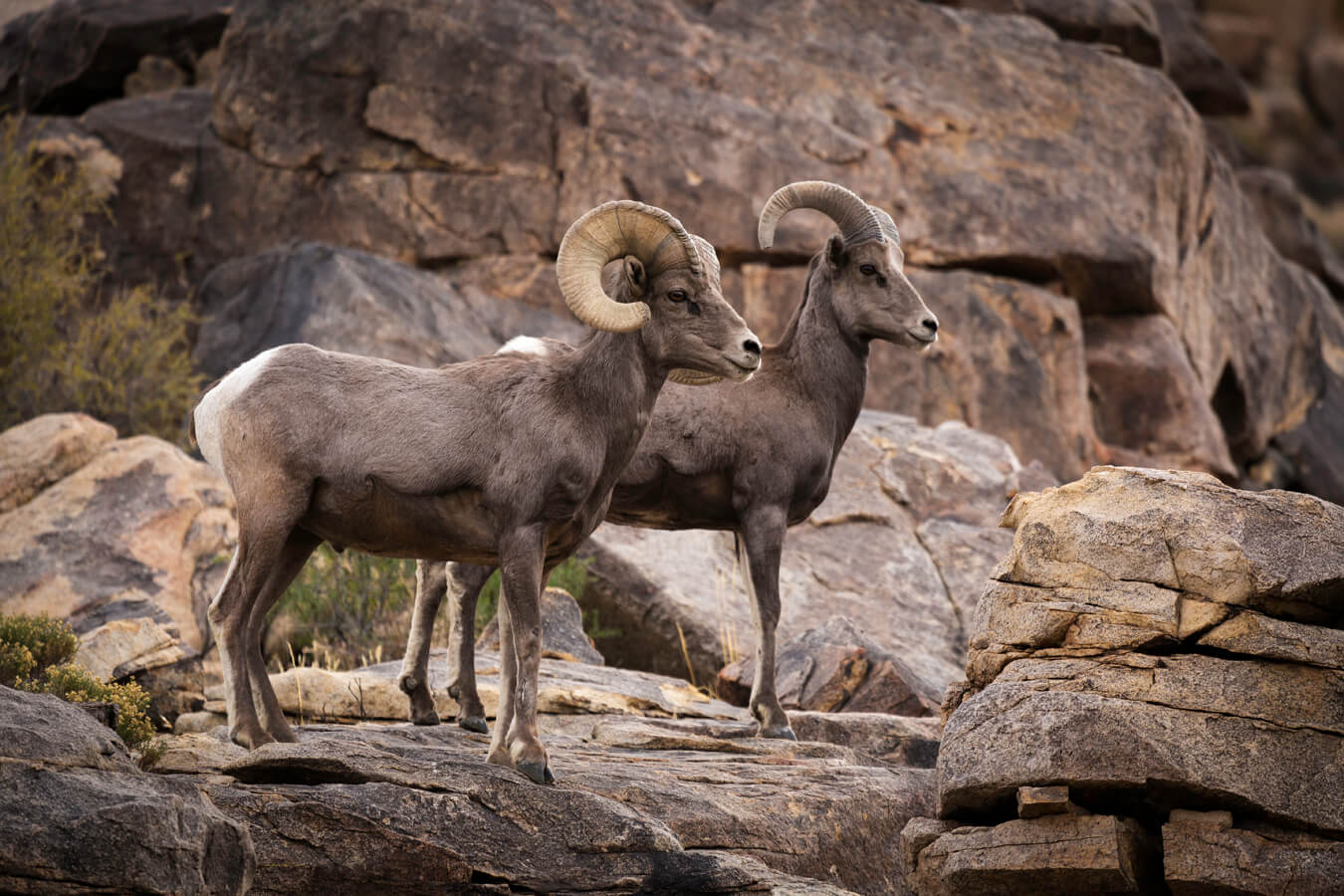
The rams’ horns are the giveaway. From the base, each horn sweeps backward above the ear and then wraps down and forward beside the face. A ram reaches a full curl at around seven or eight, and by then the horns may span 30 inches and weigh close to 30 pounds. Horn size signals rank. Many older rams have “broomed” horns, with the tips rubbed off, possibly because the tips get in the way of their vision. Ewes have shorter, slimmer horns that never go beyond a half curl.
Their feet are just as specialized. Desert bighorn have sharp-edged, elastic, concave hooves. A ledge just two inches wide is enough of a foothold, and a bighorn can clear a 20-foot gap between rocks. Their eyesight is excellent too. Bighorn regularly track movement nearly a mile off.
Habitat and Distribution
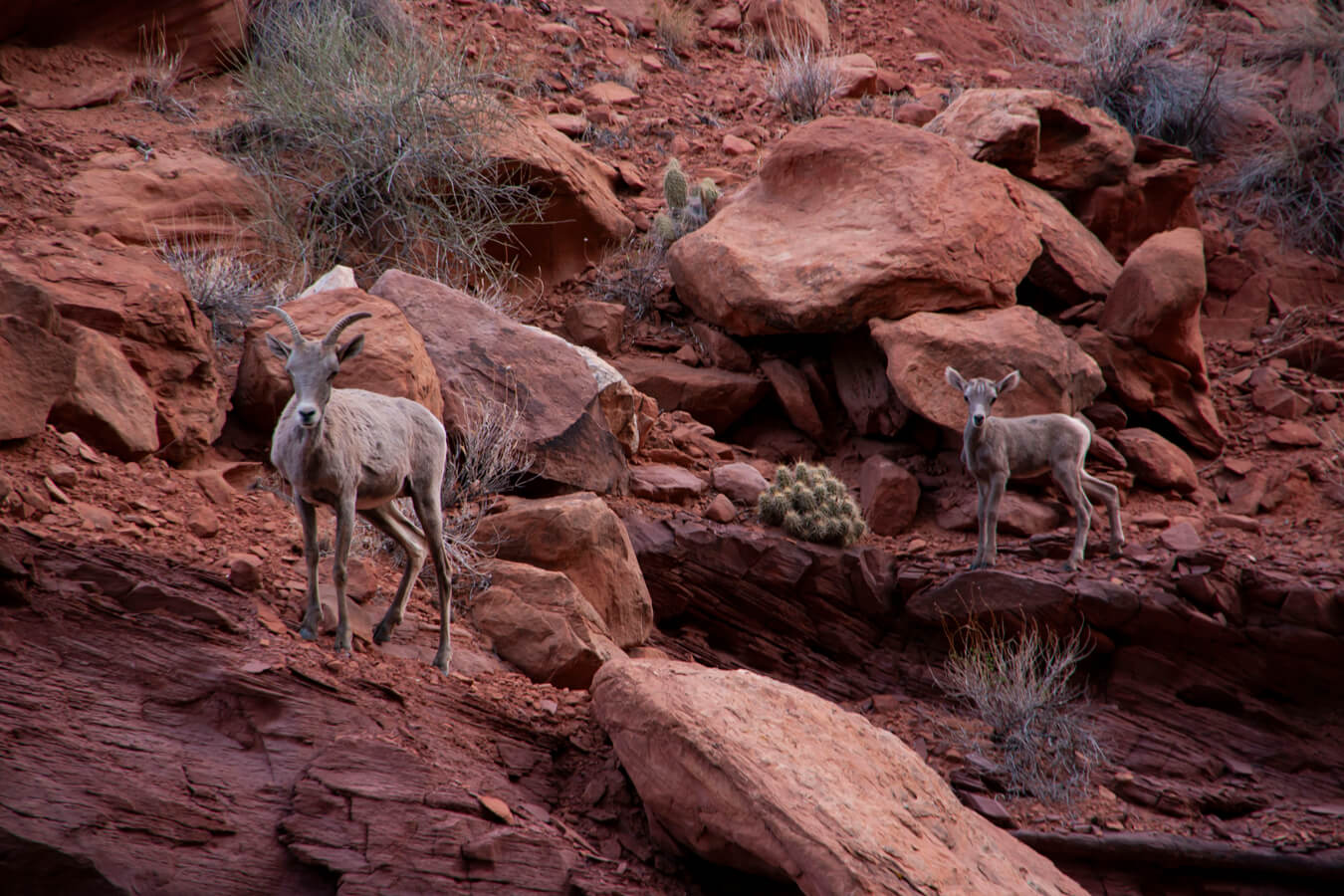
Desert bighorn range across arid mountain ranges from eastern California and most of Nevada to northwestern Arizona and southern Utah, and their range also takes in the deserts of Arizona and New Mexico and northern Mexico. Across all of that country, there are roughly 13,000 of them.
Wherever they live, desert bighorn need the same things: food, water, steep escape terrain, and space. They feed in open areas of low vegetation close to cliffs, then retreat to rock where predators struggle to follow. In Joshua Tree, that need for rugged ground divides the park’s 100 to 200 bighorn into three loosely separate groups. One lives in the Eagle Mountains, one in the Little San Bernardino Mountains, and the third around Queen Mountain and the Wonderland of Rocks.
Death Valley’s mammal list places desert bighorn at every elevation in the park, mostly on hard-to-reach ridges and in canyons close to water. Grand Canyon’s population lives along the canyon’s steep walls above the Colorado River. In Zion, sheep favor the slickrock country of the park’s east side, in the stretch from the East Entrance west to the Zion-Mount Carmel Tunnel.
Behavior and Social Structure
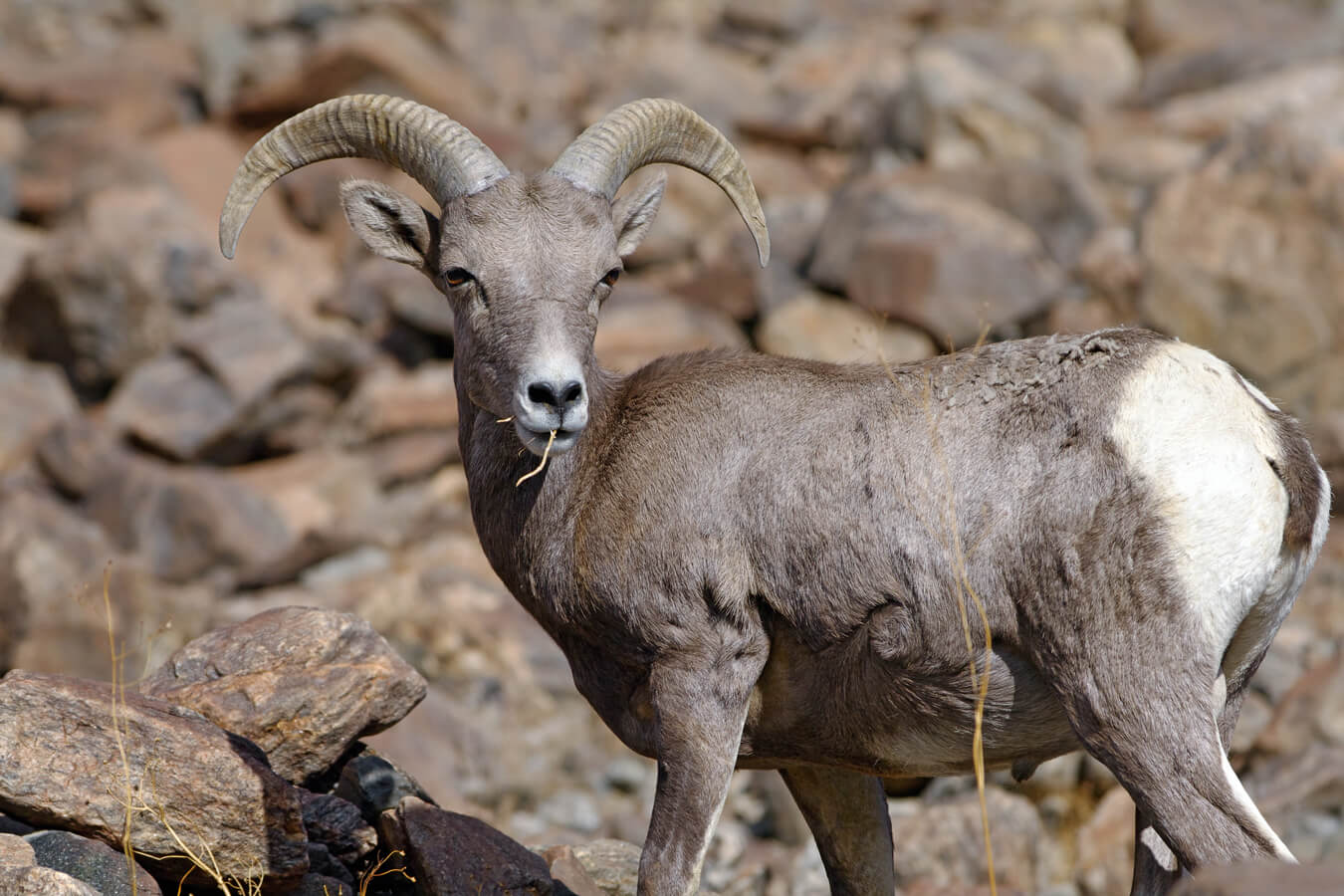
Like all wild sheep, desert bighorn are social. Herds of more than 100 have been recorded, but groups of eight to ten are more typical. Outside the breeding season, adult rams keep to their own bachelor groups, separate from the ewes and young. Ewes seldom leave the herd they were born into, while rams wander more widely.
Desert bighorn are most active during daylight. In summer they rest through the hottest part of the day, often on cliffs above a water source, and they use those rest periods to chew their cud. In Capitol Reef National Park, they are busiest in the early morning and late evening.
The rut comes earlier in the desert than in the mountains. Timing varies a bit: in Zion National Park the breeding season runs from July through October, and in Joshua Tree it peaks in August and September. Rams do not defend territories. Instead, they compete for access to ewes, clashing head-on with their horns until one backs down. Overall vigor and horn size both decide who wins.
Lambs arrive after a gestation of about 150 to 180 days. Births can happen in almost any month, but most occur from January through April. In Zion, look for newborn lambs between mid-January and late April. Twins are rare. Within a few weeks, lambs begin forming their own groups, and by six months they are weaned. Survival is hard. In Joshua Tree, roughly two out of three lambs don’t make it through their first summer.
Diet and Foraging
Desert bighorn are herbivores that eat whatever the desert provides. Grasses are their first choice when they are green.
When grass is not available, which at Joshua Tree is most of the year, they browse shrubs and other plants, including cacti. In Canyonlands, they browse on the same prickly shrubs that leave scratches on hikers’ legs. Across canyon country they favor Indian ricegrass, along with blackbrush and ephedra. At Capitol Reef, their diet shifts with the seasons, from grasses in summer to woody plants in winter.
Water is the limiting factor. After a wet winter, fresh spring growth can hold enough moisture that bighorn may skip drinking for a while. Later in the year, Joshua Tree’s sheep must reach a spring or rock depression at least every third day, and nursing ewes need water almost daily. Bighorn prefer open ground around water so they can see danger coming, and they rarely travel far from escape terrain to drink.
Role in the Ecosystem
Desert bighorn are large grazers and browsers in a landscape where plants and water are scarce, so they compete with other animals for both. Wild horses and burros add pressure too, competing with bighorn for water and food across much of the sheep’s range.
They are also prey. Joshua Tree identifies the mountain lion as the only significant predator of adult sheep there, and most of the bighorn carcasses found in the park were killed by lions. Those attacks usually happen in the narrow canyons where most springs are found, so heading down to drink is when a bighorn is most at risk. NPS educators also list coyotes, bobcats, and gray foxes as predators, and eagles feed on lambs. Still, NPS educators point out that predation is not the main cause of death for desert bighorn because of their escape terrain.
Desert bighorn have also shaped human history in the region. Bighorn are common subjects in the rock art of canyon country, and early inhabitants portrayed them often in the rock markings they left behind.
Decline and Comeback
Desert bighorn once filled the mountains of the Southwest. Early explorers’ reports point to a population that once topped two million across the Southwest. Their history in the Southwest stretches back at least 12,000 years. By the late 1800s, they had vanished or declined across much of that range. Today’s population is estimated at about 10 percent of what it was before western settlement.
Disease was the main cause. Diseases carried by domestic sheep, including scabies and anthrax, wiped out one wild herd after another. Hunting and competition with livestock for food added to the losses. Even today, a disease picked up from livestock can devastate a desert bighorn herd. Contact with domestic sheep or goats can still lead to outbreaks of respiratory disease and die-offs.
Canyonlands became the turning point. When the park was established in 1964, about 100 bighorn remained there. Grazing inside the park ended in the 1970s, and the Bureau of Land Management, which manages the land next door, allowed only cattle on its leases, cutting the bighorn’s exposure to diseases from domestic flocks. Beginning in the early 1980s, biologists captured Canyonlands sheep with nets fired from helicopters and moved them to new areas. Animals from that herd were later moved to restore bighorn in Capitol Reef, Arches, and Glen Canyon National Recreation Area. Canyonlands now has roughly 350 bighorn, and Arches roughly 75.
Other parks followed. Capitol Reef got its herd back in the mid-1990s, when 40 desert bighorn were moved there from Canyonlands. In Zion, where bighorn had disappeared by the mid-1900s, 14 sheep were restored by 1978. The herd grew to more than 500 animals by 2018, and managers now worry about density and disease. Grand Canyon is different. Its herd ranks among the largest desert bighorn populations that have survived without reintroduction, and among the most genetically diverse.
Desert Bighorn Sheep Safety
Desert bighorn are wary of people, and that is how it should stay. Learn the wildlife distance rules for each park you visit, and never approach, follow, or feed bighorn sheep. If a sheep stops feeding, stares at you, or moves away, you are too close. Back off. Use binoculars and a telephoto lens instead of closing the distance.
Water sources deserve special care. Bighorn prefer open space around drinking sites so they can watch for predators, and people waiting nearby can get in the way. In summer, a missed drink matters. Never camp near, linger at, or block a spring, seep, or water-filled pothole. Give ewes with lambs extra room, especially from January through April when most lambs are born.
Leave your dog in the car or at home. A bighorn sees, and smells, a pet dog as a predator. Drive carefully too. In Arches National Park, bighorn are frequently spotted beside US 191 just south of the visitor center, and heavier vehicle traffic on highways into Moab may be behind the alarming first-year lamb mortality seen in recent years. Watch for sheep on and near the road, slow down, and pull completely off the pavement before stopping. Remember that cliffs are as dangerous for you as they are easy for sheep. Never leave the trail or edge toward a drop-off to get a better angle.
National Park Presence
Desert bighorn are a signature species of canyon and desert parks. For photographers visiting the 63 designated U.S. National Parks, these parks have NPSpecies records of bighorn sheep as Present. Most name a desert subspecies, either as the record name or as a scientific synonym; Capitol Reef and Bryce Canyon record bighorn at the species level:
| Park Name | Occurrence | Abundance |
| Arches National Park | Present – Native | Uncommon |
| Bryce Canyon National Park | Present – Native | Unknown |
| Canyonlands National Park | Present – Native | Uncommon |
| Capitol Reef National Park | Present – Native | Uncommon |
| Death Valley National Park | Present – Native | Uncommon |
| Grand Canyon National Park | Present – Native | Uncommon |
| Joshua Tree National Park | Present – Native | Common |
| Zion National Park | Present – Native | Unknown |
According to National Park Service NPSpecies records, bighorn sheep are Present and Native in all eight parks. Joshua Tree’s record, listed as Nelson’s bighorn sheep, is the only one classified as Common. Grand Canyon’s record uses Ovis canadensis mexicana. NPSpecies records for Capitol Reef National Park list bighorn sheep as Present, Native, and Uncommon without naming a subspecies, although the park identifies its herd as desert bighorn. Bryce Canyon’s record also names no subspecies; it lists bighorn as Present and Native with unknown abundance, based on a July 2007 photo voucher. It is included here because most of Bryce Canyon lies within the Utah Division of Wildlife Resources’ Paunsaugunt unit, which the state’s bighorn plan lists under desert bighorn (“Paunsaugunt – Paria River”), and the state recorded desert bighorn releases on the Paunsaugunt’s Paria River in 1995 and 1996. Utah’s plan shows Rocky Mountain bighorn living in the state’s northern half.
NPSpecies lists bighorn at Saguaro National Park as Unconfirmed, and at Guadalupe Mountains National Park as historical and no longer present.
Desert Bighorn Sheep Photography Tips
Finding desert bighorn is the hard part. Their coloring matches sandstone and granite almost perfectly, and a sighting in Arches is a special event. Scan cliff faces, ledges, and talus slowly with binoculars, and watch for movement or a pale rump patch. Early morning and late evening are the most productive times, and they bring warmer light to red rock. Some areas are better bets than others. Try the east side of Zion between the tunnel and the East Entrance, Grand Wash and Capitol Gorge in Capitol Reef, US 191 south of the Arches visitor center, and the Wonderland of Rocks and Queen Mountain area of Joshua Tree, where sheep are seen most often by visitors.
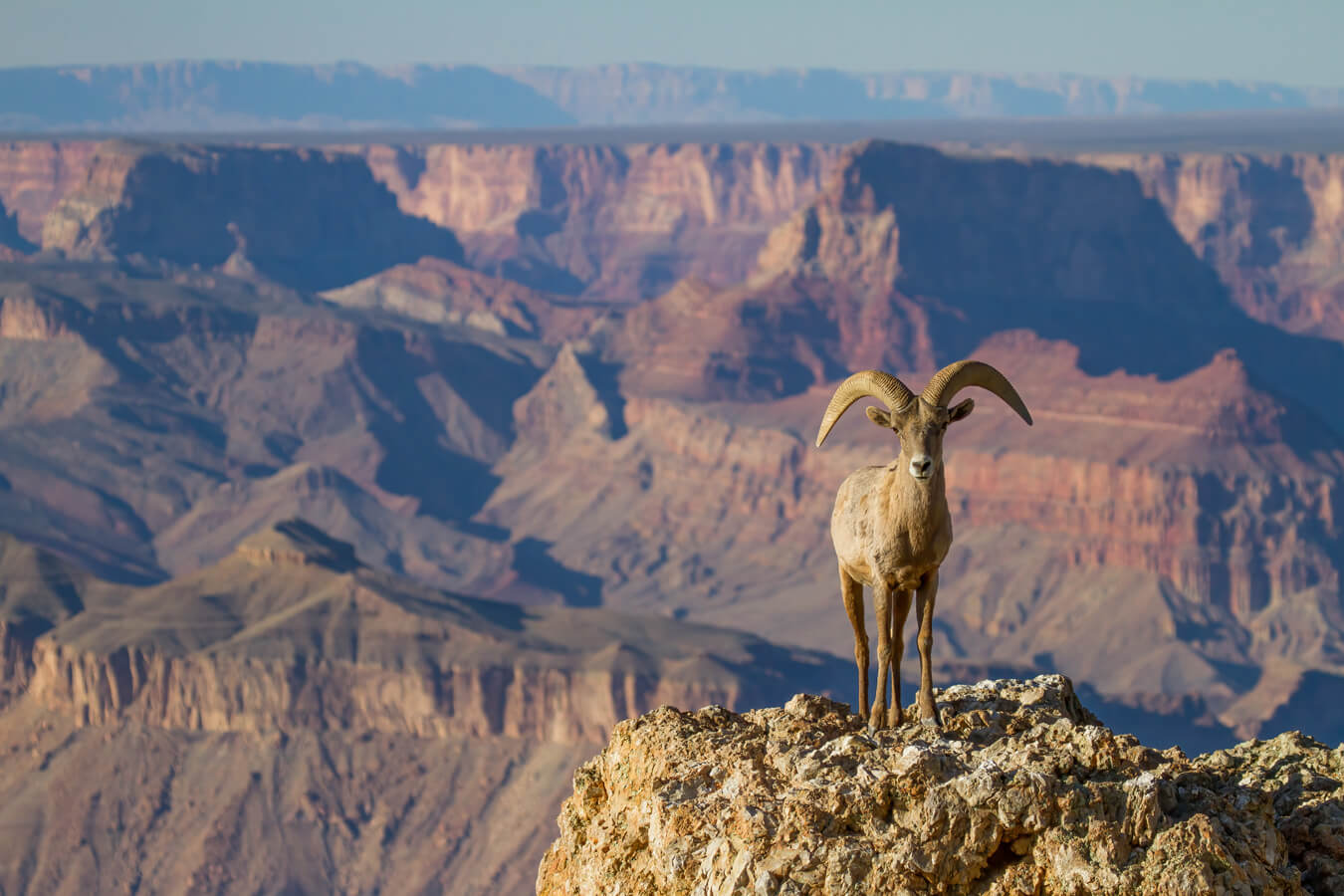
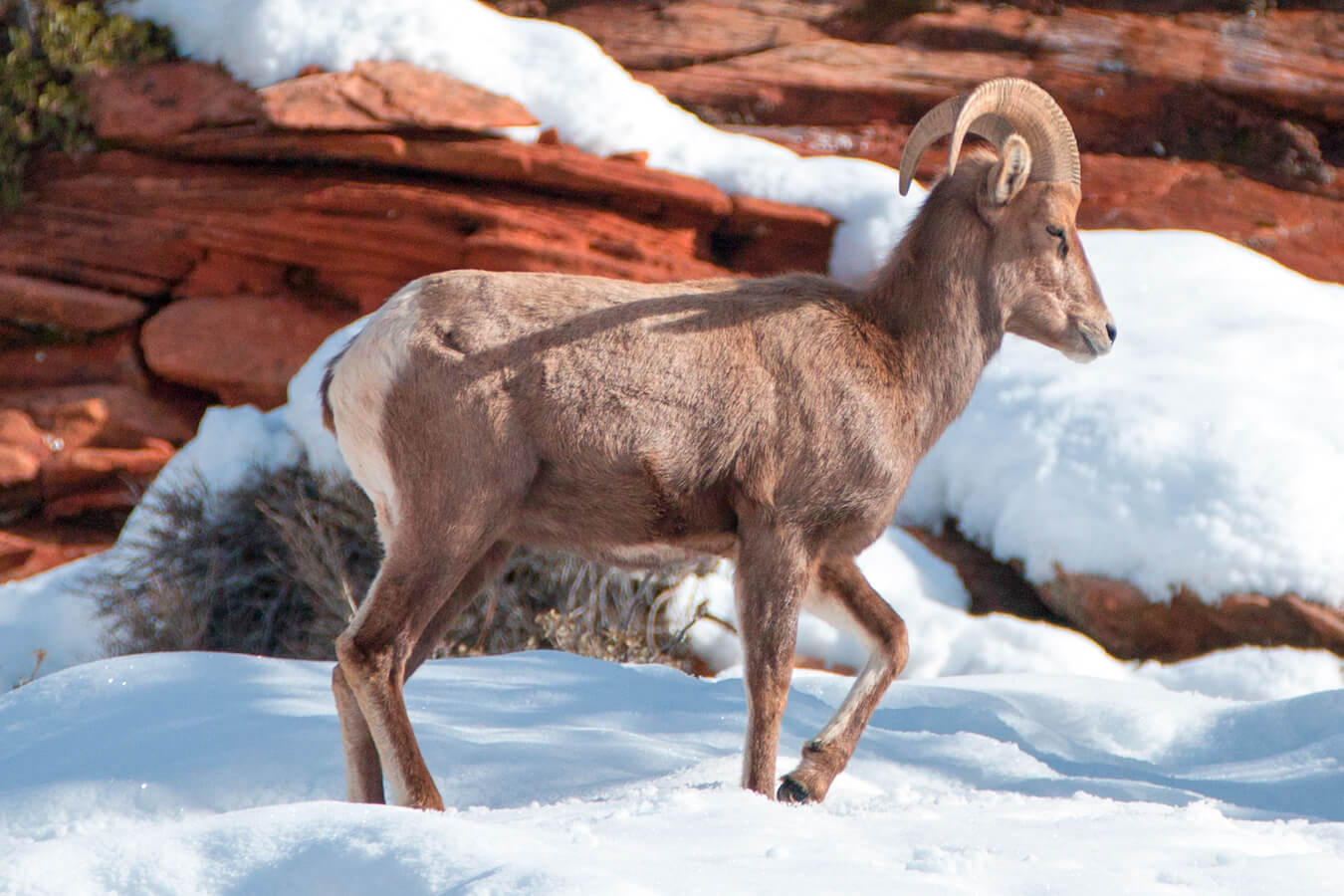
Season shapes the photograph. Late summer and early fall bring the rut and the chance of displaying or clashing rams. Winter and early spring bring lambs, and in Zion, the chance of sheep in snow. Show the landscape. A ram standing on a canyon rim or a band of ewes crossing slickrock says more about desert bighorn than a tight portrait.
A telephoto lens is essential for photographing desert bighorn sheep responsibly. If you already own or want to own a professional-grade mirrored camera like the Canon EOS 5D Mark IV Full Frame Digital SLR, we recommend using a Canon EF 100-400mm f/4.5-5.6L IS II USM Lens zoom lens for wildlife photography. If you have or are interested in a newer mirrorless model like the Canon EOS R5 Full-Frame Mirrorless Camera, we recommend using a Canon RF100-400mm F5.6-8 IS USM for long-distance shots.
Not quite ready to invest in traditional professional-grade camera equipment but want to enhance the quality of your cell phone photographs? Consider using a Moment Tele 58mm Mobile Lens II for improved reach, and use a Moment camera case with a lens mount to attach it to your phone. Since cell phones generally cannot provide the same reach as a dedicated telephoto camera lens, never compensate by moving closer to wildlife. Desert heat adds one more rule. Carry plenty of water, and never follow sheep into terrain you are not prepared for.
No photograph is worth disturbing an animal or putting yourself or others at risk.
Why Are They Called Desert Bighorn Sheep?
“Bighorn” comes from the rams’ massive curled horns. The species takes its name from those horns, and a male’s pair can weigh as much as 30 pounds. “Desert” sets this subspecies apart from the Rocky Mountain and Sierra Nevada bighorn of cooler, higher country.
The scientific name nelsoni honors American naturalist Edward William Nelson. C. Hart Merriam described the animal in 1897 as Ovis nelsoni, based on a specimen Nelson collected in 1891 in the Grapevine Mountains along the California–Nevada border, close to present-day Death Valley National Park. NPSpecies still uses the common name Nelson’s bighorn sheep for the Death Valley and Joshua Tree records, so you will see both names in park materials.

A Note About Desert Bighorn Sheep Taxonomy
Readers researching desert bighorn sheep may encounter several scientific names for animals in the same region. This page uses:
Ovis canadensis nelsoni
However, some National Park Service records use other names, including:
Ovis canadensis mexicana
Desert bighorn taxonomy has been revised several times. Older treatments split desert sheep into several subspecies, including nelsoni, mexicana, cremnobates (peninsular bighorn), and weemsi. Today, the Integrated Taxonomic Information System treats cremnobates and weemsi as synonyms of nelsoni. NPSpecies records reflect this history. Arches, Canyonlands, Death Valley, and Zion list nelsoni as a synonym, while Grand Canyon’s record uses mexicana, even though Grand Canyon’s own park pages use nelsoni.
For consistency throughout National Park Photographer, this page uses Ovis canadensis nelsoni for desert bighorn while recognizing the other names visitors may encounter. Rocky Mountain bighorn (O. c. canadensis) and Sierra Nevada bighorn (O. c. sierrae) are covered separately. Barbary sheep (Ammotragus lervia), which NPSpecies lists as non-native at Guadalupe Mountains National Park, are not bighorn at all.
Final Thoughts
Desert bighorn sheep are among the most remarkable animals of the Southwest. They survive heat, drought, and sparse forage on cliffs that look impossible to climb. Their curled horns and quiet watchfulness make every sighting feel earned.
They also show what careful restoration can do. A native herd protected in Canyonlands helped return bighorn to Arches and Capitol Reef, and Zion’s reintroduced herd now numbers in the hundreds. That recovery is not finished. Joshua Tree has lost a significant share of its springs and seeps, and a bighorn that died in the park in 2015 tested positive for bacterial pneumonia. Disease from domestic sheep and goats remains the biggest threat across the desert bighorn’s range.
Spotting a ram on a sandstone ledge or a band of ewes picking their way down a canyon wall is an unforgettable part of a desert park visit. Those encounters carry responsibility. By keeping our distance, staying away from water sources, leaving pets behind, and using telephoto lenses rather than moving closer, photographers and visitors can enjoy desert bighorn without adding to the pressures they already face. Responsible wildlife viewing and photography help keep desert bighorn, and the canyon country they call home, wild.
Want more information about the amazing wildlife that call our National Parks home? Take a look at our National Park Wildlife page to explore the various parks and the animals in them. Planning on visiting a National Park in the near future? Be sure to follow park regulations, practice Leave No Trace principles, and prioritize both your safety and the well-being of wildlife while exploring.
Joyful Journeys!
Bonnie, Co-Owner, National Park Photographer
Want to learn more about desert bighorn sheep? Check out the additional resources below!
Desert Bighorn Sheep Books & Field Guides
- The Desert Bighorn Sheep: Wilderness Icon
- Buford the Little Bighorn
- Wild Republic Bighorn Sheep Plush
- Peterson Field Guide to Mammals of North America
- 10×42 Binoculars for Wildlife Viewing
- Monocular for Wildlife Viewing
- Camera Bean Bag for Wildlife Photography
Please note, by making purchases through our affiliate links, you are supporting our mission to celebrate and showcase our National Parks and the photographers who frequent them. As an Amazon Associate, National Park Photographer earns from qualifying purchases at no cost to you. We appreciate your support.
References & Additional Resources
- National Park Service — Zion National Park: Bighorn Sheep
- National Park Service — Zion National Park and UDWR to Manage Bighorn Sheep
- National Park Service — Canyonlands National Park: Bighorn Sheep
- National Park Service — Arches National Park: Bighorn Sheep
- National Park Service — Capitol Reef National Park: Mammals
- National Park Service — Joshua Tree National Park: Desert Bighorn Sheep
- National Park Service — Grand Canyon National Park: Bighorn Sheep
- National Park Service — Death Valley National Park: Mammals
- National Park Service — Colorado National Monument: Desert Bighorn Sheep
- National Park Service — Glacier National Park: Mammals
- National Park Service — Teachers: Bighorn Sheep
- National Park Service — NPSpecies: Arches National Park Bighorn Sheep
- National Park Service — NPSpecies: Canyonlands National Park Bighorn Sheep
- National Park Service — NPSpecies: Death Valley National Park Bighorn Sheep
- National Park Service — NPSpecies: Grand Canyon National Park Bighorn Sheep
- National Park Service — NPSpecies: Zion National Park Bighorn Sheep
- National Park Service — NPSpecies: Capitol Reef National Park Bighorn Sheep
- National Park Service — NPSpecies: Bryce Canyon National Park Bighorn Sheep
- Utah Division of Wildlife Resources — Utah Bighorn Sheep Statewide Management Plan
- Utah Division of Wildlife Resources — Unit #27 (Paunsaugunt) Deer Herd Unit Management Plan (unit boundary)
- Utah Division of Wildlife Resources — Statewide Management Plan for Bighorn Sheep (1999)
- National Park Service — NPSpecies: Joshua Tree National Park Species List
- National Park Service — NPSpecies Species Search
- Integrated Taxonomic Information System — Ovis canadensis nelsoni
- Smithsonian National Museum of Natural History — Ovis canadensis nelsoni Type Specimen
Do you want to be featured on National Park Photographer?
Why wait! Contact us today at nationalparkphoto@gmail.com for a chance to be a Featured National Park Photographer!