Pronghorn are the animals you notice as a pale flicker far out on the sagebrush flats, a group of tan and white shapes that seem to be standing still until they suddenly are not. They are the fastest land mammals in North America, and on the open grasslands of the West they are often easier to see than almost any other large animal. Getting a good photograph of one is another matter, and that challenge is a big part of their appeal.
The pronghorn (Antilocapra americana) is the last surviving member of Antilocapridae, a family found only in North America. Despite the common nickname “antelope,” it is not a true antelope, and its closest living relatives are thought to be the giraffe and okapi of Africa. Pronghorn range across the grasslands and shrub-steppe of the western United States, southern Canada, and northern Mexico. NPSpecies records list pronghorn as present in 16 National Parks, including Badlands, Grand Teton, Theodore Roosevelt, Wind Cave, and Yellowstone.
Learning about animals like pronghorn can significantly enhance wildlife photography skills by providing valuable insights into animal behavior, habitat, and physical characteristics. Understanding an animal’s habits can allow photographers to better anticipate and capture unique and authentic moments. Knowledge of an animal’s habitat may also help in selecting the best locations and times for wildlife viewing and photography, while familiarity with physical characteristics is essential for accurately identifying wildlife in the field. If wildlife photography or simply wildlife viewing are of interest to you, then you’ve come to the right place! Together, let’s learn more about what makes pronghorn so special.
Physical Characteristics
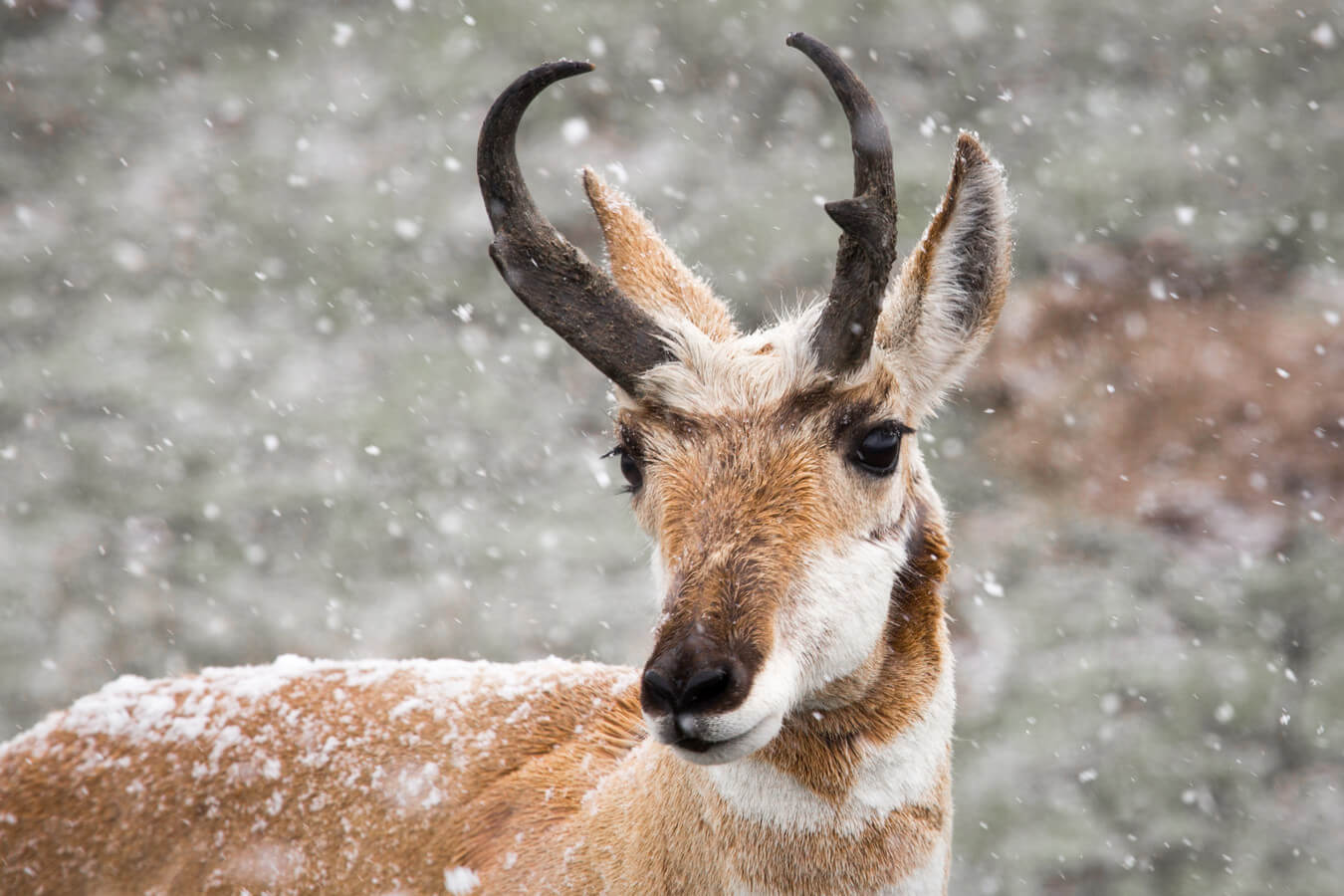
Pronghorn are about the size of a large dog with long legs. Adults stand roughly 35 to 40 inches at the shoulder and measure 45 to 55 inches from nose to tail. Bucks weigh about 100 to 125 pounds and does about 90 to 110 pounds. In the wild they usually live 7 to 10 years.
Their coloring makes them easy to pick out once you know what to look for:
- Upper body: Reddish tan to cinnamon brown on the back, sides, and upper legs.
- Underparts: White belly, white lower sides, and white bands across the throat.
- Rump: A large white rump patch that the animal can flare when alarmed.
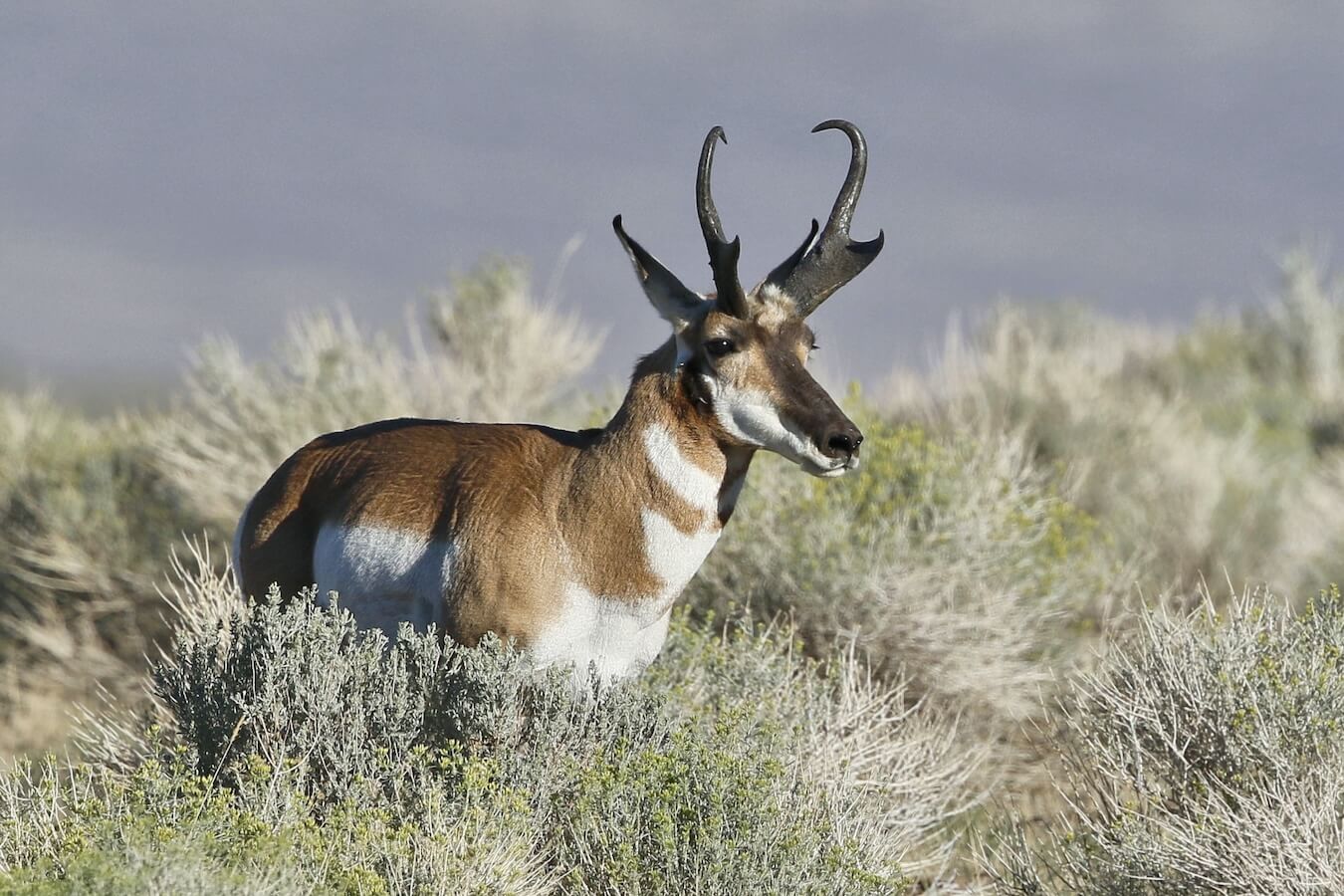
- Face: Bucks have a black mask down the face and a black patch on the cheek below the ear. Does lack the black cheek patch.
The eyes are large and set far out on the sides of the head. That placement gives a pronghorn a field of view of about 320 degrees, and it can pick up movement as far as 3 miles away. If you can see a pronghorn, it has almost certainly already seen you.
Their hair is hollow, which insulates them against winter wind on the open plains. They can also raise or flatten the hair on different parts of the body to trap warmth or release heat, a useful trick in places where the temperature swings so widely between seasons.
Horns, Not Antlers
The pronghorn gets its name from the forward-pointing prong on each of the buck’s horns. Those horns are unlike anything else in the animal world. Each one is a bony core covered by a sheath of keratin, the same material as fingernails and hair. Cattle, sheep, and goats keep their horn sheaths for life. Pronghorn shed theirs every year, which no other living animal does.
- Bucks: Horns are usually 10 to 16 inches long and can reach about 18 inches, curving back at the tips with a single prong pointing forward.
- Does: Roughly 70 percent of females grow short horns, usually only 1 to 2 inches long and without prongs.
- Shedding: Bucks shed the outer sheaths in November or December, after the breeding season.
- Regrowth: New sheaths begin growing in February or March and reach full size by August or September.
Because the sheath is shed and not the core, a buck in winter still has short, blunt horns. They look rough and pale compared with the glossy black horns of late summer. For photographers, that means August through early October is the season for a buck at his most impressive, right as the breeding season begins.
The difference between horns and antlers trips up a lot of people. Antlers, like those on elk and deer, are made of bone and fall off completely every year. Pronghorn horns are a hybrid of the two systems, which is part of what makes this animal so unusual.
Speed and Endurance
Pronghorn are built to run. Park Service pages give a range of top speeds, which makes sense for an animal that is hard to clock: Yellowstone lists bursts of 45 to 50 miles per hour, Theodore Roosevelt lists up to 55, and Wind Cave says pronghorn can hit 60 miles per hour for about half a mile, with strides up to 24 feet long. Even more impressive is their endurance. They can hold 30 to 40 miles per hour over long distances, something no predator in North America can match.
Several features make that possible:
- Heart and lungs: Oversized for the animal’s body, moving large amounts of oxygen.
- Windpipe: A wide trachea that lets air in and out quickly.
- Legs: Long and light, with cushioned, pointed hooves that absorb shock on hard ground.
- Build: A lean body with no dewclaws, carrying little extra weight.
Today’s predators cannot come close to those speeds, so why are pronghorn so fast? Many biologists think they evolved alongside fast predators that are now extinct, including the American cheetah, which disappeared at the end of the last ice age. The pronghorn kept the speed long after the threat was gone.
For all that running ability, pronghorn are poor jumpers. They prefer to crawl under fences rather than leap over them, and woven wire or a bottom strand set too low can stop them cold. Many land managers now use wildlife-friendly fences with a smooth bottom wire set high enough for pronghorn to slip underneath.
Habitat and Range
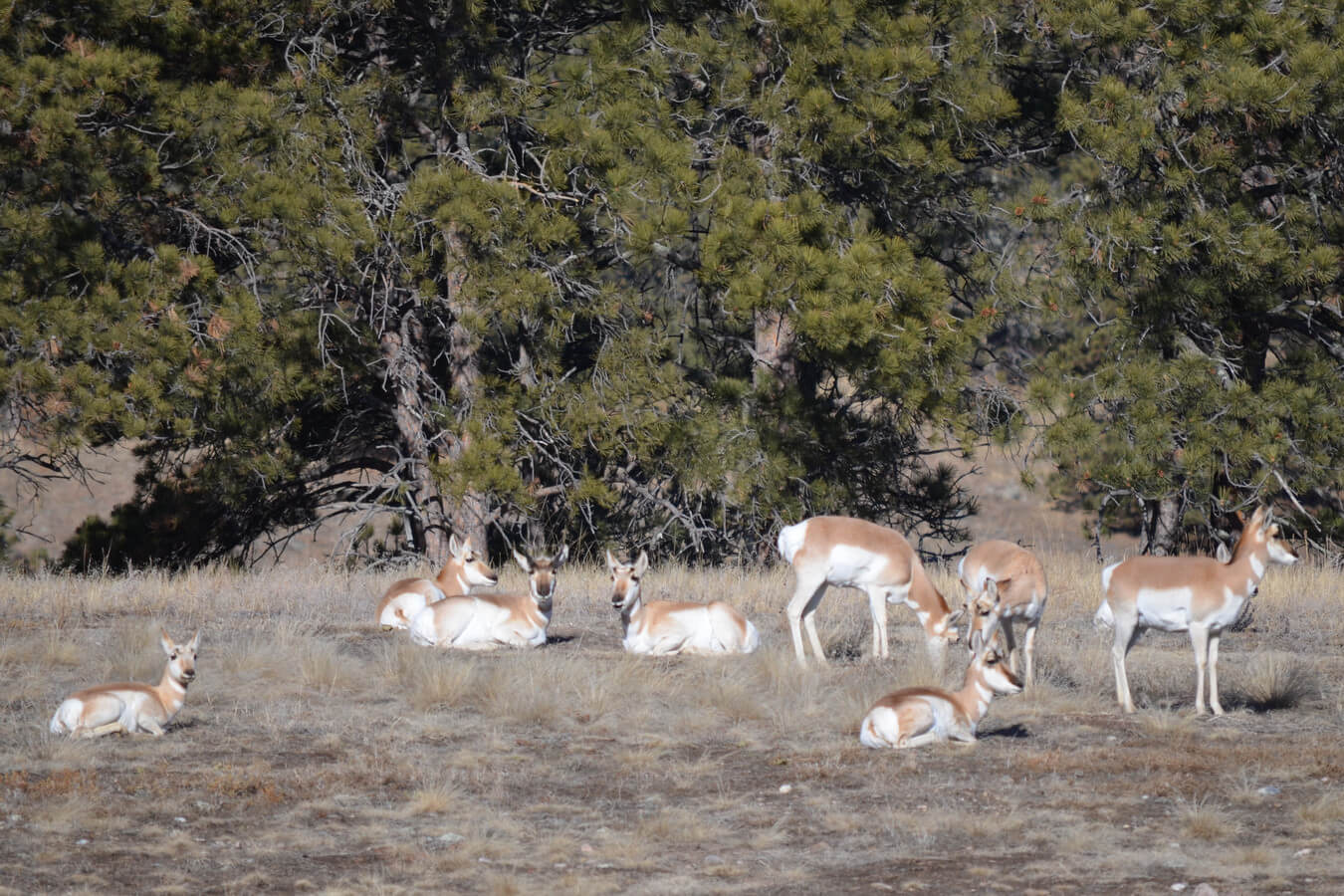
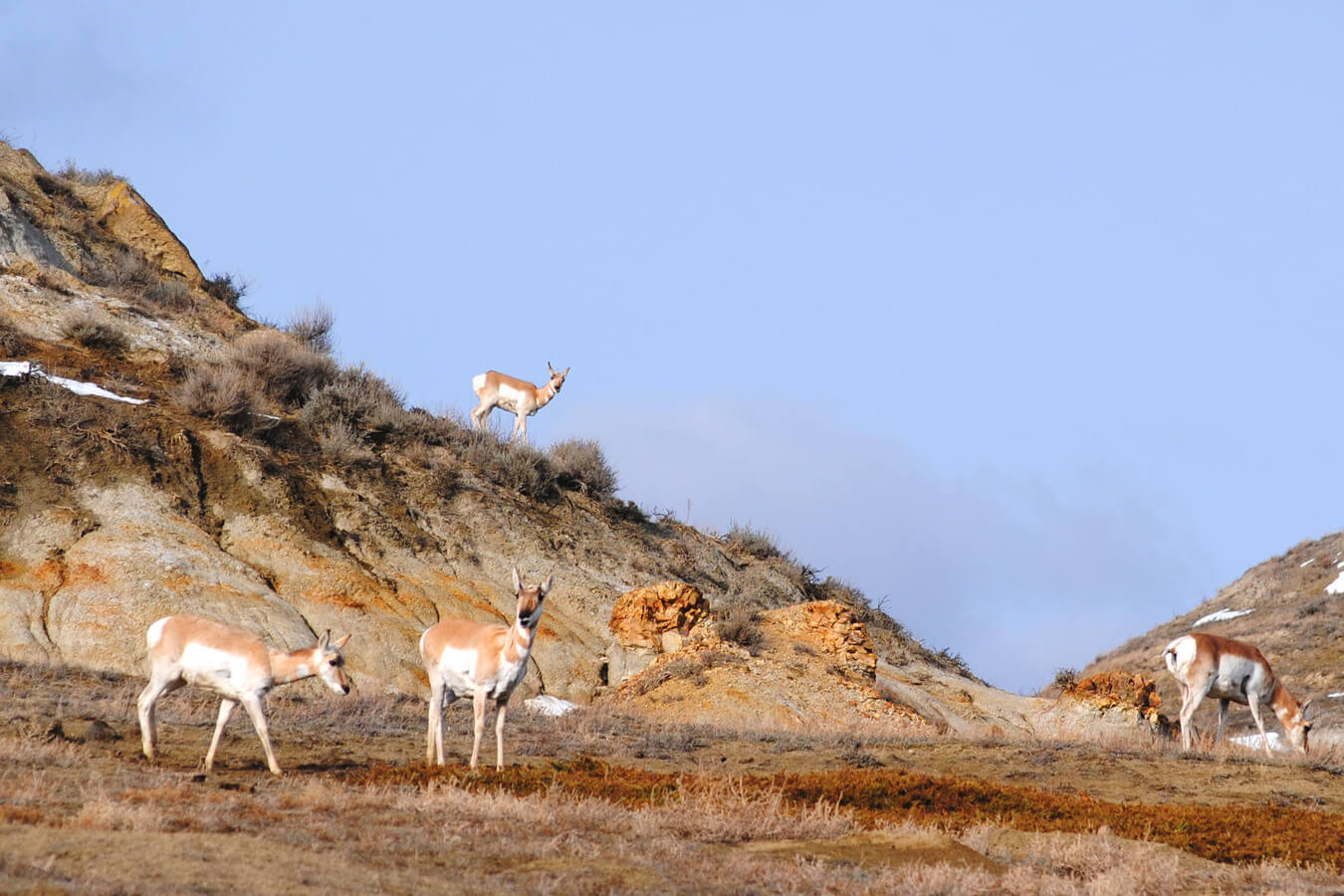
Pronghorn need wide open country. Grasslands, sagebrush flats, and desert shrublands are classic pronghorn habitat, where their long-range eyesight and speed give them the advantage. Dense forest and steep, rocky terrain are places they avoid.
Before European settlement, an estimated 35 million pronghorn roamed the West. Unregulated hunting, fencing, and habitat loss reduced them to a small fraction of that by the early 1900s. Conservation and hunting regulations helped them recover, and today the population is around 500,000.
Wind Cave National Park is a good example of that recovery. Pronghorn had disappeared from the area, and in 1914 thirteen animals from Alberta were released there. Their descendants still graze the park’s mixed-grass prairie today.
In Yellowstone, pronghorn are near the northern edge of their range. The park counted roughly 500 to 600 in 2024. In summer, many graze in Lamar Valley and the open country of the Northern Range. In winter, they gather in the lower, drier country between the North Entrance at Gardiner and Reese Creek, where the snow is shallower.
Diet
Pronghorn are browsers and grazers that eat a surprising variety of plants. Their diet changes with the seasons:
- Winter: Mainly sagebrush and rabbitbrush, shrubs that stay above the snow and remain green.
- Spring and summer: Forbs, the broad-leaved flowering plants that come up on the prairie, along with new green growth.
- Grasses: A small part of the diet overall, eaten mostly when new and tender.
- Other foods: Cactus and plants that many other grazers avoid.
Sagebrush and some other plants pronghorn eat contain compounds that are toxic to many animals. A pronghorn’s liver is unusually large for its size, which helps it break down those compounds and makes use of foods other grazers cannot.
Because of this mixed diet, pronghorn do not compete heavily with bison or cattle, which eat mostly grass. They also get much of their water from the plants they eat, which lets them live in dry country far from streams.
Fire can help them too. After a prairie burns, the new growth that comes up is tender and nutritious, and pronghorn are often drawn to recently burned ground. Wind Cave National Park uses prescribed fire to maintain its prairie, and pronghorn can sometimes be seen grazing in those burned areas soon afterward.
Herds and the Rut
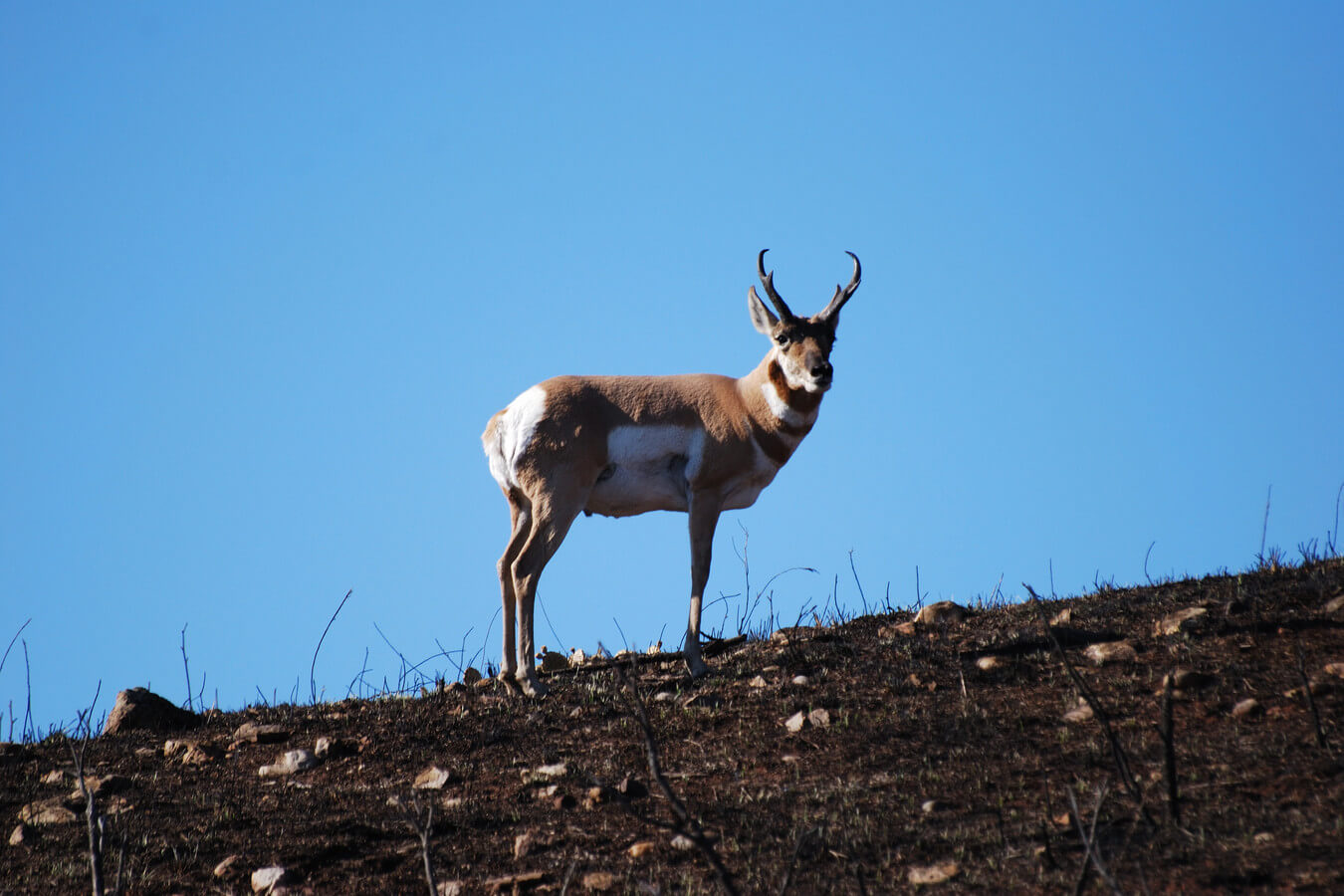
Pronghorn are social animals for much of the year. In winter they gather in mixed herds that can number in the dozens or even hundreds, where many eyes watch for predators. In spring, the herds break up. Pregnant does go off to give birth, and bucks spread out to set up territories.
The rut, or breeding season, runs from about mid-September into early October. A buck at this time is busy and loud:
- Harems: Dominant bucks gather groups of does and try to keep them together.
- Chases: A buck will run off rival males, often in long, high-speed chases across the flats.
- Fights: When two evenly matched bucks meet, they may lock horns and shove, and the prongs can do real damage.
- Scent marking: Bucks mark their territory with scent glands below the ears and with urine and dung.
The white rump patch plays a big part in herd life. When a pronghorn senses danger, the long white hairs on its rump stand on end and flare out. That flash can be seen from far away, and it alerts the rest of the herd. Pronghorn also give off a strong scent from glands in the rump when alarmed.
For photographers, the rut offers some of the most dramatic pronghorn behavior of the year. Bucks are more focused on each other and the does than on people, which can mean better chances for action shots from a safe distance.
Fawns
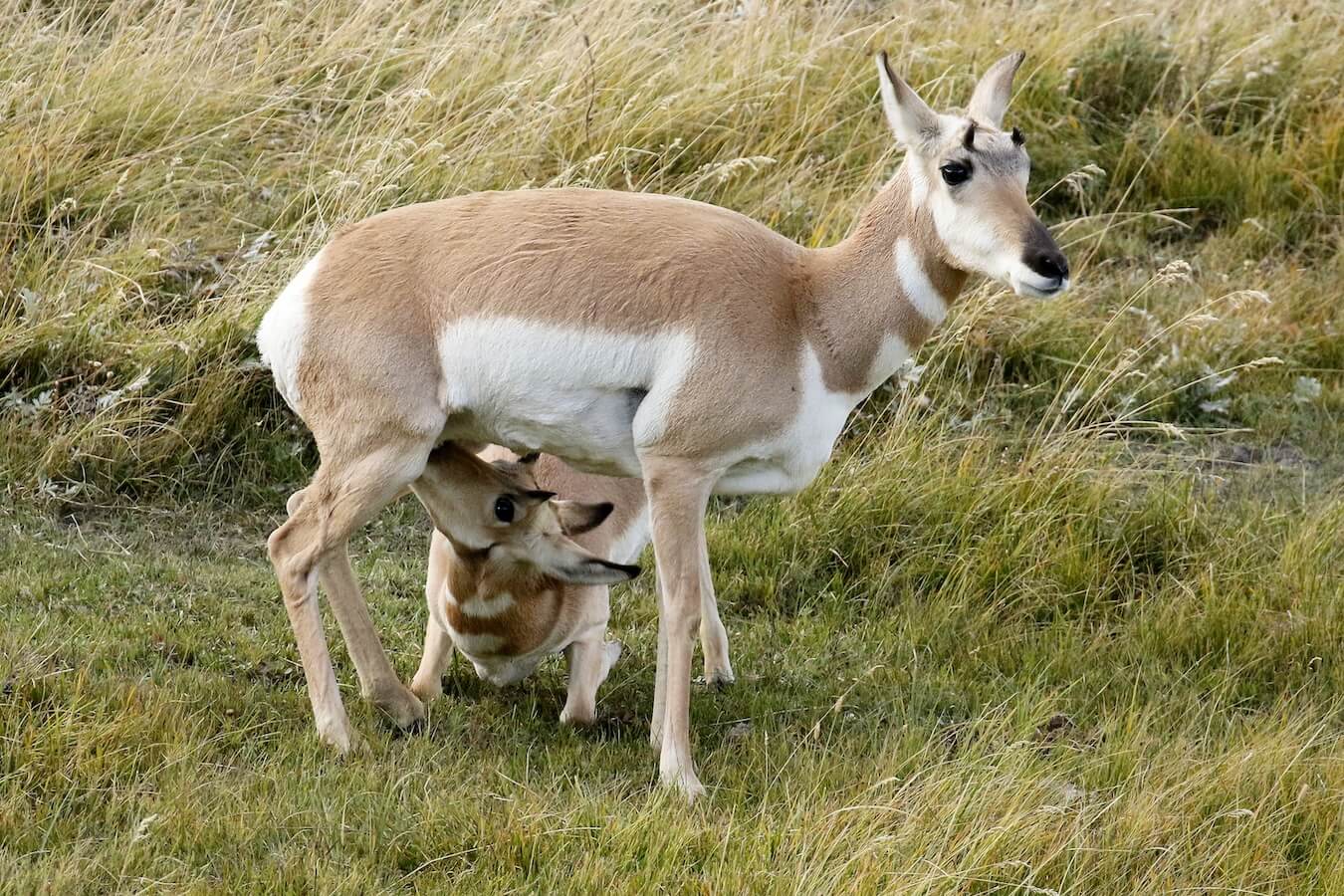
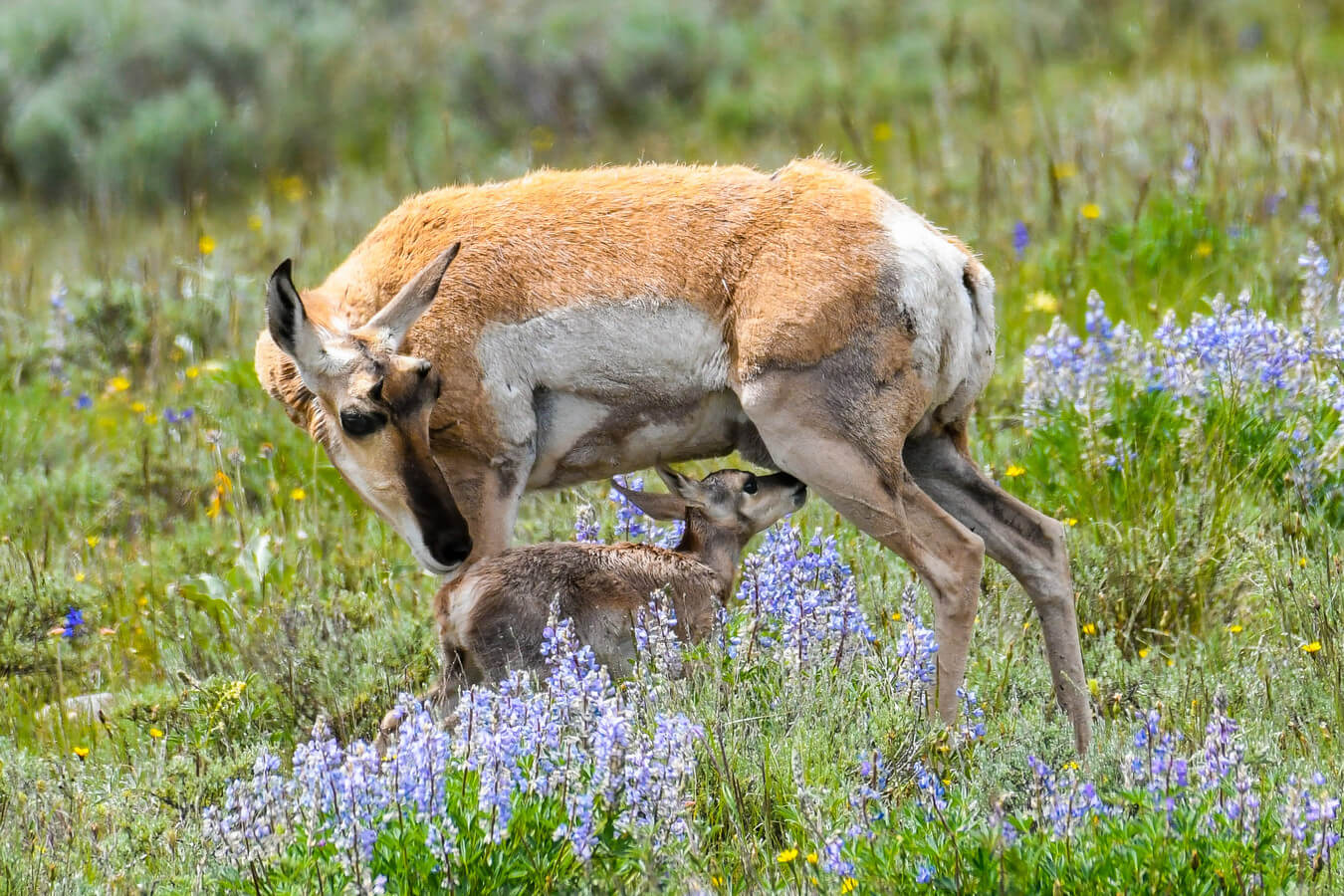
Pronghorn young are called fawns, not calves or kids. Does give birth from about mid-May to mid-June, and twins are common, especially for older does. Each fawn weighs about 5 to 9 pounds at birth.
Newborn fawns are grayish brown and have no spots. They are well camouflaged in tall grass and sagebrush and lie hidden for much of the day. That strategy works because:
- No odor: Newborn fawns have almost no scent, which makes them hard for coyotes and other predators to find.
- Short visits: The mother keeps her distance and returns to nurse only a few times a day, for a total of about 20 minutes.
- Separate hiding spots: Twins are often hidden apart, so a predator that finds one may miss the other.
- Fast development: Fawns can walk within about 30 minutes of birth and can outrun a person within a couple of days.
After about three weeks of hiding, fawns join their mothers and other does and fawns in nursery groups. They stay with the herd through the summer and fall.
The first weeks are the most dangerous time in a pronghorn’s life. Coyotes, bobcats, wolves, bears, and golden eagles all take fawns. Adults, with their speed and long-range eyesight, have fewer predators.
If you find a fawn lying alone, it has not been abandoned. Its mother is almost certainly watching from a distance. Leave the area quietly so she can return.
Migration
Some pronghorn stay in the same area all year. Others make long seasonal journeys between summer and winter ranges, following the snow line and the green-up of new plants.
In Yellowstone, roughly three-fourths of the pronghorn population migrates. Many leave the park in winter for the lower country near Gardiner and return to Lamar Valley and the surrounding grasslands in spring.
Pronghorn in Grand Teton National Park make one of the longest land migrations in the lower 48 states. Each fall they leave Jackson Hole, where the snow gets too deep, and travel roughly 100 to 150 miles to winter range in the Upper Green River Basin of western Wyoming. They return each spring. The route crosses narrow bottlenecks, rivers, highways, and fences, and in 2008 part of it became the first federally designated wildlife migration corridor in the United States, known as the Path of the Pronghorn. Highway overpasses built for wildlife now help them cross busy roads safely.
Migrations like these depend on open land. Fences, roads, and development along the route can block or slow pronghorn, which is why protecting migration corridors has become such an important part of pronghorn conservation.
National Park Presence
Pronghorn live in many of the 63 designated U.S. National Parks. For photographers, pronghorn can be found in the following parks:
| Park Name | Occurrence | Abundance |
| Arches National Park | Present – Native | Uncommon |
| Badlands National Park | Present – Native | Common |
| Big Bend National Park | Present – Native | Unknown |
| Bryce Canyon National Park | Present – Native | Unknown |
| Capitol Reef National Park | Present – Native | Unknown |
| Carlsbad Caverns National Park | Present – Native | Unknown |
| Grand Canyon National Park | Present – Native | Common |
| Grand Teton National Park | Present – Native | Common |
| Great Sand Dunes National Park and Preserve | Present – Native | Rare |
| Guadalupe Mountains National Park | Present – Native | Unknown |
| Petrified Forest National Park | Present – Native | Unknown |
| Rocky Mountain National Park | Present – Native | Occasional |
| Theodore Roosevelt National Park | Present – Native | Common |
| White Sands National Park | Present – Native | Rare |
| Wind Cave National Park | Present – Native | Uncommon |
| Yellowstone National Park | Present – Native | Common |
According to National Park Service NPSpecies records, pronghorn are listed as common in Badlands, Grand Canyon, Grand Teton, Theodore Roosevelt, and Yellowstone National Parks and as uncommon in Arches and Wind Cave National Parks. They are listed as occasional in Rocky Mountain National Park and rare in Great Sand Dunes National Park and Preserve and White Sands National Park. Several parks, including Big Bend, Bryce Canyon, Capitol Reef, Carlsbad Caverns, Guadalupe Mountains, and Petrified Forest National Parks, list abundance as unknown.
Pronghorn Photography Tips
Park pages and NPS photos point to several good places to look:
- Yellowstone: Lamar Valley and the Northern Range in summer, and the open flats between the North Entrance and Reese Creek in winter.
- Grand Teton: The sagebrush flats of Jackson Hole from spring through fall, before the herds head south.
- Theodore Roosevelt: The Beef Corral area and Lindbo Flats north of Boicourt Overlook.
- Wind Cave: The open mixed-grass prairie, including recently burned areas where new growth comes in.
- Badlands: The grasslands of the Sage Creek area and the wide prairie around the park’s roads.
Keep your distance. Pronghorn rarely threaten people, but they are easy to disturb, and a herd that runs from you is burning energy it may need to get through winter or to escape a predator. Never chase or try to get a herd to move for a better shot. Yellowstone National Park, for example, requires visitors to stay at least 25 yards from most wildlife, and many other parks have similar rules.
Timing matters. Early morning and evening light brings out the rich tan and white of their coats, and pronghorn are often more active then. Since they are so alert, a car can work like a moving blind. Many pronghorn are more tolerant of a vehicle than of a person on foot, so stay inside at pullouts and shoot from a window with a bean bag. Shoot at a fast shutter speed of 1/2000 second or more for running animals, and pan with them as they cross the frame. In summer, heat shimmer over the flats can soften distant subjects, so the cooler hours after sunrise are the sharpest.
A telephoto lens is essential for photographing pronghorn responsibly. If you already own or want to own a professional-grade mirrored camera like the Canon EOS 5D Mark IV Full Frame Digital SLR, we recommend using a Canon EF 100-400mm f/4.5-5.6L IS II USM Lens zoom lens for wildlife photography. If you have or are interested in a newer mirrorless model like the Canon EOS R5 Full-Frame Mirrorless Camera, we recommend using a Canon RF100-400mm F5.6-8 IS USM for long-distance shots.
Not quite ready to invest in traditional professional-grade camera equipment but want to enhance the quality of your cell phone photographs? Consider using a Moment Tele 58mm Mobile Lens II for improved reach, and use a Moment camera case with a lens mount to attach it to your phone. Since cell phones generally cannot provide the same reach as a dedicated telephoto camera lens, never compensate by moving dangerously close to wildlife.
No photograph is worth disturbing an animal or putting yourself or others at risk.
A Note About Pronghorn Taxonomy
Readers researching pronghorn may encounter several names. This page uses:
Antilocapra americana
However, some National Park Service records and older references use subspecies names, including:
Antilocapra americana americana and Antilocapra americana mexicana
Badlands, Carlsbad Caverns, and Guadalupe Mountains National Parks list americana as a synonym, and Big Bend National Park lists mexicana. Common names vary even more. Theodore Roosevelt, Wind Cave, Rocky Mountain, and Yellowstone National Parks all include “antelope” or “pronghorn antelope” among their common names. The name goes back to the Lewis and Clark expedition, which called the animal a goat or antelope. It stuck, even though the pronghorn is not closely related to the true antelopes of Africa and Asia.
For consistency throughout National Park Photographer, this page uses Antilocapra americana and the common name pronghorn while recognizing the other names visitors may encounter.
Final Thoughts
Pronghorn are a living link to an older North America, when cheetah-like cats hunted the plains and speed was the price of survival. They still carry that history in their oversized hearts, their keen eyes, and the horns they shed each fall.
Whether it’s a buck standing on the sage flats of Lamar Valley in Yellowstone, a doe nursing her fawn in Grand Teton, or a herd grazing new grass on the burned prairie at Wind Cave, a pronghorn sighting tells you that you are in wide open country. Watch for that flash of white, keep your distance, and be patient.
Want more information about the amazing wildlife that call our National Parks home? Take a look at our National Park Wildlife page to explore the various parks and the animals in them. Planning on visiting a National Park in the near future? Be sure to follow park regulations, practice Leave No Trace principles, and prioritize both your safety and the well-being of wildlife while exploring.
Joyful Journeys!
Bonnie, Co-Owner, National Park Photographer
Want to learn more about pronghorn? Check out the additional resources below!
Pronghorn Books & Field Guides
- Built for Speed: A Year in the Life of Pronghorn
- Peterson Field Guide to Mammals of North America
- Mammal Tracks & Sign: A Guide to North American Species
- 10×42 Binoculars for Wildlife Viewing
- Monocular for Wildlife Viewing
- Camera Bean Bag for Wildlife Photography
Please note, by making purchases through our affiliate links, you are supporting our mission to celebrate and showcase our National Parks and the photographers who frequent them. As an Amazon Associate, National Park Photographer earns from qualifying purchases at no cost to you. We appreciate your support.
References & Additional Resources
- National Park Service — Yellowstone National Park: Pronghorn
- National Park Service — Theodore Roosevelt National Park: Pronghorn
- National Park Service — Wind Cave National Park: Pronghorn
- National Park Service — Grand Teton National Park: Mammals
- National Park Service — Yellowstone National Park: Safety
- USDA Forest Service — Fire Effects Information System: Antilocapra americana
- Montana Field Guide: Pronghorn
- National Park Service — NPSpecies Species Search
Do you want to be featured on National Park Photographer?
Why wait! Contact us today at nationalparkphoto@gmail.com for a chance to be a Featured National Park Photographer!