Roosevelt elk (Cervus canadensis roosevelti) are generally recognized as the largest-bodied of North America’s living elk subspecies and are one of the signature wildlife species of the Pacific Northwest. These impressive members of the deer family inhabit coastal forests, mountains, river valleys, rainforests, and open prairies, where their massive bodies and dark coloration make them particularly striking wildlife photography subjects.
Named for President Theodore Roosevelt, Roosevelt elk have an unusually important connection to the history of wildlife conservation in the United States. Their dramatic decline during the late nineteenth and early twentieth centuries helped inspire efforts to protect both the animals and their habitat on the Olympic Peninsula. Today, some of the best opportunities to encounter Roosevelt elk in our National Parks are found at Olympic National Park in Washington and Redwood National and State Parks in northern California. Roosevelt elk also occur in Crater Lake National Park in Oregon.
Learning about animals like Roosevelt elk can significantly enhance wildlife photography skills by providing valuable insights into animal behavior, habitat, and physical characteristics. Understanding an animal’s habits can allow photographers to better anticipate and capture unique and authentic moments. Knowledge of an animal’s habitat may also help in selecting the best locations and times for wildlife viewing and photography, while familiarity with physical characteristics is essential for accurately identifying wildlife in the field. If wildlife photography or simply wildlife viewing are of interest to you, then you’ve come to the right place! Together, let’s learn more about what makes Roosevelt elk so special.
Physical Characteristics
Roosevelt elk are generally recognized as the largest-bodied of North America’s living elk subspecies and are among the largest members of the deer family.
According to the National Park Service, Roosevelt elk can weigh from approximately 377 to nearly 1,100 pounds. Olympic National Park reports that cows commonly weigh approximately 600 to 700 pounds, while large bulls can reach approximately 1,100 pounds. Redwood National and State Parks notes that exceptionally large bulls can weigh as much as 1,200 pounds.
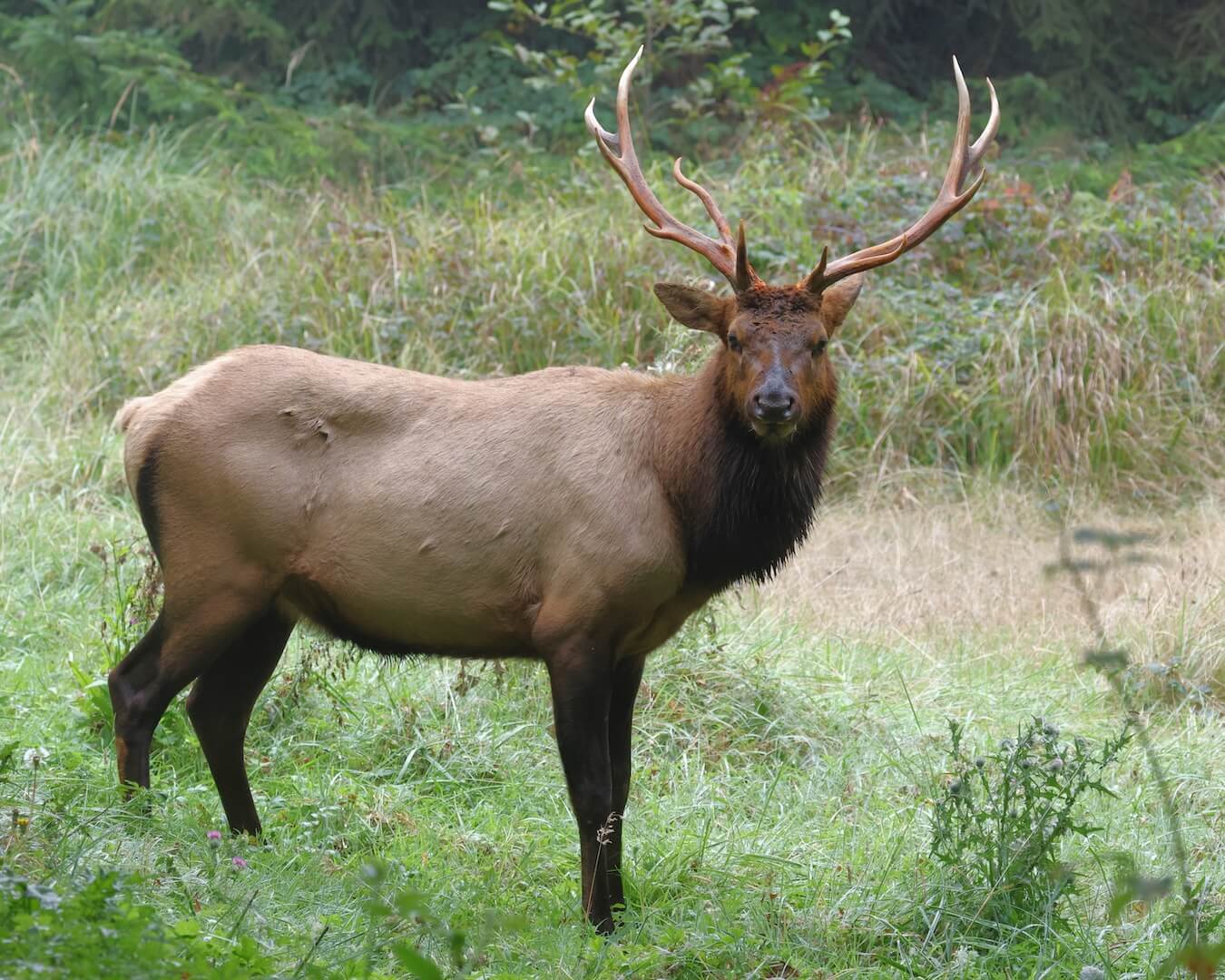
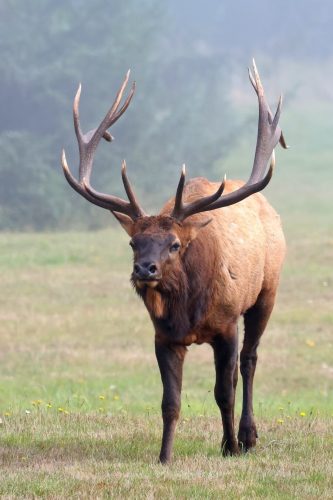
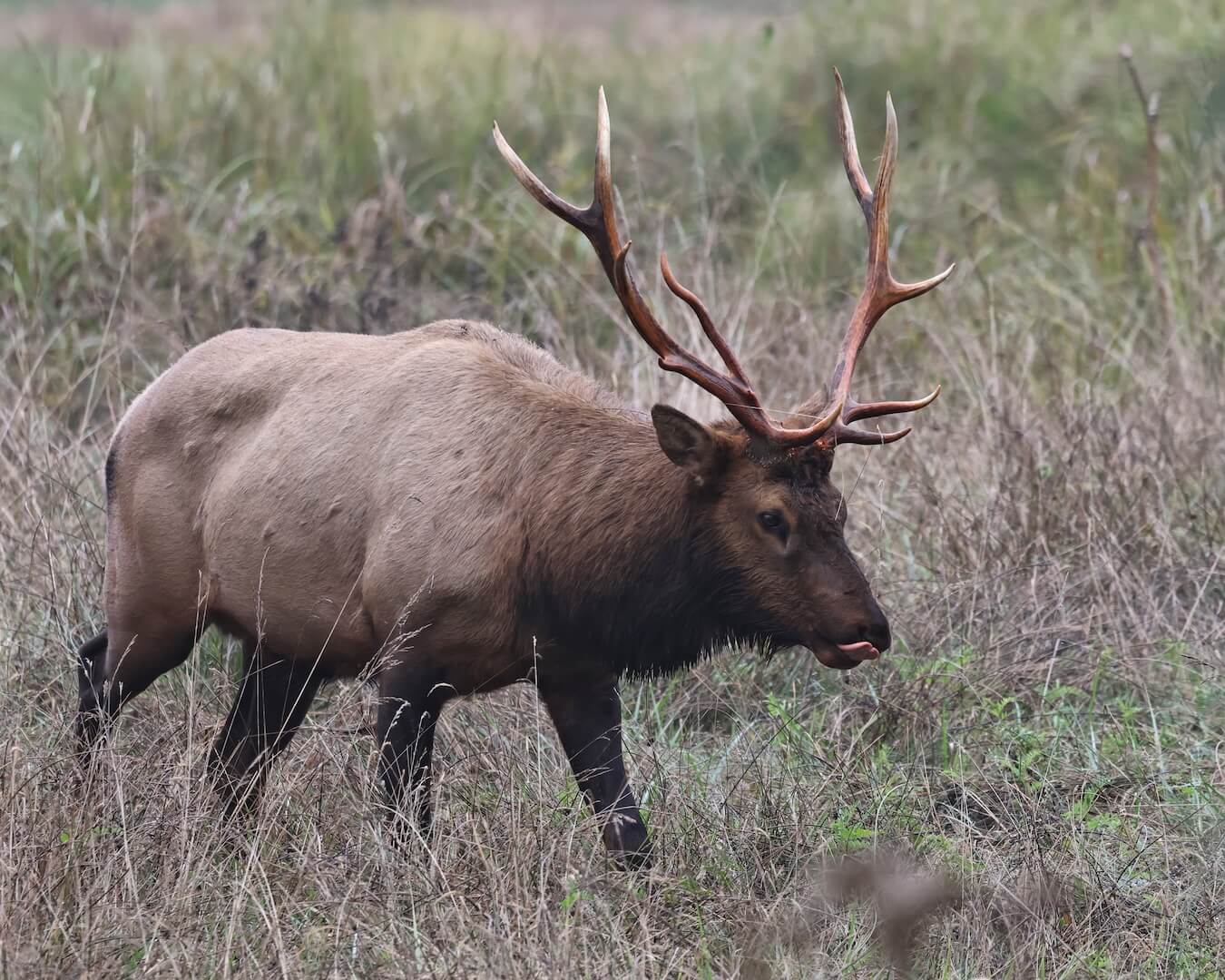
Roosevelt elk are generally darker than their Rocky Mountain elk relatives. They have brown bodies with particularly dark coloration around the head, neck, and legs, along with a conspicuous pale or off-white rump patch.
Their large size and dark coloration can be useful characteristics when distinguishing Roosevelt elk from other elk subspecies. Adult bulls grow impressive branching antlers each year. The antlers begin growing during spring and are initially covered by a soft, blood-rich tissue known as velvet. As growth finishes, the velvet is rubbed away and the antlers harden in preparation for the breeding season.
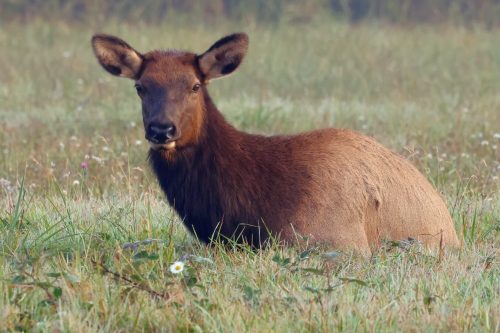
After the breeding season and winter, bulls shed their antlers and begin the annual growth cycle again. Cows do not grow antlers. Young Roosevelt elk are called calves. Newborn calves have spotted coats that provide camouflage while they remain concealed among vegetation during their vulnerable first weeks of life.
Habitat and Distribution
Roosevelt elk are animals of the Pacific Northwest. Their range is closely associated with coastal forests and mountains west of the Cascade Range, extending from northern California north through Oregon and Washington and into British Columbia and Alaska. Unlike Rocky Mountain elk, which are often associated with the more open landscapes and mountain valleys of the interior West, Roosevelt elk are especially well adapted to the wet coastal environments of the Pacific Northwest. They inhabit temperate rainforests, conifer forests, river valleys, mountain habitats, coastal areas, and open prairies.
Roosevelt elk can be particularly associated with areas where open feeding habitat occurs near forest cover. These environments provide grasses and other vegetation for feeding while keeping protective forest habitat nearby. This combination is especially visible at Redwood National and State Parks, where Roosevelt elk can be encountered in forests and prairies, along gravel bars, and even on beaches.
Olympic National Park demonstrates another side of Roosevelt elk habitat. Elk occupy habitats ranging from montane meadows and forests to the park’s famous lowland temperate rainforests. Some Roosevelt elk herds do not make the long seasonal migrations associated with certain other elk populations. The herds inhabiting Olympic’s Hoh Rain Forest, for example, remain in the Hoh area throughout the year.
Behavior and Social Structure
Roosevelt elk are social animals, although their social organization changes throughout the year. Cows and their calves commonly gather in herds, while adult bulls may be encountered alone or in small groups during portions of the year. According to Olympic National Park, the non-migratory Roosevelt elk herds of the Hoh Rain Forest commonly gather in groups of approximately 20 animals, composed primarily of females and their calves. Their social behavior changes dramatically as the breeding season approaches.
The annual breeding season, known as the rut, occurs during late summer and fall. At Redwood National and State Parks, the National Park Service reports that the fall rut generally occurs from late August through October. During the rut, mature bulls compete for access to groups of cows.
One of the most memorable behaviors associated with the rut is bugling. A bull elk’s bugle is an unmistakable combination of deep and high-pitched sounds that can carry remarkable distances across meadows, river valleys, and forests. Bulls use bugling, body posture, scent, and displays of their antlers to advertise themselves and challenge competitors. Rival bulls may display their antlers and bodies to one another. If neither animal retreats, they can lock antlers and physically compete for dominance.
After successful breeding in the fall, cows give birth the following spring, usually to a single calf. Newborn calves spend considerable time hidden in vegetation. Their spotted coats provide camouflage, while their mothers typically remain nearby. Calving season is also an important time for visitors to give Roosevelt elk additional space. Cows can become extremely defensive when protecting their young.
Diet and Foraging
Roosevelt elk are herbivores whose diets change with habitat, season, and available vegetation. Their Pacific Northwest environment gives them access to a particularly diverse collection of plants.
In Olympic National Park’s temperate rainforest, Roosevelt elk feed extensively on ferns, shrubs, lichens, and meadow grasses. They may also consume other grasses and herbaceous plants as well as woody vegetation, including leaves, shoots, twigs, and branches. Open meadows and prairies can provide important feeding habitat, which is one reason Roosevelt elk are frequently observed grazing in open areas adjacent to forests.
Like other elk, Roosevelt elk are ruminants. Their specialized digestive systems allow them to process fibrous plant material and obtain nutrients from vegetation that humans and many other animals could not efficiently digest. Their enormous size means Roosevelt elk require substantial quantities of food. As a result, a large concentration of elk can significantly influence the vegetation in an area through grazing and browsing.
Role in the Ecosystem
Roosevelt elk are an important component of Pacific Northwest ecosystems. In Olympic National Park, they are the largest herbivores on the Olympic Peninsula. Because of their size and the amount of vegetation they consume, Roosevelt elk can have a significant influence on plant communities.
Their grazing and browsing can shape vegetation in forests, meadows, and river valleys. This relationship makes elk abundance ecologically important. Large concentrations of grazing animals can substantially influence vegetation, while changes in elk populations can also affect predators, scavengers, and other organisms that depend upon them.
Roosevelt elk are an important prey species for large predators. Bears and mountain lions are among their natural predators, with young calves particularly vulnerable to predation. Even after death, the enormous size of a Roosevelt elk makes it an important ecological resource. A single carcass can provide food for predators, scavengers, insects, and decomposers while eventually returning nutrients to the surrounding ecosystem. Because of their size, abundance, habitat requirements, and relationships with vegetation and predators, Roosevelt elk can also provide scientists with valuable information about the ecosystems they inhabit.
A Unique Conservation History
The conservation history of Roosevelt elk is one of the characteristics that makes this subspecies particularly fascinating. Roosevelt elk once occupied coastal areas throughout much of the Pacific Northwest, but their numbers declined dramatically during the late nineteenth and early twentieth centuries as hunting, settlement, agriculture, and habitat changes increased.
The Olympic Peninsula became an especially important refuge for Roosevelt elk as populations declined elsewhere in their range. Concern over the disappearance of the region’s native elk helped motivate federal protection of the Olympic Peninsula. When President Theodore Roosevelt established Mount Olympus National Monument in 1909, the presidential proclamation specifically noted that the Olympic Mountains contained important summer range and breeding grounds for the native elk, whose numbers had been rapidly declining.
The protected area was later incorporated into Olympic National Park, which was established in 1938. According to the National Park Service, Olympic National Park is now home to the largest fully wild herd of Roosevelt elk in the Pacific Northwest.
By 1925, the National Park Service estimates that as few as 15 Roosevelt elk remained in California. One of the last surviving groups persisted in the coastal lowlands around what is now Prairie Creek Redwoods State Park. Protection of the remaining animals and their habitat eventually allowed Roosevelt elk to recover in northern California.
Today, the National Park Service recognizes seven Roosevelt elk herds within Redwood National and State Parks. Roosevelt elk still face conservation challenges, including habitat loss and fragmentation, roads, vehicle collisions, illegal killing, and disease. Protecting large, connected landscapes containing both forest and productive feeding habitat remains important to their long-term conservation.
Roosevelt elk in California have an equally remarkable conservation history. According to the National Park Service, market hunting beginning during the California Gold Rush dramatically reduced their numbers, while settlement and conversion of habitat placed additional pressure on the remaining animals.
Roosevelt Elk Safety
Roosevelt elk may appear calm, but they are enormous, powerful wild animals capable of causing serious injury. Always follow the wildlife-distance requirements of the individual National Park you are visiting. Olympic National Park currently instructs visitors to remain at least 50 yards (150 feet) from wildlife, including Roosevelt elk. Redwood National and State Parks recommends remaining at least 25 yards (75 feet) from elk and giving them additional space during sensitive periods such as the fall rut and spring calving season.
Regardless of the minimum distance specified by a park, give elk even more room whenever conditions warrant it. Extra caution is particularly important during the fall rut, when bulls can become defensive and unpredictable, and during late spring and early summer, when cows may aggressively defend newborn calves.
Never approach or pursue an elk for a photograph, place yourself between members of a herd, block an elk’s path, or attempt to provoke a reaction from an animal for a better photograph. Pay attention to the animal’s behavior. Elk may show signs of anxiety or aggression by laying their ears back, grinding their teeth, lowering their heads, or moving toward a perceived threat. If an elk approaches you, move away and restore a safe distance. Never touch or feed an elk or calf. If you encounter a calf alone, leave it where it is. Its mother is likely nearby. Use binoculars and telephoto lenses to safely enjoy and photograph Roosevelt elk without disturbing them.
National Park Presence
Roosevelt elk have a considerably more restricted distribution than Rocky Mountain elk, making encounters with this subspecies especially characteristic of the Pacific Northwest. For photographers visiting the 63 designated U.S. National Parks, Roosevelt elk are associated with three particularly important parks:
| Park Name | Occurrence | Abundance |
| Olympic National Park | Present – Native | Abundant |
| Redwood National and State Parks | Present – Native | Abundant |
| Crater Lake National Park | Present | Unknown |
According to National Park Service NPSpecies records, Roosevelt elk are classified as Present, Native, and Abundantin both Olympic National Park and Redwood National and State Parks. National Park Service monitoring information also documents Roosevelt elk in Crater Lake National Park.
Olympic National Park
[IMAGE: Roosevelt Elk in Hoh Rain Forest | Photo Credit]
Olympic National Park is one of the premier places in the National Park System to observe Roosevelt elk. According to the National Park Service, Olympic National Park is home to the largest fully wild herd of Roosevelt elk in the Pacific Northwest. Roosevelt elk occur in a variety of habitats throughout the park, but the lower valleys and rainforests provide particularly important habitat.
The Hoh Rain Forest is one of the best-known places to look for them. Roosevelt elk are observed there throughout the year, and the local Hoh herds are non-migratory. Early morning and evening can provide especially good opportunities for viewing. Dense rainforest can make elk surprisingly difficult to see despite their enormous size, so meadows, clearings, river valleys, and areas along park roads may provide better visibility. The fall rut can be an especially memorable time to experience Roosevelt elk as bulls bugle and compete for breeding opportunities. Remember that Olympic National Park instructs visitors to remain at least 50 yards (150 feet) from wildlife. Use binoculars or a telephoto lens rather than approaching elk.
Redwood National and State Parks
[IMAGE: Roosevelt Elk in Redwood Prairie | Photo Credit]
Redwood National and State Parks provides another exceptional opportunity to observe and photograph Roosevelt elk. According to the National Park Service, seven Roosevelt elk herds occur within Redwood National and State Parks. The general herd areas identified by the National Park Service include Crescent Beach, Gold Bluffs Beach, Prairie Creek Redwoods State Park, Elk Meadow, Lower Redwood Creek, park lands in the Orick Valley, and the Bald Hills.
The National Park Service identifies the Bald Hills herd as the largest of the parks’ Roosevelt elk herds. Roosevelt elk can occur in an impressive variety of Redwood habitats. Visitors may encounter them in forests and open prairies, along Redwood Creek gravel bars, and even on beaches. These environments can create spectacular photographic opportunities, particularly when elk are framed against the forests and landscapes of northern California. Redwood National and State Parks recommends remaining at least 25 yards (75 feet) from Roosevelt elk and advises visitors to give them even more space during spring calving and the fall rut.
Crater Lake National Park
[IMAGE: Roosevelt Elk at Crater Lake National Park | Photo Credit]
Roosevelt elk also occur at Crater Lake National Park in Oregon. The National Park Service’s Klamath Inventory & Monitoring Network specifically identifies Crater Lake National Park and Redwood National and State Parks as the two parks within that monitoring network where Roosevelt elk occur. Sightings at Crater Lake may be less predictable than encounters at some of the well-known elk-viewing locations in Redwood or Olympic, but the park remains part of the Roosevelt elk’s National Park presence in the Pacific Northwest.
Roosevelt Elk Photography Tips
Roosevelt elk are magnificent wildlife photography subjects, but their size should never be mistaken for an invitation to approach. Early morning and evening are often productive times to look for elk, particularly when animals move into open areas to feed. Look for transitions between forest and open habitat. Meadows, prairies, river valleys, and forest edges can provide opportunities to photograph elk while still showing the Pacific Northwest landscape that makes Roosevelt elk photographs distinctive.
Autumn provides especially dramatic photographic opportunities during the rut. Bulls may bugle, display their antlers, gather cows, and interact with competing males. However, this is also a time when bulls can be particularly unpredictable. Spring presents a different photographic opportunity as calves begin appearing, but cows can become extremely protective of their young.
A telephoto lens is essential for photographing elk responsibly. If you already own or want to own a professional-grade mirrored camera like the Canon EOS 5D Mark IV Full Frame Digital SLR, we recommend using a Canon EF 100-400mm f/4.5-5.6L IS II USM Lens zoom lens for wildlife photography. If you have or are interested in a newer mirrorless model like the Canon EOS R5 Full-Frame Mirrorless Camera, we recommend using a Canon RF100-400mm F5.6-8 IS USM for long-distance shots.
Not quite ready to invest in traditional professional-grade camera equipment but want to enhance the quality of your cell phone photographs? Consider using a Moment 58mm Tele Lens for improved reach, and be sure you have a compatible phone case to mount your new lens. Since cell phones generally cannot provide the same reach as a dedicated telephoto camera lens, never compensate by moving dangerously close to wildlife.
No photograph is worth disturbing an animal or putting yourself or others at risk.
Why Are They Called Roosevelt Elk?
Roosevelt elk are named in honor of President Theodore Roosevelt, whose legacy is closely associated with conservation and the protection of America’s natural resources. Naturalist C. Hart Merriam formally described the Olympic elk as a distinct form in 1897, naming it Cervus roosevelti in honor of Theodore Roosevelt.
The name is especially fitting because Roosevelt elk later became closely intertwined with the conservation history of the Olympic Peninsula. President Theodore Roosevelt established Mount Olympus National Monument in 1909, with the presidential proclamation specifically recognizing the importance of the area as summer range and breeding grounds for the region’s rapidly declining native elk. The animals were also historically known as Olympic elk, a name visitors may still encounter in older literature.
A Note About Roosevelt Elk Taxonomy
Readers researching Roosevelt elk may encounter more than one scientific name for the same animal.
This page uses:
Cervus canadensis roosevelti
However, many National Park Service pages and older scientific records identify Roosevelt elk as:
Cervus elaphus roosevelti
The difference reflects changes in the scientific classification of North American elk. North American elk were historically classified together with the European red deer under Cervus elaphus. Modern taxonomic treatments commonly recognize North American elk as the separate species Cervus canadensis. National Park Service NPSpecies records illustrate this taxonomic history. Records may retain Cervus elaphus rooseveltiwhile also identifying Cervus canadensis roosevelti as an associated scientific synonym.
For consistency throughout National Park Photographer, this page uses the modern North American classification Cervus canadensis roosevelti while recognizing the older nomenclature that visitors may encounter in National Park Service publications and scientific literature.
Final Thoughts
Roosevelt elk are among the most impressive wildlife species of the Pacific Northwest. Their tremendous size, dark coloration, enormous antlers, distinctive bugles, and close association with coastal forests and temperate rainforests distinguish them from the elk many visitors encounter elsewhere in the American West. They also have an extraordinary connection to the history of conservation and our National Parks.
The decline of native elk helped inspire federal protection of the Olympic Peninsula more than a century ago. According to the National Park Service, Olympic National Park now protects the largest fully wild herd of Roosevelt elk in the Pacific Northwest, while Redwood National and State Parks supports seven recognized Roosevelt elk herds in northern California.
Seeing a Roosevelt elk grazing beneath towering trees in Redwood or emerging from the dense vegetation of the Hoh Rain Forest is an unforgettable wildlife experience. Those encounters also carry responsibility. By maintaining safe distances, using telephoto lenses rather than approaching animals, respecting seasonal behaviors, and protecting the landscapes upon which Roosevelt elk depend, photographers and visitors can enjoy these magnificent animals without interfering with their lives. Through responsible wildlife viewing and photography, we can help keep Roosevelt elk—and the remarkable Pacific Northwest landscapes they inhabit—wild.
Want more information about the amazing wildlife that call our National Parks home? Take a look at our National Park Wildlife page to explore the various parks and the animals in them. Planning on visiting a National Park in the near future? Be sure to follow park regulations, practice Leave No Trace principles, and prioritize both your safety and the well-being of wildlife while exploring.
Joyful Journeys!
Bonnie, Co-Owner, National Park Photographer
Want to learn more about Roosevelt elk? Check out the additional resources below!
Roosevelt Elk Books & Field Guides
- Population Ecology of Roosevelt Elk: Conservation and Management in Redwood National and State Parks — Butch Weckerly
- https://www.amazon.com/s?k=Population+Ecology+of+Roosevelt+Elk+Butch+Weckerly
- Wildlife of the Pacific Northwest: Tracking and Identifying Mammals, Birds, Reptiles, Amphibians, and Invertebrates — David Moskowitz
- https://www.amazon.com/s?k=Wildlife+of+the+Pacific+Northwest+David+Moskowitz
- Peterson Field Guide to Mammals of North America
- https://www.amazon.com/s?k=Peterson+Field+Guide+to+Mammals+of+North+America
- Field Guide to the Cascades & Olympics
- https://www.amazon.com/s?k=Field+Guide+to+the+Cascades+and+Olympics
- Moon Olympic Peninsula: With Olympic National Park
- https://www.amazon.com/s?k=Moon+Olympic+Peninsula+with+Olympic+National+Park
- Wildlife Viewing
- 10×42 Binoculars for Wildlife Viewing
- https://www.amazon.com/s?k=10×42+binoculars+wildlife+viewing
- Monocular for Wildlife Viewing
- https://www.amazon.com/s?k=monocular+wildlife+viewing
- Wildlife Photography
- Canon EOS R5 Mirrorless Camera
- https://www.amazon.com/s?k=Canon+EOS+R5
- Canon RF 100-400mm F5.6-8 IS USM Lens
- https://www.amazon.com/s?k=Canon+RF+100-400mm+F5.6-8+IS+USM
- Canon EOS 5D Mark IV DSLR Camera
- https://www.amazon.com/s?k=Canon+EOS+5D+Mark+IV
- Canon EF 100-400mm f/4.5-5.6L IS II USM Lens
- https://www.amazon.com/s?k=Canon+EF+100-400mm+f%2F4.5-5.6L+IS+II+USM
- Moment 58mm Tele Lens
- https://www.amazon.com/s?k=Moment+58mm+Tele+Lens
- Camera Bean Bag for Wildlife Photography
- https://www.amazon.com/s?k=camera+bean+bag+wildlife+photography
References & Additional Resources
- National Park Service — Olympic National Park: Roosevelt Elk
- National Park Service — Olympic National Park: Wildlife Viewing
- National Park Service — Olympic National Park: Wildlife Safety
National Park Service — Redwood National and State Parks: Roosevelt Elk
https://www.nps.gov/redw/
National Park Service — Redwood National and State Parks: Watch Wild Elk
https://www.nps.gov/
National Park Service — Roosevelt Elk: Klamath Inventory & Monitoring Network
https://www.nps.gov/articles/
National Park Service — NPSpecies: Olympic National Park Roosevelt Elk
https://irma.nps.gov/
National Park Service — NPSpecies: Redwood National Park Roosevelt Elk
https://irma.nps.gov/
National Park Service — NPSpecies Species Search
https://irma.nps.gov/
National Park Service — Mount Olympus National Monument Historical Resources
https://www.nps.gov/olym/
Please note, by making purchases through our affiliate links, you are supporting our mission to celebrate and showcase our National Parks and the photographers who frequent them. As an Amazon Associate, National Park Photographer earns from qualifying purchases at not cost to you. We appreciate your support.