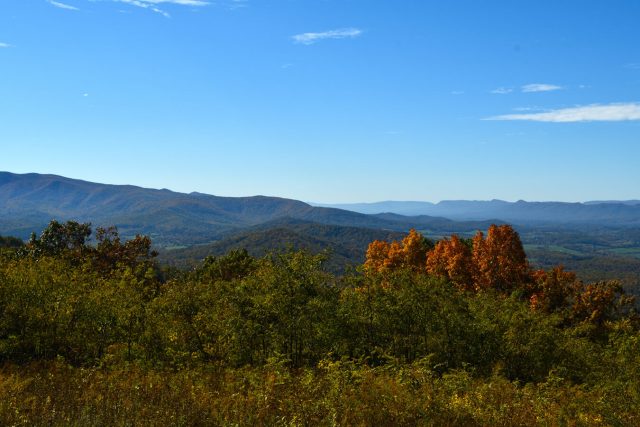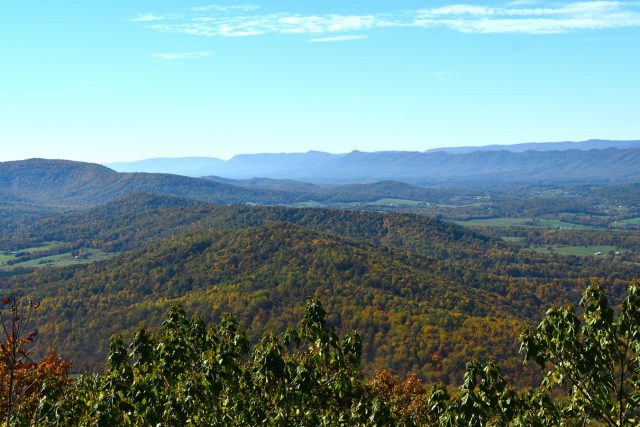
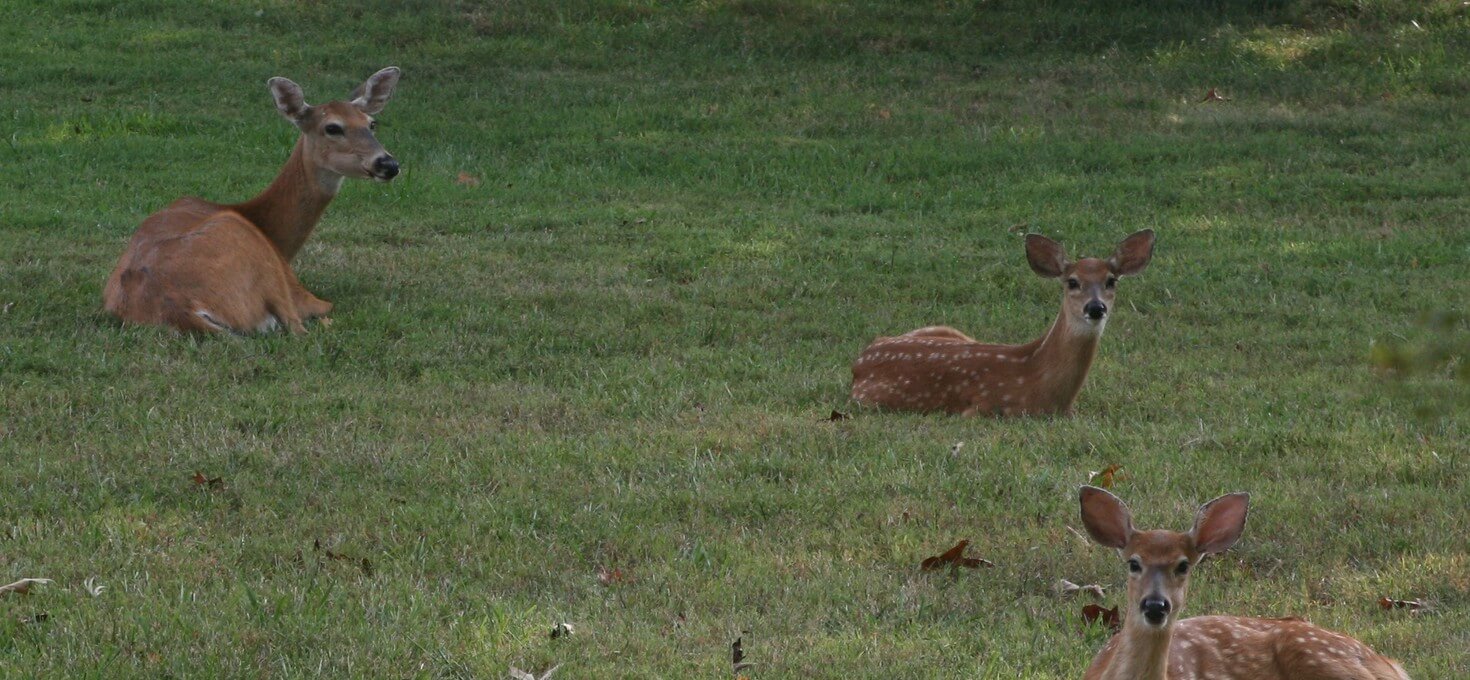
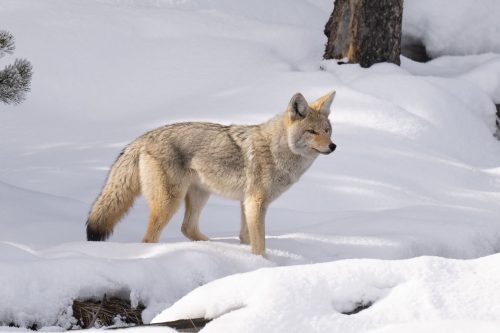
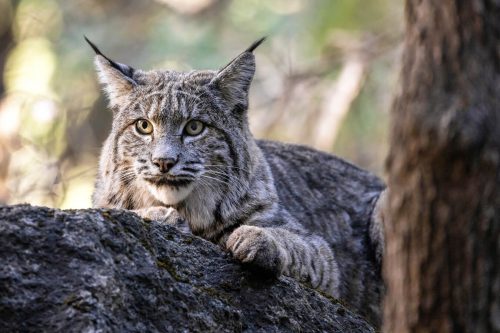
Mammoth Cave National Park was established in 1941 to protect not only the longest known cave system in the world but also the rolling hills, deciduous forests and Green River Valley above it. The park covers almost 53,000 acres of south-central Kentucky, and water and nutrients from the surface seep down through the karst landscape to support life far below. Wildlife here lives in two worlds. On the surface, white-tailed deer and wild turkeys are common sights along the park’s roads, eastern gray squirrels are among the most frequently seen animals, and coyotes are often spotted crossing roads in the evening. Red foxes, gray foxes, bobcats, river otters and beavers also live in the park. Black bears were once common in the area but are now rarely found. Underground, nearly 160 animal species live in the cave system itself, including cave crickets, Allegheny woodrats and Rafinesque’s big-eared bats. Woodrat nests can be seen just inside the Frozen Niagara entrance. Thirteen species of bats are confirmed in the park, and three of them, the Indiana bat, gray bat and northern long-eared bat, are federally listed as endangered or threatened. White-nose syndrome, a fungal disease that has killed many bats in North America, was first found at Mammoth Cave in 2012.
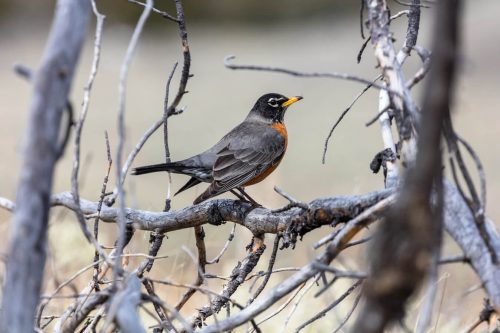
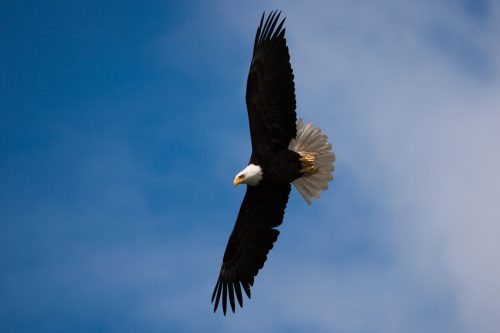
More than 170 species of birds have been reported in the park. Wild turkeys, American crows, blue jays, northern cardinals, Carolina chickadees and Carolina wrens live here year-round, red-tailed hawks are abundant, and bald eagles visit in winter. In late spring and summer, the forests fill with warblers, vireos and flycatchers that have flown north from the tropics. Eastern box turtles are often seen crossing trails and roads, American bullfrogs call from Sloans Pond, and orange cave salamanders cling to the rock walls near cave entrances. The park’s two venomous snakes, the copperhead and the timber rattlesnake, usually stay hidden. The rivers above and below ground hold a wide variety of fish. Mammoth Cave is one of the few places in the world where both the northern and southern cavefish live, eyeless and colorless fish that spend their entire lives in the dark. Northern cavefish were first described from the rivers of Mammoth Cave in the early 1800s and may live 30 to 40 years. Keep reading to see featured photos of Mammoth Cave’s wildlife and to learn more about wildlife photography.
Featured Mammoth Cave National Park Wildlife Photographs
Have a National Park Wildlife photograph you’d like featured? Contact us today to learn more!
Wildlife Photography Tips
Wildlife photography in the US National Parks offers a unique and enriching experience, as these protected areas are havens for diverse species and pristine natural landscapes. Capturing wildlife in such settings requires preparation and respect for both the environment and its inhabitants. Photographers should familiarize themselves with the specific animals and ecosystems of the park they are visiting, as each park hosts different species and behaviors. Early mornings and late afternoons, known as the golden hours, provide the best light and increased wildlife activity. Different seasons also offer different wildlife viewing opportunities. Patience and stillness are key, as the best moments often come to those who wait quietly.
If wildlife does present itself, always make sure to maintain a safe distance. Using a telephoto lens allows for close-up shots without intruding on the animals’ space. If you already own or want to own a professional grade mirrored camera like the Canon EOS 5D Mark IV Full Frame Digital SLR, we recommend using a Canon EF 100-400mm f/4.5-5.6L IS II USM Lens zoom lens for wildlife photography. If you have or are interested in a newer mirrorless model like the Canon EOS R5 Full-Frame Mirrorless Camera, we recommend using a Canon RF100-400mm F5.6-8 IS USM Black for long distance shots.
Not quite ready to invest in traditional professional-grade camera equipment but want to enhance the quality of your cell phone photographs? Consider using a Moment Tele 58mm Mobile Lens II for improved reach, and use a Moment camera case with a lens mount to attach it to your phone. Since cell phones generally cannot provide the same reach as a dedicated telephoto camera lens, never compensate by moving dangerously close to wildlife. As with any visit to a national park, it’s important to follow park regulations, practice “Leave No Trace” principles, and prioritize safety while photographing wildlife.
Want to take your wildlife photos further? Featured photographer Vella Torvik shares her field-tested advice on gear, camera settings, light, composition and safely approaching wildlife in our Wildlife Photography 101: Insider Tips From the Field masterclass.
Mammoth Cave Wildlife Education and Resources
Want to learn more about Mammoth Cave National Park and the wildlife that inhabits it? Check out these guides & books:
- Peterson Field Guide To Mammals Of North America: Fourth Edition (Peterson Field Guides)
- Peterson Field Guide to Birds of Eastern and Central North America, Seventh Edition (Peterson Field Guides)
- Bird Songs: 250 North American Birds in Song
- Peterson Field Guide to Reptiles and Amphibians of Eastern and Central North America, Fourth Edition (Peterson Field Guides)
- Peterson Field Guide to Freshwater Fishes, Second Edition (Peterson Field Guides)
- Animal Tracks: A Folding Pocket Guide to the Tracks & Signs of Familiar North American Species (Wildlife and Nature Identification)
Please note, by making purchases through our affiliate links, you are supporting our mission to celebrate and showcase our National Parks and the photographers who frequent them. As an Amazon Associate, National Park Photographer earns from qualifying purchases at no cost to you. We appreciate your support.
Mammoth Cave National Park Species List
The wildlife at Mammoth Cave National Park is beautiful and diverse. There are a variety of mammals, birds, reptiles, amphibians and fish to view. Check out all the incredible species this park has to offer! Click on the links below to see the different animal species that inhabit Mammoth Cave National Park:
Species Spotlight
Photo posts of animals you’ll find in Mammoth Cave.
Mammoth Cave National Park Mammals
50 species
- Allegheny Woodrat(Neotoma magister)
- American Beaver(Castor canadensis)
- Big Brown Bat(Eptesicus fuscus)
- Bobcat Photo post(Lynx rufus)
- Coyote Photo post(Canis latrans)
- Domestic Cat(Felis catus)
- Domestic Dog(Canis familiaris)
- Eastern Chipmunk(Tamias striatus)
- Eastern Cottontail(Sylvilagus floridanus)
- Eastern Fox Squirrel(Sciurus niger)
- Eastern Gray Squirrel(Sciurus carolinensis)
- Eastern Harvest Mouse(Reithrodontomys humulis)
- Eastern Mole(Scalopus aquaticus)
- Eastern Red Bat(Lasiurus borealis)
- Eastern Small-footed Bat(Myotis leibii)
- Evening Bat(Nycticeius humeralis)
- Gray Bat(Myotis grisescens)
- Gray Fox(Urocyon cinereoargenteus)
- Hoary Bat(Lasiurus cinereus)
- Indiana Bat(Myotis sodalis)
- Least Shrew(Cryptotis parva)
- Little Brown Bat(Myotis lucifugus)
- Long-tailed Weasel(Mustela frenata)
- Meadow Jumping Mouse(Zapus hudsonius)
- Mink(Mustela vison)
- Muskrat(Ondatra zibethicus)
- Nine-banded Armadillo(Dasypus novemcinctus)
- Northern Long-eared Bat(Myotis septentrionalis)
- Northern Short-tailed Shrew(Blarina brevicauda)
- Norway Rat(Rattus norvegicus)
- Prairie Vole(Microtus ochrogaster)
- Pygmy Shrew(Sorex hoyi)
- Raccoon(Procyon lotor)
- Rafinesque’s Big-eared Bat(Corynorhinus rafinesquii)
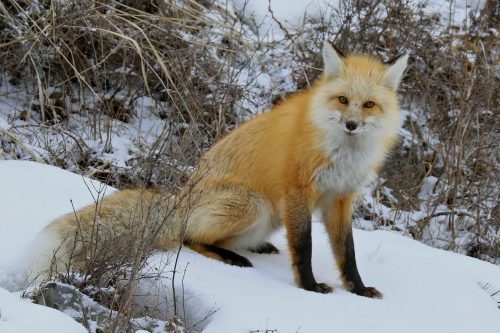
- Red Fox Photo post(Vulpes vulpes)
- River Otter(Lontra canadensis)
- Seminole Bat(Lasiurus seminolus)
- Silver-haired Bat(Lasionycteris noctivagans)
- Smoky Shrew(Sorex fumeus)
- Southeastern Bat(Myotis austroriparius)
- Southeastern Shrew(Sorex longirostris)
- Southern Bog Lemming(Synaptomys cooperi)
- Southern Flying Squirrel(Glaucomys volans)
- Striped Skunk(Mephitis mephitis)
- Tricolored Bat(Perimyotis subflavus)
- Virginia Opossum(Didelphis virginiana)
- White-footed Mouse(Peromyscus leucopus)
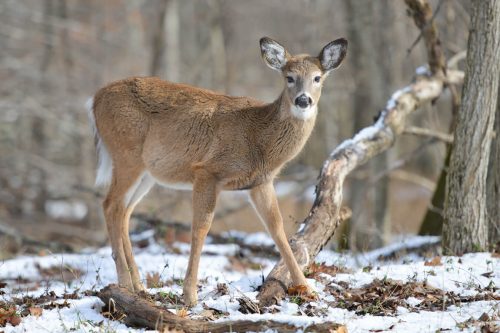
- White-tailed Deer Photo post(Odocoileus virginianus)
- Woodchuck(Marmota monax)
- Woodland Vole(Microtus pinetorum)
No mammals match.
Mammoth Cave National Park Birds
160 species
- Acadian Flycatcher(Empidonax virescens)
- American Black Duck(Anas rubripes)
- American Coot(Fulica americana)
- American Crow(Corvus brachyrhynchos)
- American Goldfinch(Carduelis tristis)
- American Kestrel(Falco sparverius)
- American Redstart(Setophaga ruticilla)
- American Robin Photo post(Turdus migratorius)
- American Tree Sparrow(Spizella arborea)
- American Woodcock(Scolopax minor)
- Bald Eagle Photo post(Haliaeetus leucocephalus)
- Baltimore Oriole(Icterus galbula)
- Barn Swallow(Hirundo rustica)
- Barred Owl(Strix varia)
- Bay-breasted Warbler(Dendroica castanea)
- Belted Kingfisher(Ceryle alcyon)
- Black Vulture(Coragyps atratus)
- Black-and-white Warbler(Mniotilta varia)
- Black-throated Blue Warbler(Dendroica caerulescens)
- Black-throated Green Warbler(Dendroica virens)
- Blackburnian Warbler(Setophaga fusca)
- Blackpoll Warbler(Dendroica striata)
- Blue Grosbeak(Passerina caerulea)
- Blue Jay(Cyanocitta cristata)
- Blue-gray Gnatcatcher(Polioptila caerulea)
- Blue-headed Vireo(Vireo solitarius)
- Blue-winged Warbler(Vermivora pinus)
- Broad-winged Hawk(Buteo platypterus)
- Brown Creeper(Certhia americana)
- Brown Thrasher(Toxostoma rufum)
- Brown-headed Cowbird(Molothrus ater)
- Canada Goose(Branta canadensis)
- Canada Warbler(Wilsonia canadensis)
- Cape May Warbler(Dendroica tigrina)
- Carolina Chickadee(Poecile carolinensis)
- Carolina Wren(Thryothorus ludovicianus)
- Cedar Waxwing(Bombycilla cedrorum)
- Cerulean Warbler(Dendroica cerulea)
- Chestnut-sided Warbler(Dendroica pensylvanica)
- Chimney Swift(Chaetura pelagica)
- Chipping Sparrow(Spizella passerina)
- Chuck-will’s-widow(Caprimulgus carolinensis)
- Common Grackle(Quiscalus quiscula)
- Common Snipe(Gallinago gallinago)
- Common Yellowthroat(Geothlypis trichas)
- Connecticut Warbler(Oporornis agilis)
- Cooper’s Hawk(Accipiter cooperii)
- Dark-eyed Junco(Junco hyemalis)
- Dickcissel(Spiza americana)
- Downy Woodpecker(Picoides pubescens)
- Eastern Bluebird(Sialia sialis)
- Eastern Kingbird(Tyrannus tyrannus)
- Eastern Meadowlark(Sturnella magna)
- Eastern Phoebe(Sayornis phoebe)
- Eastern Screech-owl(Megascops asio)
- Eastern Towhee(Pipilo erythrophthalmus)
- Eastern Wood Pewee(Contopus virens)
- European Starling(Sturnus vulgaris)
- Field Sparrow(Spizella pusilla)
- Fox Sparrow(Passerella iliaca)
- Gadwall(Anas strepera)
- Golden Eagle(Aquila chrysaetos)
- Golden-crowned Kinglet(Regulus satrapa)
- Golden-winged Warbler(Vermivora chrysoptera)
- Gray Catbird(Dumetella carolinensis)
- Gray-cheeked Thrush(Catharus minimus)
- Great Blue Heron(Ardea herodias)
- Great Crested Flycatcher(Myiarchus crinitus)
- Great Horned Owl(Bubo virginianus)
- Green Heron(Butorides virescens)
- Hairy Woodpecker(Picoides villosus)
- Hermit Thrush(Catharus guttatus)
- Hooded Merganser(Lophodytes cucullatus)
- Hooded Warbler(Wilsonia citrina)
- Horned Lark(Eremophila alpestris)
- House Finch(Carpodacus mexicanus)
- House Sparrow(Passer domesticus)
- House Wren(Troglodytes aedon)
- Indigo Bunting(Passerina cyanea)
- Kentucky Warbler(Oporornis formosus)
- Killdeer(Charadrius vociferus)
- Least Flycatcher(Empidonax minimus)
- Lincoln’s Sparrow(Melospiza lincolnii)
- Louisiana Waterthrush(Seiurus motacilla)
- Magnolia Warbler(Dendroica magnolia)
- Mallard(Anas platyrhynchos)
- Merlin(Falco columbarius)
- Mourning Dove(Zenaida macroura)
- Mourning Warbler(Oporornis philadelphia)
- Nashville Warbler(Vermivora ruficapilla)
- Northern Bobwhite(Colinus virginianus)
- Northern Cardinal(Cardinalis cardinalis)
- Northern Flicker(Colaptes auratus)
- Northern Harrier(Circus cyaneus)
- Northern Mockingbird(Mimus polyglottos)
- Northern Parula(Parula americana)
- Northern Rough-winged Swallow(Stelgidopteryx serripennis)
- Northern Waterthrush(Seiurus noveboracensis)
- Olive-sided Flycatcher(Contopus cooperi)
- Orange-crowned Warbler(Vermivora celata)
- Orchard Oriole(Icterus spurius)
- Osprey(Pandion haliaetus)
- Ovenbird(Seiurus aurocapilla)
- Palm Warbler(Dendroica palmarum)
- Philadelphia Vireo(Vireo philadelphicus)
- Pied-billed Grebe(Podilymbus podiceps)
- Pileated Woodpecker(Dryocopus pileatus)
- Pine Siskin(Carduelis pinus)
- Pine Warbler(Dendroica pinus)
- Prairie Warbler(Dendroica discolor)
- Prothonotary Warbler(Protonotaria citrea)
- Purple Finch(Carpodacus purpureus)
- Purple Martin(Progne subis)
- Red-bellied Woodpecker(Melanerpes carolinus)
- Red-breasted Nuthatch(Sitta canadensis)
- Red-eyed Vireo(Vireo olivaceus)
- Red-headed Woodpecker(Melanerpes erythrocephalus)
- Red-shouldered Hawk(Buteo lineatus)
- Red-tailed Hawk(Buteo jamaicensis)
- Red-winged Blackbird(Agelaius phoeniceus)
- Ring-billed Gull(Larus delawarensis)
- Rock Pigeon(Columba livia)
- Rose-breasted Grosbeak(Pheucticus ludovicianus)
- Rough-legged Hawk(Buteo lagopus)
- Ruby-crowned Kinglet(Regulus calendula)
- Ruby-throated Hummingbird(Archilochus colubris)
- Rusty Blackbird(Euphagus carolinus)
- Savannah Sparrow(Passerculus sandwichensis)
- Scarlet Tanager(Piranga olivacea)
- Sharp-shinned Hawk(Accipiter striatus)
- Song Sparrow(Melospiza melodia)
- Spotted Sandpiper(Actitis macularius)
- Summer Tanager(Piranga rubra)
- Swainson’s Thrush(Catharus ustulatus)
- Swamp Sparrow(Melospiza georgiana)
- Tennessee Warbler(Vermivora peregrina)
- Tree Swallow(Tachycineta bicolor)
- Tufted Titmouse(Baeolophus bicolor)
- Turkey Vulture(Cathartes aura)
- Veery(Catharus fuscescens)
- Warbling Vireo(Vireo gilvus)
- Whip-poor-will(Caprimulgus vociferus)
- White-breasted Nuthatch(Sitta carolinensis)
- White-crowned Sparrow(Zonotrichia leucophrys)
- White-eyed Vireo(Vireo griseus)
- White-throated Sparrow(Zonotrichia albicollis)
- Wild Turkey(Meleagris gallopavo)
- Wilson’s Warbler(Wilsonia pusilla)
- Winter Wren(Troglodytes troglodytes)
- Wood Duck(Aix sponsa)
- Wood Thrush(Hylocichla mustelina)
- Worm-eating Warbler(Helmitheros vermivorum)
- Yellow Warbler(Dendroica petechia)
- Yellow-bellied Flycatcher(Empidonax flaviventris)
- Yellow-bellied Sapsucker(Sphyrapicus varius)
- Yellow-billed Cuckoo(Coccyzus americanus)
- Yellow-breasted Chat(Icteria virens)
- Yellow-rumped Warbler(Dendroica coronata)
- Yellow-throated Vireo(Vireo flavifrons)
- Yellow-throated Warbler(Dendroica dominica)
No birds match.
Mammoth Cave National Park Reptiles
32 species
- Black Kingsnake(Lampropeltis getula nigra)
- Black Racer(Coluber constrictor)
- Black Rat Snake(Elaphe spiloides)
- Broadhead Skink(Eumeces laticeps)
- Brown Snake(Storeria dekayi)
- Coal Skink(Eumeces anthracinus)
- Common Map Turtle(Graptemys geographica)
- Common Snapping Turtle(Chelydra serpentina)
- Copperhead(Agkistrodon contortrix)
- Corn Snake(Elaphe guttata)
- Eastern Box Turtle(Terrapene carolina)
- Eastern Fence Lizard(Sceloporus undulatus)
- Eastern Garter Snake(Thamnophis sirtalis)
- Eastern Hognose Snake(Heterodon platirhinos)
- Eastern Milk Snake(Lampropeltis triangulum triangulum)
- Eastern River Cooter(Pseudemys concinna)
- Eastern Slender Glass Lizard(Ophisaurus attenuatus)
- Five-lined Skink(Eumeces fasciatus)
- Ground Skink(Scincella lateralis)
- Midland Painted Turtle(Chrysemys picta marginata)
- Northern Redbelly Snake(Storeria occipitomaculata)
- Northern Water Snake(Nerodia sipedon)
- Ouachita Map Turtle(Graptemys ouachitensis)
- Prairie Kingsnake(Lampropeltis calligaster calligaster)
- Queen Snake(Regina septemvittata)
- Red-eared Slider(Trachemys scripta elegans)
- Ringneck Snake(Diadophis punctatus)
- Rough Green Snake(Opheodrys aestivus)
- Spiny Softshell Turtle(Apalone spinifera)
- Timber Rattlesnake(Crotalus horridus)
- Western Earth Snake(Virginia valeriae elegans)
- Worm Snake(Carphophis amoenus)
No reptiles match.
Mammoth Cave National Park Amphibians
27 species
- American Bullfrog(Rana catesbeiana)
- American Toad(Bufo americanus)
- Cave Salamander(Eurycea lucifuga)
- Cope’s Gray Treefrog(Hyla chrysoscelis)
- Eastern Narrowmouth Toad(Gastrophryne carolinensis)
- Eastern Spadefoot(Scaphiopus holbrookii)
- Four-toed Salamander(Hemidactylium scutatum)
- Fowler’s Toad(Bufo fowleri)
- Green Frog(Rana clamitans)
- Jefferson Salamander(Ambystoma jeffersonianum)
- Longtail Salamander(Eurycea longicauda)
- Marbled Salamander(Ambystoma opacum)
- Midland Mud Salamander(Pseudotriton diastictus)
- Mountain Chorus Frog(Pseudacris brachyphona)
- Northern Cricket Frog(Acris crepitans)
- Northern Dusky Salamander(Desmognathus fuscus)
- Northern Red Salamander(Pseudotriton ruber)
- Northern Slimy Salamander(Plethodon glutinosus)
- Northern Zigzag Salamander(Plethodon dorsalis)
- Pickerel Frog(Rana palustris)
- Red-spotted Newt(Notophthalmus viridescens)
- Southern Leopard Frog(Rana sphenocephala)
- Southern Two-lined Salamander(Eurycea cirrigera)
- Spotted Salamander(Ambystoma maculatum)
- Spring Peeper(Pseudacris crucifer)
- Upland Chorus Frog(Pseudacris feriarum)
- Wood Frog(Rana sylvatica)
No amphibians match.
Mammoth Cave National Park Fish
86 species
- American Eel(Anguilla rostrata)
- Banded Darter(Etheostoma zonale)
- Banded Sculpin(Cottus carolinae)
- Bigeye Chub(Hybopsis amblops)
- Black Crappie(Pomoxis nigromaculatus)
- Black Redhorse(Moxostoma duquesnei)
- Blackstripe Topminnow(Fundulus notatus)
- Bluegill(Lepomis macrochirus)
- Bluntnose Minnow(Pimephales notatus)
- Brindled Madtom(Noturus miurus)
- Brook Silverside(Labidesthes sicculus)
- Bullhead Minnow(Pimephales vigilax)
- Channel Catfish(Ictalurus punctatus)
- Channel Darter(Percina copelandi)
- Common Carp(Cyprinus carpio)
- Creek Chub(Semotilus atromaculatus)
- Dusky Darter(Percina sciera)
- Emerald Shiner(Notropis atherinoides)
- Fantail Darter(Etheostoma flabellare)
- Flathead Catfish(Pylodictis olivaris)
- Freckled Madtom(Noturus nocturnus)
- Freshwater Drum(Aplodinotus grunniens)
- Ghost Shiner(Notropis buchanani)
- Gilt Darter(Percina evides)
- Gizzard Shad(Dorosoma cepedianum)
- Golden Redhorse(Moxostoma erythrurum)
- Golden Shiner(Notemigonus crysoleucas)
- Goldfish(Carassius auratus)
- Grass Pickerel(Esox americanus)
- Green Sunfish(Lepomis cyanellus)
- Greenside Darter(Etheostoma blennioides)
- Highland Shiner(Notropis micropteryx)
- Johnny Darter(Etheostoma nigrum)
- Kentucky Snubnose Darter(Etheostoma rafinesquei)
- Largemouth Bass(Micropterus salmoides)
- Largescale Stoneroller(Campostoma oligolepis)
- Logperch(Percina caprodes)
- Longear Sunfish(Lepomis megalotis)
- Longnose Gar(Lepisosteus osseus)
- Mimic Shiner(Notropis volucellus)
- Mooneye(Hiodon tergisus)
- Mosquitofish(Gambusia affinis)
- Mountain Madtom(Noturus eleutherus)
- Muskellunge(Esox masquinongy)
- Northern Cavefish(Amblyopsis spelaea)
- Northern Hog Sucker(Hypentelium nigricans)
- Northern Studfish(Fundulus catenatus)
- Orangefin Darter(Etheostoma bellum)
- Orangethroat Darter(Etheostoma spectabile)
- Popeye Shiner(Notropis ariommus)
- Pugnose Minnow(Opsopoeodus emiliae)
- Quillback(Carpiodes cyprinus)
- Rainbow Darter(Etheostoma caeruleum)
- Rainbow Trout(Oncorhynchus mykiss)
- Redear Sunfish(Lepomis microlophus)
- River Carpsucker(Carpiodes carpio)
- River Redhorse(Moxostoma carinatum)
- Rock Bass(Ambloplites rupestris)
- Rosefin Shiner(Lythrurus ardens)
- Rosyface Shiner(Notropis rubellus)
- Shorthead Redhorse(Moxostoma macrolepidotum)
- Silver Redhorse(Moxostoma anisurum)
- Silver Shiner(Notropis photogenis)
- Skipjack Herring(Alosa chrysochloris)
- Slenderhead Darter(Percina phoxocephala)
- Smallmouth Bass(Micropterus dolomieu)
- Smallmouth Buffalo(Ictiobus bubalus)
- Smallmouth Redhorse(Moxostoma breviceps)
- Southern Cavefish(Typhlichthys subterraneus)
- Southern Redbelly Dace(Phoxinus erythrogaster)
- Speckled Chub(Macrhybopsis aestivalis)
- Speckled Darter(Etheostoma stigmaeum)
- Spotfin Shiner(Cyprinella spiloptera)
- Spotted Bass(Micropterus punctulatus)
- Spotted Darter(Etheostoma maculatum)
- Spotted Sucker(Minytrema melanops)
- Spring Cavefish(Forbesichthys agassizii)
- Streamline Chub(Erimystax dissimilis)
- Striped Shiner(Luxilus chrysocephalus)
- Tippecanoe Darter(Etheostoma tippecanoe)
- Walleye(Sander vitreus)
- Warmouth(Lepomis gulosus)
- Western Sand Darter(Ammocrypta clara)
- White Bass(Morone chrysops)
- White Crappie(Pomoxis annularis)
- White Sucker(Catostomus commersonii)
No fish match.
Note: The wildlife species included in the lists above have been confirmed with the National Park Service to be present in Mammoth Cave National Park. Other species may exist in the park that are currently under review or not yet known.
Do you want to be featured on National Park Photographer?
Why wait! Contact us today at nationalparkphoto@gmail.com for more information!